Long before the dawn of modern parenting, animals laid eggs and moved on. Now, a study published in Nature by researchers at Rockefeller University reveals one of the elegant ways evolution transformed neglect into nurture — by repurposing the brain's ancient hunger circuits.
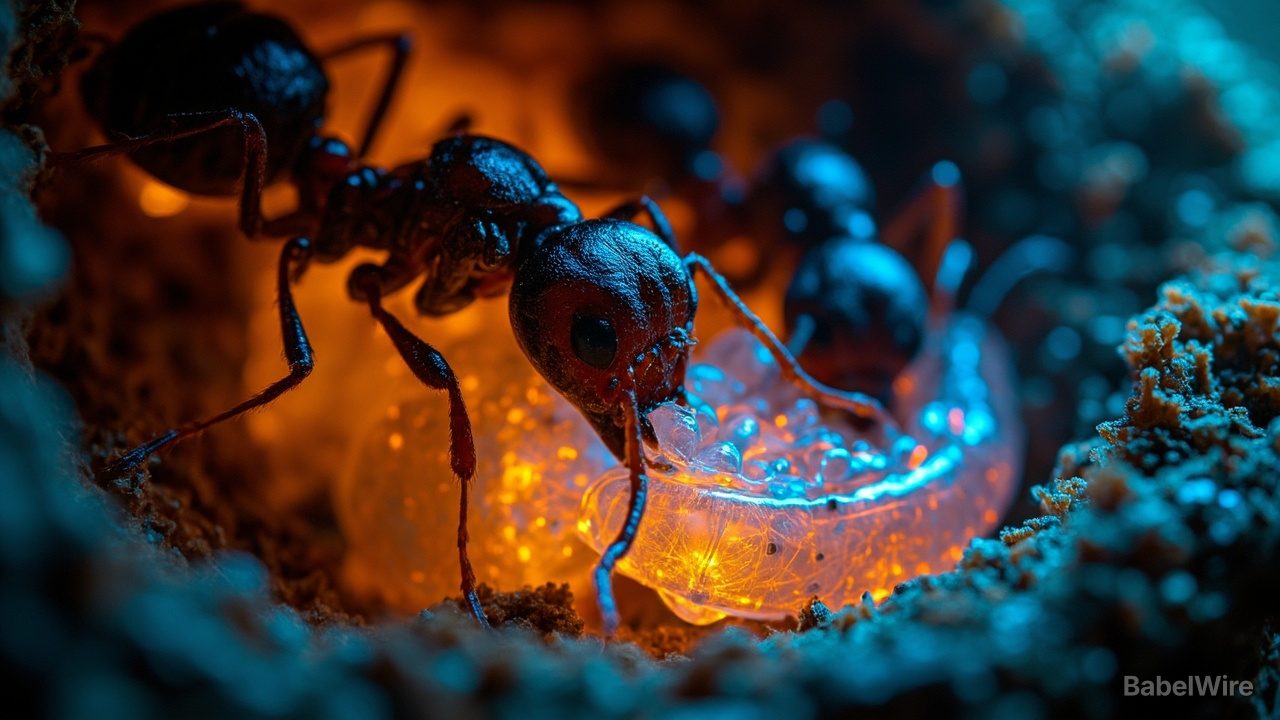
Working with clonal raider ants (Ooceraea biroi), a surprisingly parental insect, scientists led by Professor Daniel Kronauer discovered that rather than evolving entirely new neural systems for caregiving, ants use two neuropeptides — Neuropeptide F (NPF) and Allatostatin A (AstA) — that act as opposing regulators of behavior. These molecules originally evolved to control feeding.
"Our work is a prime example of how evolution seldom invents things from scratch," says Kronauer. "Evolution takes what it has and works with that, sometimes in very surprising ways."
The team developed a behavioral platform pairing individual ants with larvae to track hundreds of caregiving interactions automatically. They then synthesized and systematically tested 70 neuropeptides in the ant brain. Their findings revealed that NPF promotes caregiving while AstA encourages ants to leave larvae behind and forage. Young ants naturally have more NPF and less AstA, while older ants show the opposite pattern.
Strikingly, starving ants showed increased NPF and reduced AstA, causing them to behave like caregivers — while feeding reversed the balance and pushed ants to forage. This confirms that the parental care circuitry remains directly wired to ancient feeding circuits.
"We learned that parental behaviors build on the neural circuitry for feeding, and that makes sense," Kronauer says. "Parental behavior is a lot about feeding — not just yourself, but your offspring."
Because mammals, including humans, share closely related neuropeptide systems involved in caregiving, the findings offer a powerful new model for understanding how parenting evolved across the animal kingdom. Ants — with only 60,000 brain cells compared to 100 million in mice — may offer a faster path to mapping these circuits at finer resolution.
Furthermore, since ants naturally transition from caregivers to foragers as they age, they offer researchers a model for understanding how the brain changes throughout a healthy lifespan. "We actually know very little about how the brain changes throughout the normal healthspan of an individual," Kronauer notes. "Our discovery provides a striking demonstration that neuromodulators can produce age-dependent changes in behavioral proclivities."