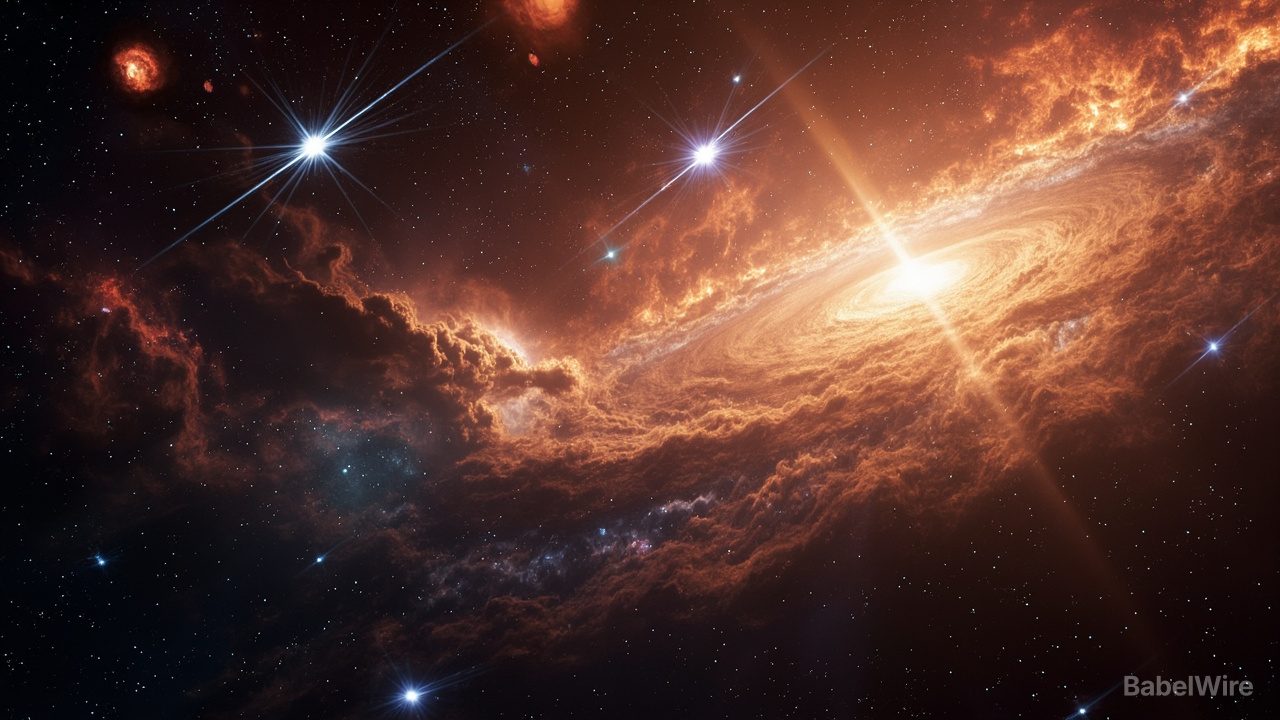
Astronomers have uncovered 31 of the oldest known quasars — including the two earliest ever detected — shining from a time when the universe was barely 670 million years old, just 5% of its current age. The discovery is forcing scientists to rethink how supermassive black holes could have grown so large so quickly after the Big Bang.
Quasars are among the brightest objects in the universe, powered by supermassive black holes at the centers of galaxies that feed on surrounding gas and dust, releasing enormous amounts of energy. But finding them so early in cosmic history poses a serious challenge to existing models of black hole formation.
A Cosmic Time Capsule
The newly identified quasars date back to an era known as the "cosmic dawn," when the first stars and galaxies were forming and the universe emerged from its dark ages. Each quasar is a supermassive black hole millions to billions of times the mass of our Sun, actively consuming matter and outshining entire galaxies.
"These quasars shouldn't exist so soon after the Big Bang according to our current understanding of black hole growth," the research team noted. Standard models suggest it takes hundreds of millions of years for supermassive black holes to accumulate their mass through normal accretion processes.
The two earliest quasars in the sample are the most distant ever found, pushing the observational frontier deeper into the early universe than ever before. They existed when the universe was a mere 670 million years old — a blink of an eye in cosmic terms.
Peering Back to the Beginning
The discovery was made possible by combining data from multiple powerful telescopes, including space-based observatories that can detect the faint infrared light from these distant objects, whose light has been traveling toward Earth for more than 13 billion years.
Because light takes time to travel across the universe, looking at distant objects is equivalent to looking back in time. The light from these quasars began its journey when the universe was in its infancy, offering astronomers a direct window into the processes that shaped the early cosmos.
What This Means for Science
The findings challenge existing models of how the first supermassive black holes formed. If black holes could become so massive so quickly, there may be exotic formation channels at work in the early universe — perhaps through direct collapse of enormous gas clouds, or through rapid mergers of smaller black holes.
Understanding how quasars and their host galaxies evolved together is one of the most active frontiers in modern astrophysics. These newly discovered ancient quasars provide crucial data points that will help refine theories of galaxy formation and black hole growth.
The research has been published and is expected to reshape the timeline of cosmic evolution, pushing the known era of supermassive black hole formation earlier than previously thought possible.