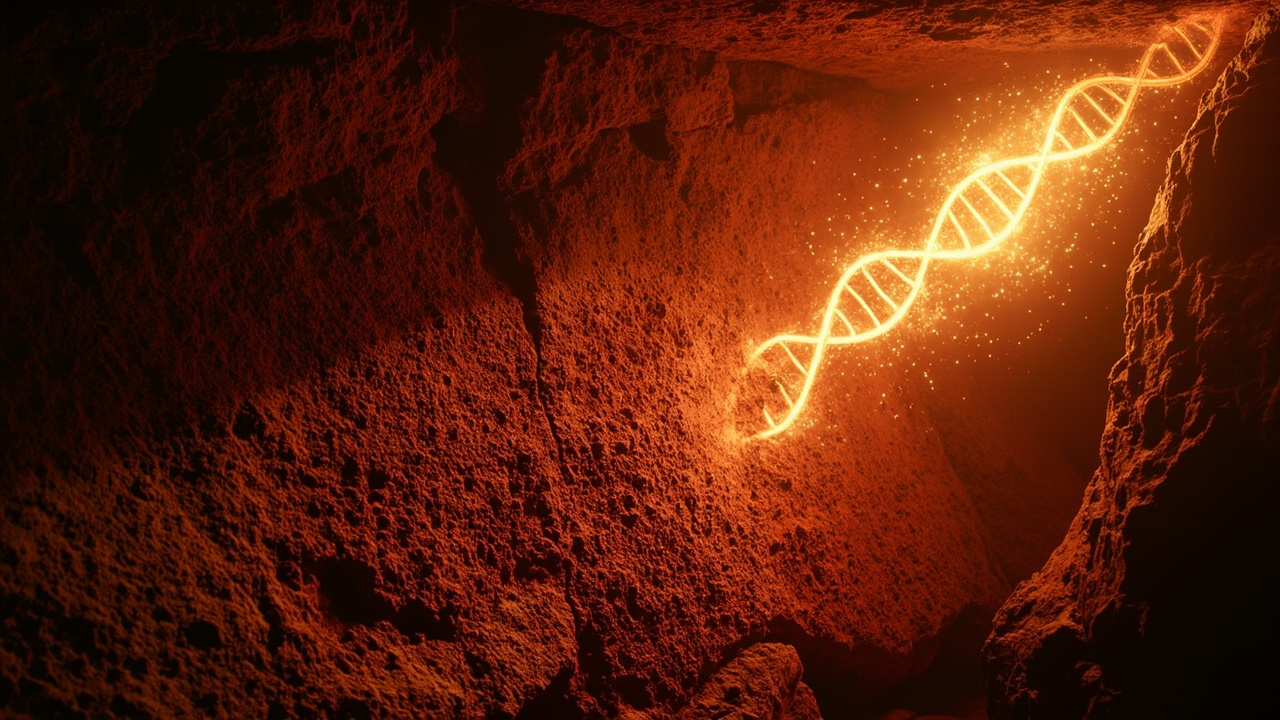
A Genetic Time Capsule on Stone
For decades, a major challenge in archaeology has been linking cultural artifacts — especially cave paintings — to the human groups who created them. Skeletal remains and sediments can yield DNA, but the art itself has remained beyond the reach of paleogenetics. Until now.
An international team led by the Max Planck Institute for Evolutionary Anthropology has, for the first time, extracted ancient human DNA directly from cave walls — including from sites adorned with prehistoric rock art.
How They Did It
The researchers analyzed DNA preserved in pigment samples collected from 24 rock art panels across 11 caves in Spain and Portugal. The paintings, most created with red ochre, included simple marks, dots, hand stencils from Maltravieso Cave, and figurative imagery from the Cave of Altamira.
The strongest result came from Escoural Cave in Portugal, where a sample taken from a pigmented calcite crust yielded genetic material from one or more humans, with no trace of animal DNA — suggesting the DNA came from direct human contact, not environmental contamination.
Who Were They?
At Covarón Cave in Asturias, Spain, genetic analysis linked the DNA to a population of western hunter-gatherers who lived in Europe roughly between 5,200 and 16,700 years ago. The DNA likely came from women. A separate wall sample from Escoural Cave pointed to a male source.
The Limits — And the Promise
Despite extensive sampling, usable ancient human DNA was recovered from only one of the 24 painted panels. The study stops short of establishing who made the paintings — the DNA may have come from the artists or from unrelated human activity in the caves.
But as Dr. Matthias Meyer, a paleogeneticist at Max Planck, put it: 'This study fundamentally changes how we think about where ancient DNA can be found. Cave walls are genetic archives of past human presence.'
What Comes Next
The research, published in Nature Communications, opens the possibility of one day identifying the makers of cave art. Alba Bossoms Mesa, the study's lead author, says: 'With further work, it may become possible to reveal the makers of at least some pieces of cave art — and to put faces, or at least genetic identities, to the artists who created them.'
Sources
- sci.newsScientists Recover Ancient Human DNA from Cave Walls — Sci.News
- mpg.deAncient DNA Found on Cave Walls — Max Planck Society
- newscientist.comAncient Human DNA Found on Cave Art for the First Time — New Scientist
- archaeology.orgHuman DNA Detected on Cave Walls — Archaeology Magazine
- doi.orgInvestigating Ancient Human DNA Preservation on Cave Walls — Nature Communications