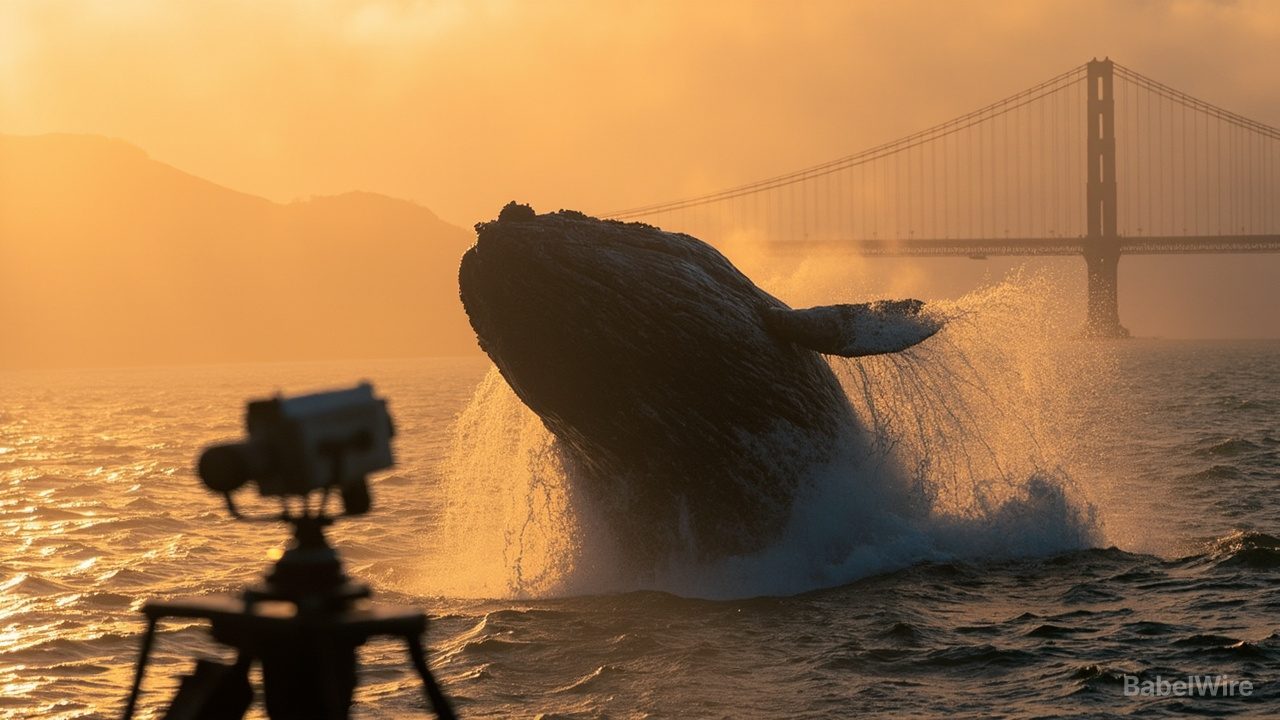
On a sunny afternoon in San Francisco Bay, a group of scientists on Angel Island watch three gray whales surface for breath. Nearby, container ships the size of skyscrapers navigate the same waters. This intersection of marine life and industrial traffic has become deadly — and a new AI-powered system is racing to change that.
Developed by Massachusetts-based WhaleSpotter, a thermal camera system mounted on a Coast Guard tower at Angel Island's Point Blunt uses artificial intelligence to detect the distinctive warm breath of gray whales from up to 7 kilometers away. The system runs 24/7, through fog, darkness, and all weather conditions — something human observers cannot do.
A Climate Change Crisis at Sea
Gray whales make the longest migration of any mammal — 15,000 to 20,000 kilometers roundtrip from Alaska to Baja California, Mexico. Historically, they never stopped along the way. But since 2018, over 100 gray whales have detoured into San Francisco Bay on their northward journey.
Scientists believe record-low sea ice levels driven by climate change are decimating the algae that fertilize the Arctic food chain the whales rely on. Unable to eat enough to sustain their full migration, the whales come to the bay for food — and some stay for over a month.
"Gray whales are trying to be a brave new whale in a weird world," said Douglas McCauley, director of the Benioff Ocean Science Laboratory at UC Santa Barbara. "This is a front row view to climate change."
The consequences are severe. A study published in April estimates an 18% mortality rate for gray whales that enter the bay. In 2025, a record 21 gray whales died in and around the bay, with necropsies showing 40% of those deaths were caused by ship strikes. Seven whales have already died here in 2026.
6,600 Detections in Under Two Weeks
WhaleSpotter's system uses an AI model trained to recognize whale spouts — the warm exhaled air that appears as a thermal signature distinct from the surrounding water. When the AI detects a potential whale, the footage is sent to a marine mammal expert for verification. If confirmed, an alert goes to the U.S. Coast Guard's Vessel Traffic Service, which warns nearby ships to slow down or reroute.
In its first week and a half of operation starting May 19, the system had already logged 6,600 whale detections. The technology reduces the risk of ship strikes by 90%, according to WhaleSpotter.
The San Francisco Bay system is the first to combine land-based and vessel-based monitors, and scientists plan to add another camera on a ferry running between San Francisco and Vallejo. WhaleSpotter's CEO Shawn Henry says the data from human verifications is being fed back into the algorithm to improve it, with the eventual goal of eliminating the need for human verification entirely.
"I like the AI — it doesn't get tired like humans," Henry said. "We want to rely on AI as much as possible."
The system represents a powerful example of how AI can serve conservation, helping protect endangered species while maintaining the economic activity of one of the world's busiest harbors.
Sources
- spectrum.ieee.orgIEEE Spectrum — Thermal Cameras and AI Help Ships Steer Clear of Gray Whales
- news.ucsb.eduUCSB / University of California — New AI System Uses Cameras and Thermal Sensors to Steer Ships Clear of Gray Whales
- abc7news.comABC7 News — New AI cameras providing Bay Area researchers insight into gray whale behavior
- mercurynews.comThe Mercury News — Scientists install AI-powered tech in San Francisco Bay to detect gray whales