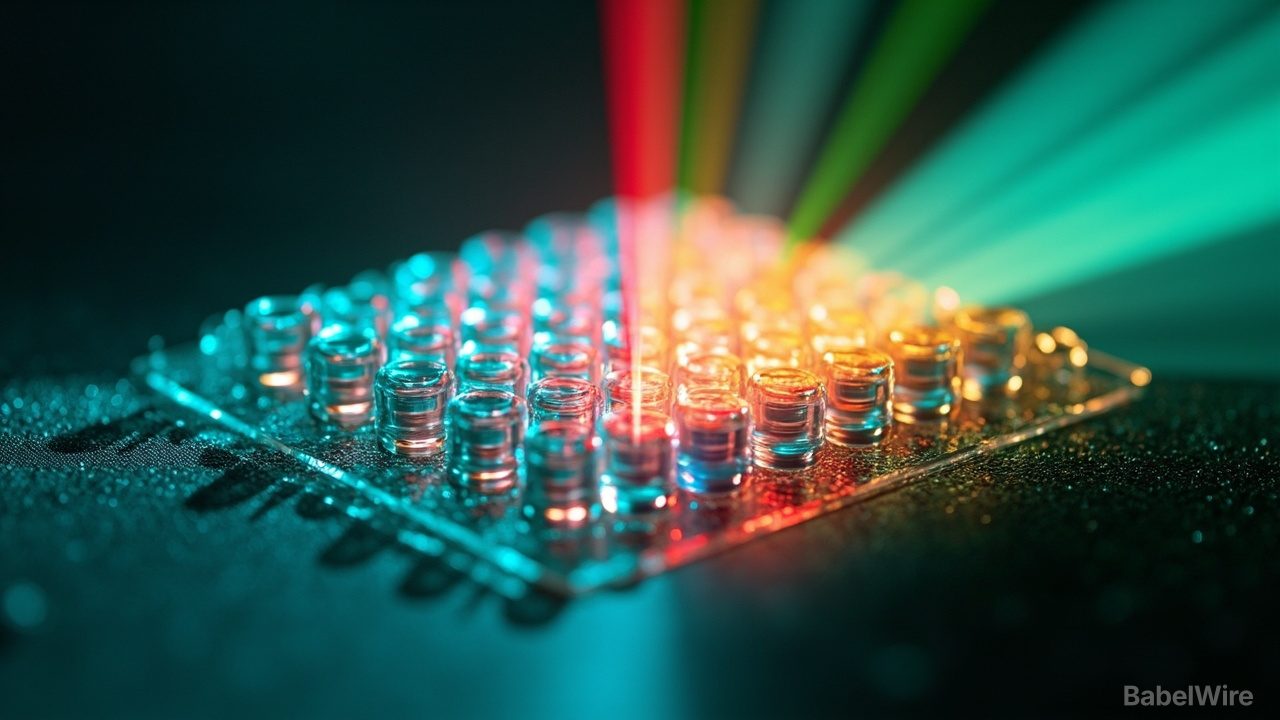
Every digital photo begins with a compromise. A camera sensor can measure how much light hits a pixel, but not its colour, so manufacturers cover individual pixels with red, green or blue filters. These dye-based filters reject most of the spectrum: in a typical arrangement, only about a quarter of the incoming light reaches the sensor in usable form.
A team led by Hyoseok Park has now designed an alternative that steers light instead of absorbing it. Rather than filtering colours, a metasurface — a patterned layer of silicon-nitride nanopillars — routes red, green and blue light towards the detector pixels best suited to capture them.
The obstacle has always been computational. Finding the right arrangement of nanopillars means searching an astronomically large space, while accurate electromagnetic simulations are far too slow to test millions of candidates. The researchers trained a neural network on 140,000 simulated structures and paired it with a genetic algorithm that repeatedly selected and modified the most promising designs. The trained network evaluated optical fields roughly 230,000 times faster than the full simulations, letting the team screen about 40 million candidate patterns.
The resulting device transmitted 88.8% of incident light in experiments, compared with 24.7% for the conventional colour-filter array the researchers used as a baseline — a 3.6-fold improvement, as reported by Physics World.
The gain is not free. Some colour crosstalk remains, meaning the router does not separate the three channels perfectly, and the design gives up a little spatial resolution. The researchers also emphasise a practical benefit: because the network predicts the full optical-field distribution, it can be reused to design devices for different detector geometries without retraining — a shortcut to adapting the approach across sensor formats.
The most obvious applications are wherever a small camera must work in scarce light: smartphone photography, night-vision and low-light imaging, security cameras, medical endoscopes and microscopes. The decades-old Bayer mosaic is unlikely to disappear overnight, but the result suggests its absorptive logic is no longer the only option.