The artificial-intelligence boom may be ushering in the next industrial revolution, but first it is going to have to answer to Cheryl Cordes.
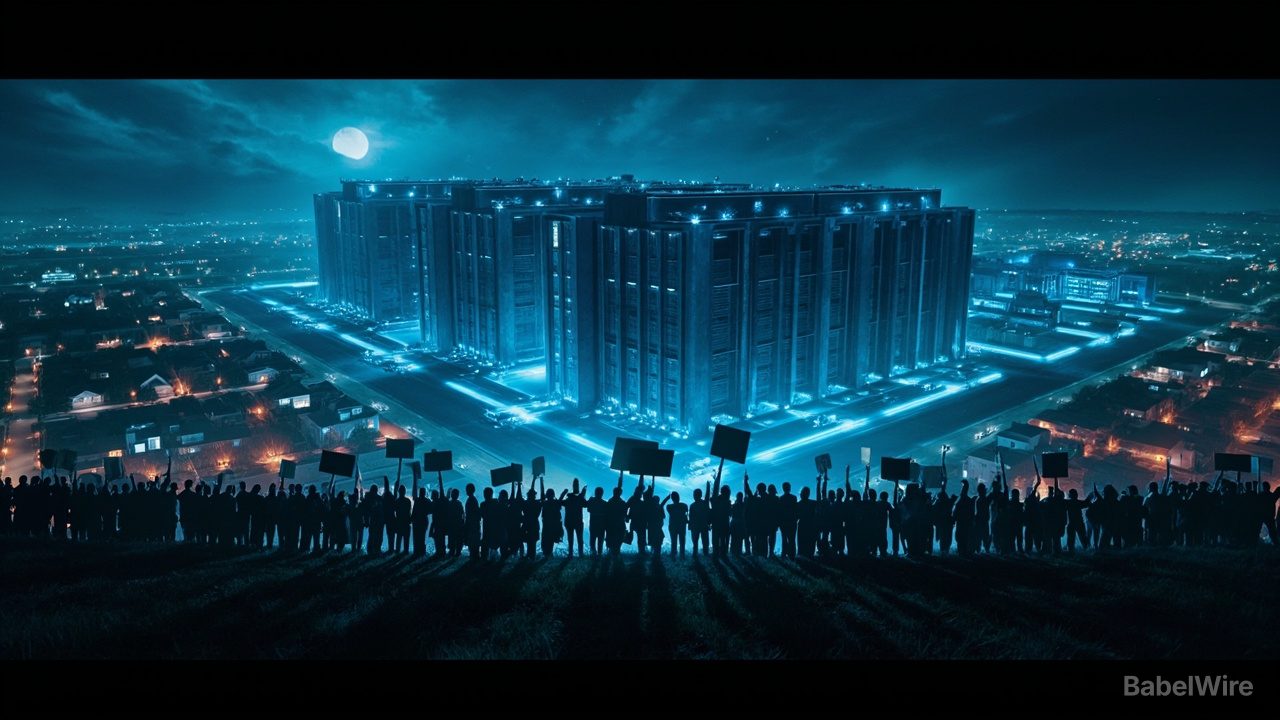
The retired nurse and her neighbors in Genesee County, New York, have spent months protesting the construction of a massive data center in their rural community — a 90-acre facility that would draw about 500 megawatts of electricity, making it one of the largest in the country. The Cordes family has parked a motor home in front of their house as an "emergency exit" should the project move forward.
They are far from alone. A grassroots backlash against AI data-center construction is snowballing into a national movement across the United States, threatening to slow — or even derail — the single most important driver of the economy and stock market.
Record-Breaking Opposition
In the first quarter of 2026, 75 data-center projects worth $130 billion were blocked or delayed by local opposition, according to Data Center Watch, a research firm. That matches the total number of projects that faced that fate in all of 2025.
A Reuters/Ipsos poll conducted in June found that 44% of Americans oppose data-center construction nationwide, versus 21% who support it. The numbers are far starker when people are asked about their own communities: 57% oppose, and only 14% are in favor.
Opponents raise concerns about intense power needs that drive up local electricity costs, the constant humming noise emitted by cooling equipment, and the environmental impact of facilities that researchers at the Dallas Fed warned could add up to 0.13 percentage points to annual inflation by 2030.
A Bipartisan Revolt
Remarkably, the backlash has united Americans across political lines. Some anti-AI advocates say it is the most bipartisan issue they have ever worked on.
New York Gov. Kathy Hochul is now considering signing a statewide moratorium on large data-center construction into law. Lawmakers in Arizona, Illinois, and Ohio have recently restricted or ended tax breaks for data centers. At the federal level, Sen. Bernie Sanders (I., Vt.) has proposed a nationwide moratorium, as has Rep. Alexandria Ocasio-Cortez (D., N.Y.), while Rep. Nancy Mace (R., S.C.) wants to pause construction in her home state.
"The coordinated pushback that we're seeing is definitely creating issues for the industry to be able to grow as quickly as it wants to grow," says Oisín Ó Murchú, chief development officer at Stream Data Centers, the developer behind the embattled New York project.
Industry on the Defensive
AI companies are scrambling to mount a defense. Super PAC Leading the Future, backed by Andreessen Horowitz and executives from OpenAI and Palantir, has raised more than $100 million to support pro-AI candidates. Build American AI, a nonprofit advocacy group, is running a multimillion-dollar campaign to spread the message that America needs AI investment to stay ahead of China.
The uncomfortable reality, however, is that a huge portion of planned capacity may simply not materialize. Microsoft, Google, and CoreWeave all say they are already capacity-constrained. Morgan Stanley estimates hyperscalers will spend $800 billion on capital expenditures this year alone.
"Why is the world angry at us? They're angry at us because we were dopes," said Andrew Feldman, CEO of AI chip maker Cerebras Systems. "We raced ahead, and we didn't think about the communities into which we were putting these data centers."
As the movement gains momentum, families like the Cordes face an agonizing question. "Where do you go?" Cheryl Cordes asks. "What's the guarantee that a data center ain't going to pop up?"