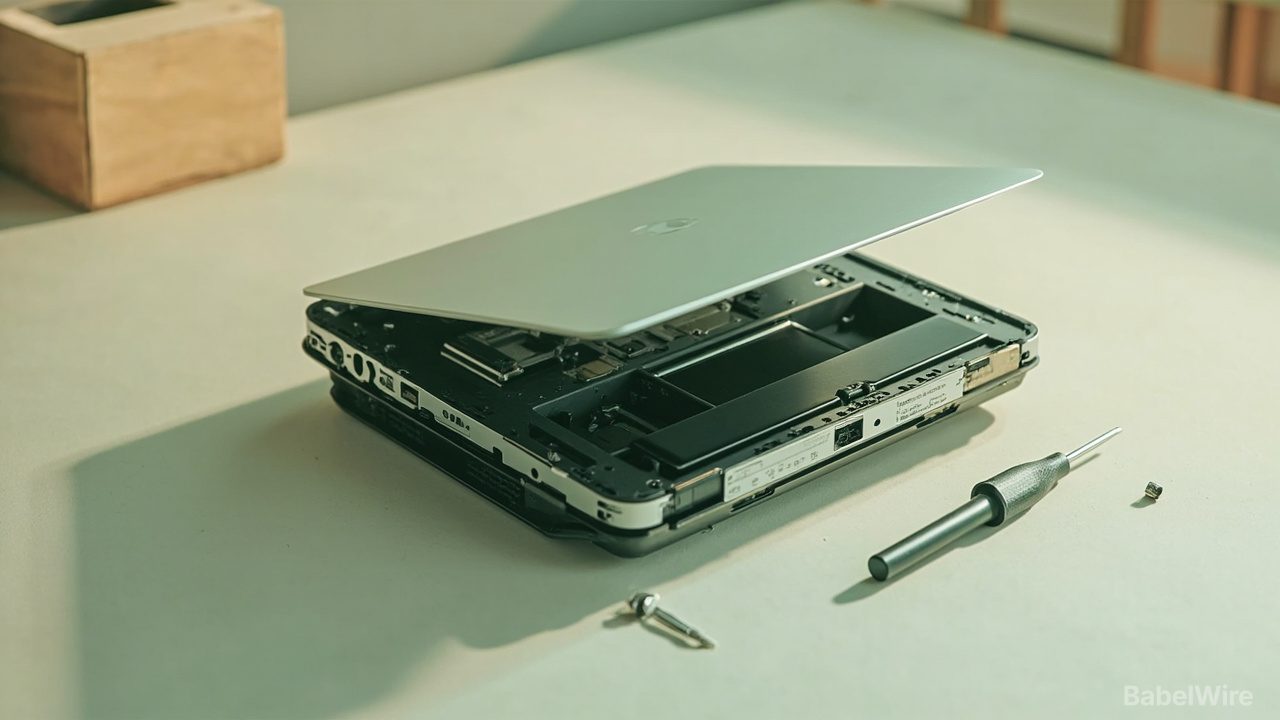
Acer is taking a page from Framework's playbook. At the IFA trade show in Berlin, the company presented the Vero 16, a 16-inch laptop built around serviceability and longevity, which Acer frames as part of its sustainability line. The device can be taken apart with ordinary tools to swap out the battery, the memory and even the display or mainboard.
The display is a 16-inch OLED panel with up to 3K resolution and a 120 Hz refresh rate. Inside, Acer installs processors from Intel's Core Ultra 300 series, codenamed "Panther Lake." The built-in memory can be removed and upgraded to 32 GB of RAM with a few steps, and the 71 Wh battery is not glued in and is replaceable. The webcam has a mechanical privacy shutter, and the port bar is a separate, swappable module offering HDMI 2.1 and Thunderbolt USB-C connectors. The chassis is made of recycled aluminum certified to the U.S. military's MIL-STD-810H durability standard.
Acer says the Vero 16 is "designed to support processor upgrades over at least two generations." Spare parts are planned to be offered through the repair center Enfinitec Germany and parts partner IPC Computer, and Acer says they will be available to end customers. The laptop is expected in stores at the earliest in late 2026, more likely in early 2027.
What is missing are the concrete commitments that made Framework famous. Acer has not yet announced prices, and — more importantly — it has not committed to a defined period during which spare parts will remain available. Framework sells all components openly in its own shop, lets buyers choose and swap expansion modules, and sells new mainboards that fit into old chassis. Acer's history offers mixed signals: its 2021 Aspire Vero promised easy access and recycled materials, and parts partner IPC Computer still lists many spare parts for it today, but not for every configuration, and Acer's own product page does not show a list of available replacement components.
The Vero 16 therefore positions itself as a more repairable mainstream laptop rather than a full Framework rival for now. Industry observers note that even Dell's modular "Concept Luna," shown in 2022, has only partially reached production devices, with separate USB-C daughterboards as one of the few adopted ideas. Whether Acer's modularity promise extends beyond the first product generation is a question the company has yet to answer.