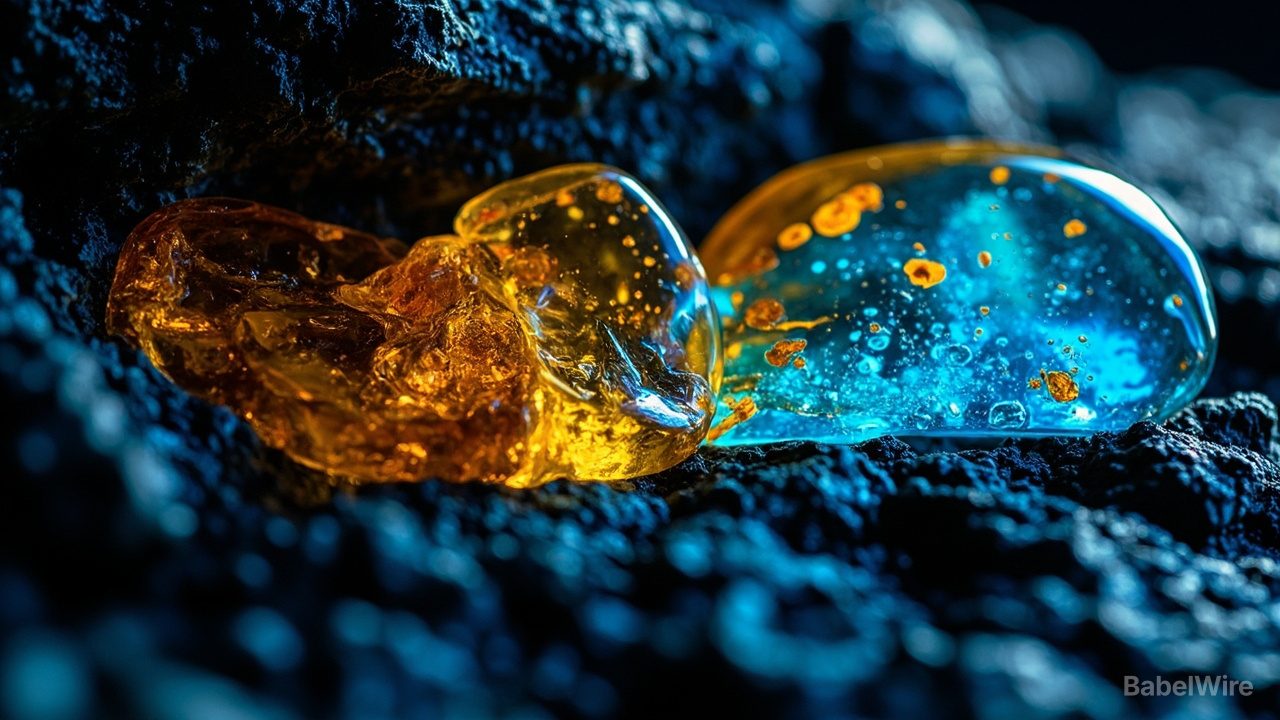
Paleontologists in China have unearthed the oldest chemically verified amber ever found, dating to the Middle Devonian epoch approximately 385 million years ago — a staggering 140 million years before the first dinosaurs roamed the Earth.
The discovery, published July 15 in the journal Science Advances, pushes back the confirmed amber record by 65 million years. The previous record-holder was a Late Carboniferous sample from the United States dated to about 320 million years ago.
Led by Dr. Cihang Luo of the Nanjing Institute of Geology and Palaeontology, the team analyzed roughly 10 kg of coal collected from the Hujiersite Formation near Hoxtolgay in China's Xinjiang region. Using ultraviolet light, they located tiny clusters of amber embedded within the coal and painstakingly extracted 241 fragments — most measuring just 0.1 to 0.5 mm across.
Chemical analysis using Fourier transform infrared spectroscopy and mass spectrometry revealed that the amber's molecular composition closely resembles resin from modern and fossil conifers. This is remarkable because seed plants had not yet evolved when this resin formed. The authors suggest the resin was most likely produced by progymnosperms — an extinct group of seedless plants that gave rise to seed plants — or by tree-like lycopsids.
"Our chemically verified Hujiersite amber represents the earliest confirmed amber record thus far," the researchers said. "It shares comparable chemical components with coniferous ambers, providing insights into the early evolution of terpenoid resin biosynthesis in vascular plants."
The finding indicates that the biochemical machinery for producing complex terpenoid-based resin — a trait long associated exclusively with seed plants — had already evolved in non-seed plants by the Middle Devonian. The researchers propose that early resin likely served to seal wounds and fend off fungal infections, rather than deter insect feeding, since insect-plant attack evidence doesn't appear until later in the Carboniferous period.