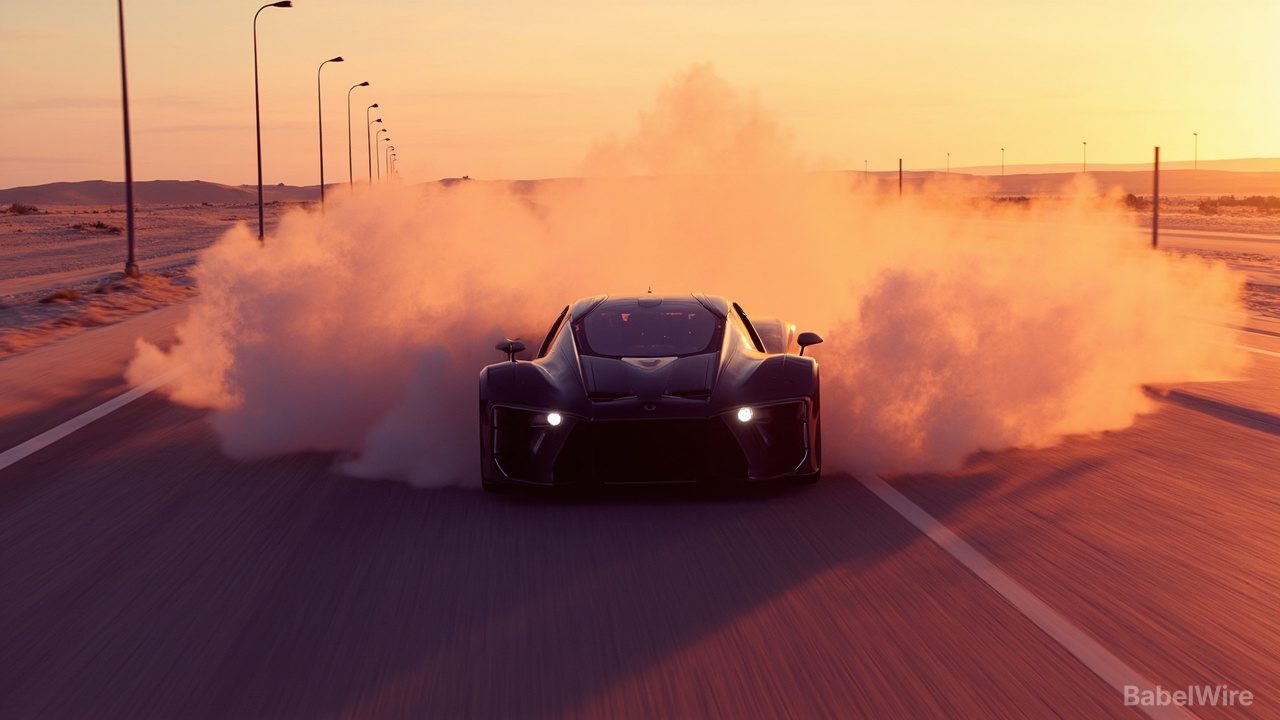
On 1 November, on a closed section of the Sheikh Khalifa Bin Zayed International Road in Abu Dhabi's Al Dhafra region, a BYD Yangwang U9 Xtreme reached 503.17 km/h (312.7 mph). It is the first production car past 500 km/h, and it beats the car's own 496.22 km/h run at ATP Papenburg in September 2025.
Two Guinness World Records were awarded — highest speed by a production car in a single-direction run, and highest speed by an electric production car in a single-direction run — and the FIA recognised the figure. Driver Marc Basseng, who set the previous record, was at the wheel again.
"Single direction" is doing real work in that sentence
The qualifier is not legalistic decoration. A two-way average — the standard for FIA land-speed records — takes wind and gradient out of the result. BYD's two records are explicitly one-way. CarNewsChina flagged the same point: fast, first past 500, but not an adjudicated two-way average.
The venue adds its own asterisk and its own difficulty. This was a public road, not a proving ground: 10 km closed, 7 km of usable straight, run over two days. The surface had to be swept first and then walked metre by metre to remove wire particles left by cleaning brushes, which at 500 km/h could have destroyed a tyre. Two runs on 31 October peaked at 490 km/h; engineers worked overnight on rear-wing angle, suspension rebound damping for the road's undulations, and tyre pressures. The second run on 1 November produced the record.
What 500 km/h required
3,019 PS from four motors, each capable of 30,000 rpm, on a 1,200-volt platform up from the regular U9's 800 V and supporting up to 1,000 A. The Blade LFP battery's single-cell power density is up 170% over an 800 V system, enabling 30C discharge — a full pack emptied in two minutes, in theory — and still delivering 1,800 kW at 20% state of charge. BYD claims up to 67% less heat generation than 800 V at matched output. Materials: 0.1 mm super-silicon steel in the stator, 970 MPa rotor steel, 1,217 PS per tonne.
DiSus-X body control applies up to 50 kN of active force in 120 ms and can lean the car into a corner by 2.43° at 0.3 g. Giti built a semi-slick with a knurled rim interface and high-viscosity lubricant so the tyre does not migrate on the wheel under that torque.
The same specification holds the production-EV lap record at the Nürburgring — 6:59.157.
Thirty cars
The U9 Xtreme is limited to 30 units. The first customer-specification car, "Dawn Moment", was shown at this year's Beijing auto show, and some buyers have approved their specifications and are moving into contract signing and production scheduling.
Which is the real point of the exercise: the record is a marketing instrument attached to a hypercar, and it is also an endurance test for a 1,200-volt architecture and an LFP chemistry that BYD puts in far cheaper cars.
A century of combustion engineering never got a production car past 500 km/h. An electric one did it three years into the project, on a public road, in one direction, on a Sunday.