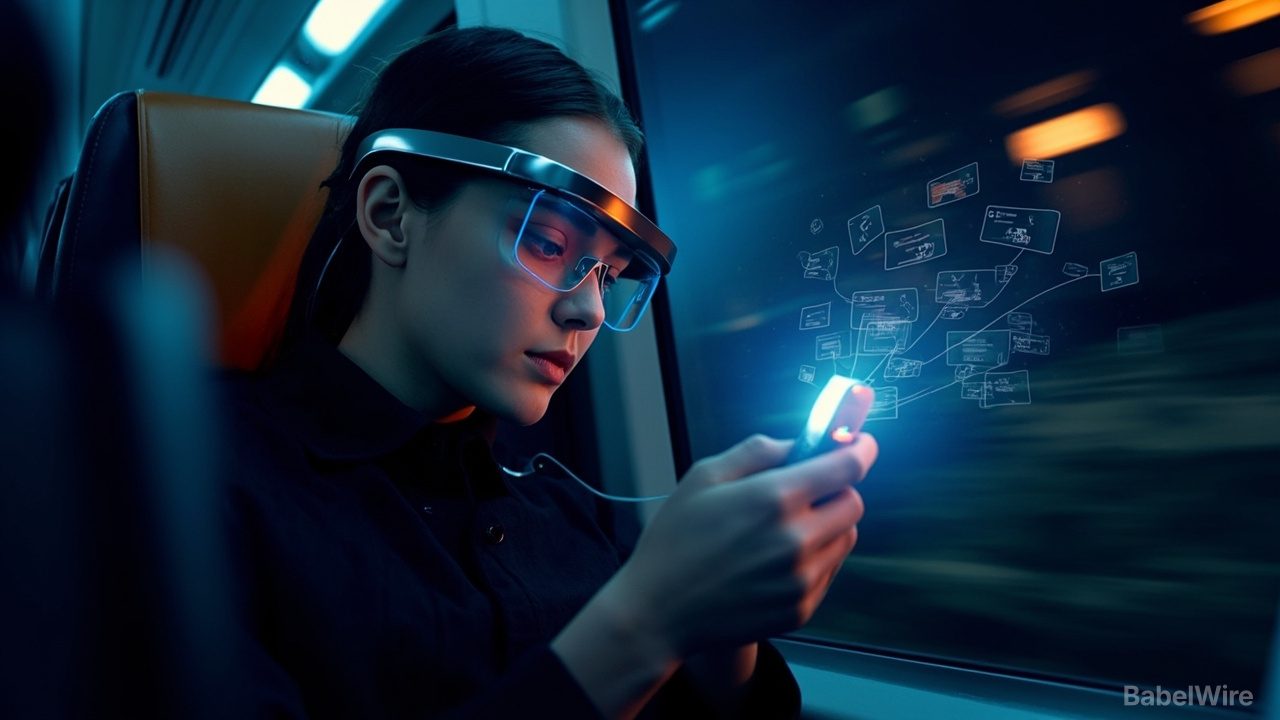
Google has pitched Android XR as a platform for many hardware makers rather than a device of its own. On Wednesday that strategy got its first real consumer product: at the Android Developer Summit, Xreal launched the Aura, a wired pair of glasses that displays images and leaves the computing to a phone-sized puck.
That puts Xreal in direct competition with Meta's Ray-Ban Display, and the scorecard is mixed. On paper Xreal wins: Sony micro-OLED at 1,200p and 120Hz with a 95-degree field of view, driven by Qualcomm's Snapdragon Reality Elite, plus Bose-tuned audio and Gemini as an assistant that can read what is on screen. In the hand it loses on two counts: 95 grams against Meta's 69, and you have to carry the puck.
What is in the box, and what is not
The Aura is not a standalone device. It tethers by cable to a compute unit running Android XR and projects apps, games and a virtual desktop into your field of view. Plug a laptop or a handheld console into the USB-C port and the glasses become a secondary display — the mode Xreal has spent years selling as the real reason to own its hardware.
At launch the company names several experiences built specifically for Android XR: the NBA App for Android XR, Nevatars, Fallout: Factions, Project Hail Mary: Journey Among the Stars, a NASCAR XR app, and a version of The Nutcracker from the San Francisco Ballet. Ordinary Google Play apps and games run too.
Two configurations are on sale: 12GB of RAM with 256GB of storage for $1,279, and 16GB with 512GB for $1,499. Through December there is a launch price of $1,099 and $1,299 respectively. Orders opened today in the United States, Canada, Japan and South Korea, with shipping from mid-November.
The price is the actual announcement
At $1,099 to start, the Aura undercuts Meta's Ray-Ban Display by a clear margin — and that is the story. Google is repeating with Android XR what it did with Android on phones: the platform belongs to Google, the hardware comes from partners such as Samsung and Xreal. For Xreal it is a route out of the display-glasses niche the company has been fighting in for years.
How hard that business is, chief executive Chi Xu said himself in May: building smart glasses is difficult and everyone is losing money. His hope was that hardware, operating system and interface had finally matured at the same time. The Aura is the test of that claim — not in a demo, on a shelf.
The open question is the form factor
Xreal chose a cable and a puck to keep weight and heat out of the glasses. That is technically sensible and strategically risky: it turns the Aura into an accessory you have to carry, while Meta positions its glasses as something you simply put on. Someone who wants a screen for ten minutes on a train will prefer 69 grams and no puck; someone who wants a three-monitor virtual desk will prefer Xreal's 95-degree field.
The content offer is also thin. Six launch experiences are a beginning, not an ecosystem — and the Android XR story overall depends on developers building for an installed base that has yet to form.
What to watch over the next few months: whether the Aura sells beyond its reservation holders, whether Samsung's own Android XR device sets a different price and shape, and whether Google iterates on the platform faster than Meta iterates on its glasses. The contest for people's faces has only just started — and this time it comes with a $1,099 price tag.