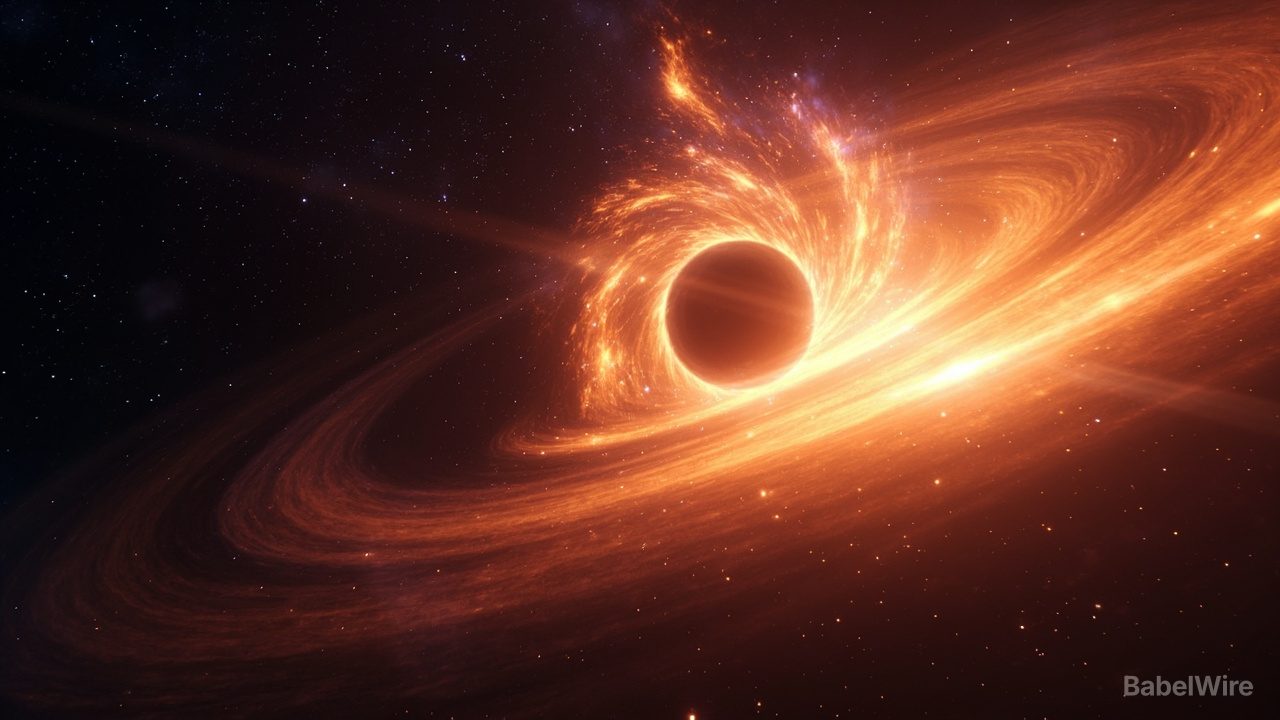
A team of researchers at the University of North Carolina-Chapel Hill used the SOAR telescope to observe TDE 2025abcr — a tidal disruption event (TDE) that occurred some 30,000 light-years from the center of its host galaxy, making it the most "off-nuclear" TDE ever discovered.
"Almost every tidal disruption event we've ever observed has occurred at the center of a galaxy, right where we expect the biggest black holes to be," said Jonathan Carney, a PhD student who led the study. "The tidal disruption event we discovered happened tens of thousands of light-years away from the center, revealing a massive black hole in a place we would not normally expect to find one."
The team used an AI classification program adapted to search for TDEs away from galactic cores. "By removing the assumption that these events only happen in the galactic center, we were able to find a black hole that might have otherwise been missed," explained team member Akash Anumarlapudi.
The black hole is estimated to be about a million times the mass of the Sun. It may have been kicked out of its galaxy's center through a past galaxy collision or interactions with other black holes.
This discovery opens a new window for studying wandering black holes, which normally produce no light and are nearly impossible to detect — until they tangle with an unlucky star. Future observatories like the **Vera C. Rubin Observatory** could discover hundreds of thousands of such events per year.