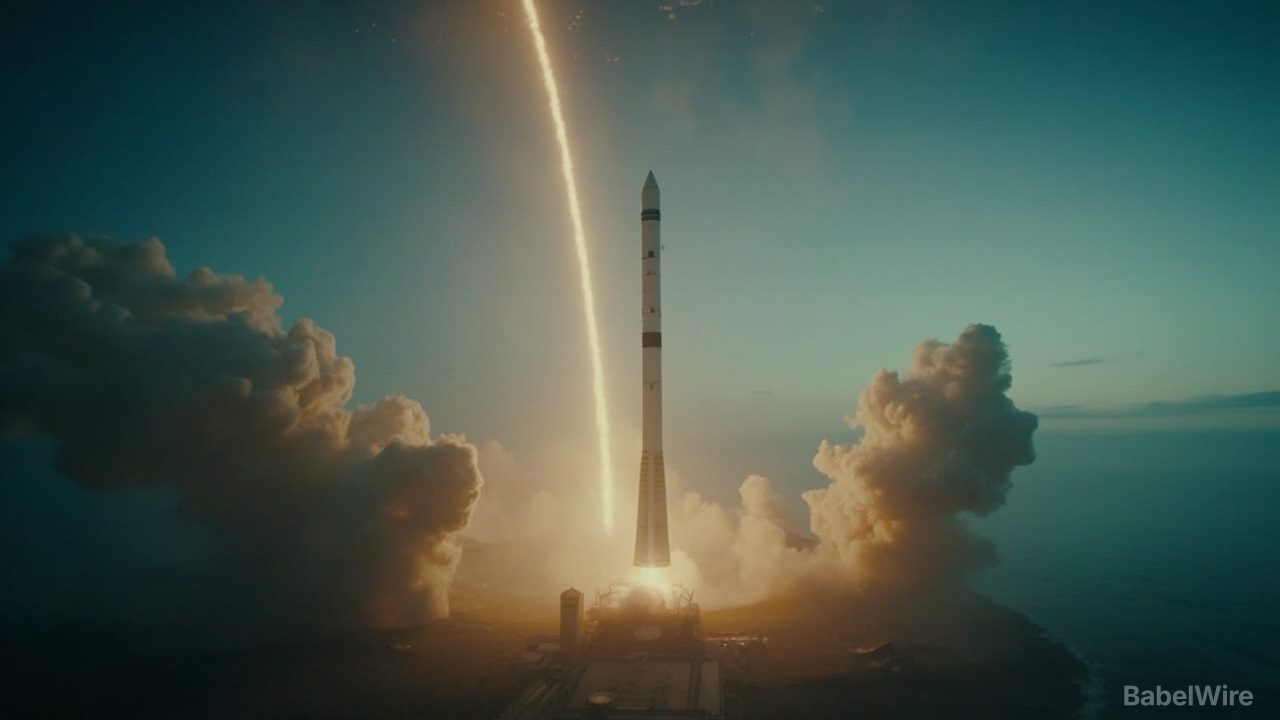
Over the weekend, a United Launch Alliance Vulcan Centaur failed during launch. The 40 Amazon Leo satellites it was carrying were destroyed — the entire payload of the mission, and a meaningful slice of a broadband constellation Amazon has been assembling at speed. Ars Technica framed the loss plainly: a major blow to the companies hoping to compete with SpaceX. Neither the exact point of failure nor the cause has been made public.
The damage runs in three directions at once.
The rocket. Vulcan is the centrepiece of ULA's plan to stay relevant in a market that Falcon 9 has spent a decade compressing. It is also the vehicle the US Space Force certified to fly national-security missions alongside Falcon 9 — the structural hedge against a single-provider launch market. Vulcan had only just returned to flight this month, and every mission in this phase is read as a reliability signal rather than a delivery. A failure of this kind normally triggers an anomaly investigation that stops flights until the cause is understood and corrected. That clock starts now.
The payload. Amazon Leo — the constellation formerly known as Project Kuiper — has been filling out through a mixed manifest: Falcon 9, Atlas V, Vulcan, Ariane 6. Losing forty satellites on a single flight is a scheduling wound, not a fatal one; a constellation of hundreds absorbs it. But it lands at the worst possible moment, with commercial service approaching and the company under pressure to show subscribers a filled sky. Amazon has always described its multi-launcher strategy as insurance. This is the week that argument gets tested — and the fallback is, awkwardly, the competitor's rocket.
The coalition. Western launch capacity outside SpaceX was already thin, and this month made it thinner. Blue Origin's New Glenn is not expected to fly again until 2027 after its own mishap, and Blue Origin also builds the BE-4 engines that power Vulcan's first stage, which means the same industrial base carries both bets. The Pentagon has been spreading money around precisely because of this: a $300 million bet on Rocket Lab and Stoke, placed as Falcon 9's own flight rate winds down. Every grounding moves more of the manifest onto the one vehicle everyone was trying to stop depending on.
For Amazon, the arithmetic is uncomfortable. It holds launch contracts across several providers, but contracts are not orbits, and a grounded vehicle is a queue that does not move. Leo's service launch depends on a satellite count, not a press release; the schedule slips by however long the investigation runs, plus however long it takes to build and fly replacements. Amazon has not said how the loss changes its plans.
For ULA, the question is narrower and harder: is Vulcan's design sound, or was this a process failure in a vehicle that has flown only a handful of times? The answer determines whether the Space Force keeps assigning it sensitive missions and whether commercial customers keep their payloads on the manifest. Insurers will reprice as well — a first-class failure in a young vehicle is exactly the event that resets premiums across a small fleet.
What is not in doubt is the strategic read. The last two years of Western launch policy have been an exercise in diversification: certify a second vehicle, sign a third, fund a fourth. That strategy works only if the alternatives actually fly. One bad flight does not invalidate it. But it does mean that for the next several months the launch market will look a great deal more like a monopoly than anyone in Washington or Seattle wanted.
What to watch: ULA's preliminary cause statement and its effect on the manifest; whether Amazon reallocates Vulcan batches to other vehicles; and whether the Space Force pauses or reopens Vulcan's certification for national-security missions.