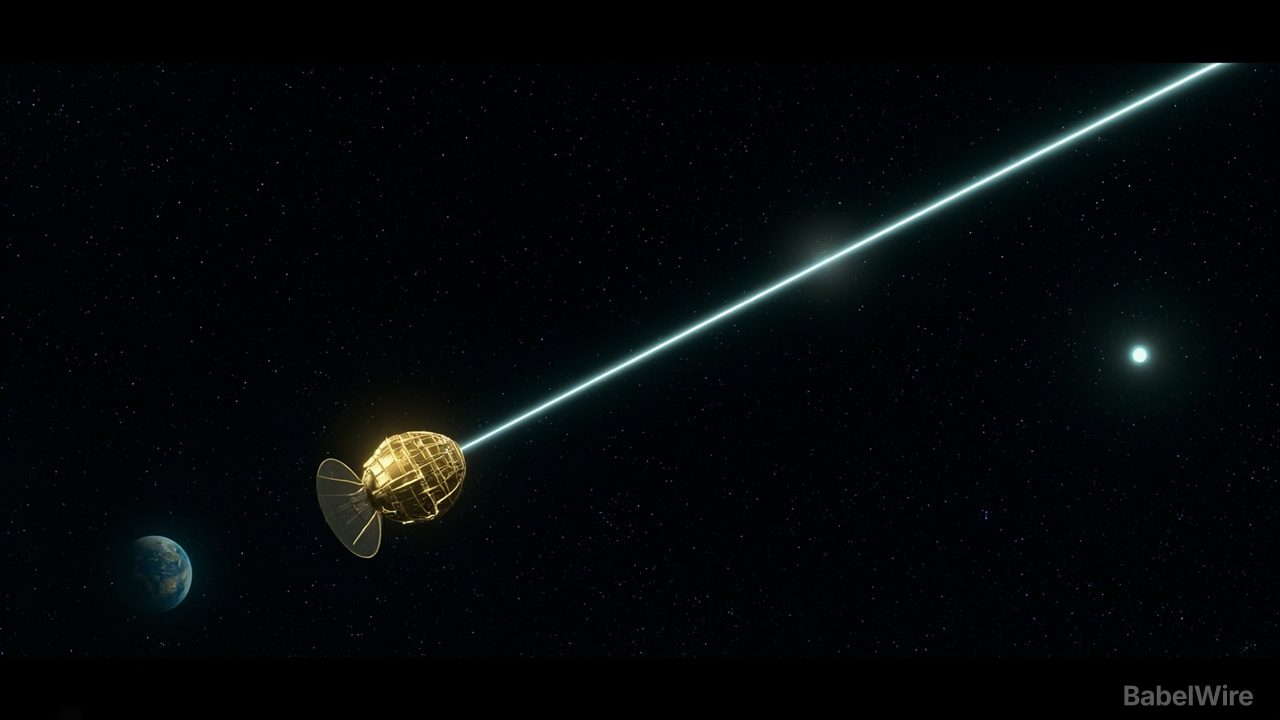
On Wednesday, November 18, at 5:16:07 a.m. EST, a spacecraft launched in 1977 will cross a line no manufactured object has crossed before: the distance light travels in a single day.
NASA calculates that Voyager 1 will be 16.094 billion miles (25.902 billion kilometres) from Earth — one light-day, roughly 24 light-hours. The probe reaches it after 49 years, two months and 11 days of flight from Cape Canaveral, past Jupiter and Saturn, through the heliopause and into interstellar space.
The number is a distance, not a duration, which is the part worth holding on to. At one light-day, a radio command from Earth takes a full 24 hours to arrive; Voyager's answer takes another day to come back. Engineers running the mission are effectively operating a 1970s computer from two days ago in each direction.
Voyager 1 and its twin, Voyager 2, remain the only spacecraft operating outside the heliosphere — the bubble of particles and magnetic fields blown outward by the Sun. Both are running on shrinking power. To keep them alive, engineers have been switching off instruments and heaters one by one: Voyager 1's Cosmic Ray Subsystem went dark in February 2025 and its Low-Energy Charged Particle instrument followed in April 2026. The magnetometer and the plasma wave subsystem are still on, and mission planners expect a few more years of science on a diet of decaying plutonium.
NASA has turned the milestone into a shared moment. It is inviting everyone on the planet to step outside after sunset on Tuesday, November 17 — the eve of the crossing — and flash a light with a phone, a flashlight or entire buildings, a "symbolic wave of golden light" encircling the Earth. The agency is also collecting messages from the public for the spacecraft.
For scale: sunlight takes about 8 minutes and 20 seconds to reach Earth. Voyager 1's signal now takes roughly 173 times longer, and the spacecraft's own transmissions are extraordinarily faint by the time they land on the Deep Space Network's dishes.
The probe carries the Golden Record, a phonograph of sounds and images from a planet it can no longer see. It will keep drifting outward long after it goes quiet — which engineers expect in the early 2030s, when the last of its power is spent.