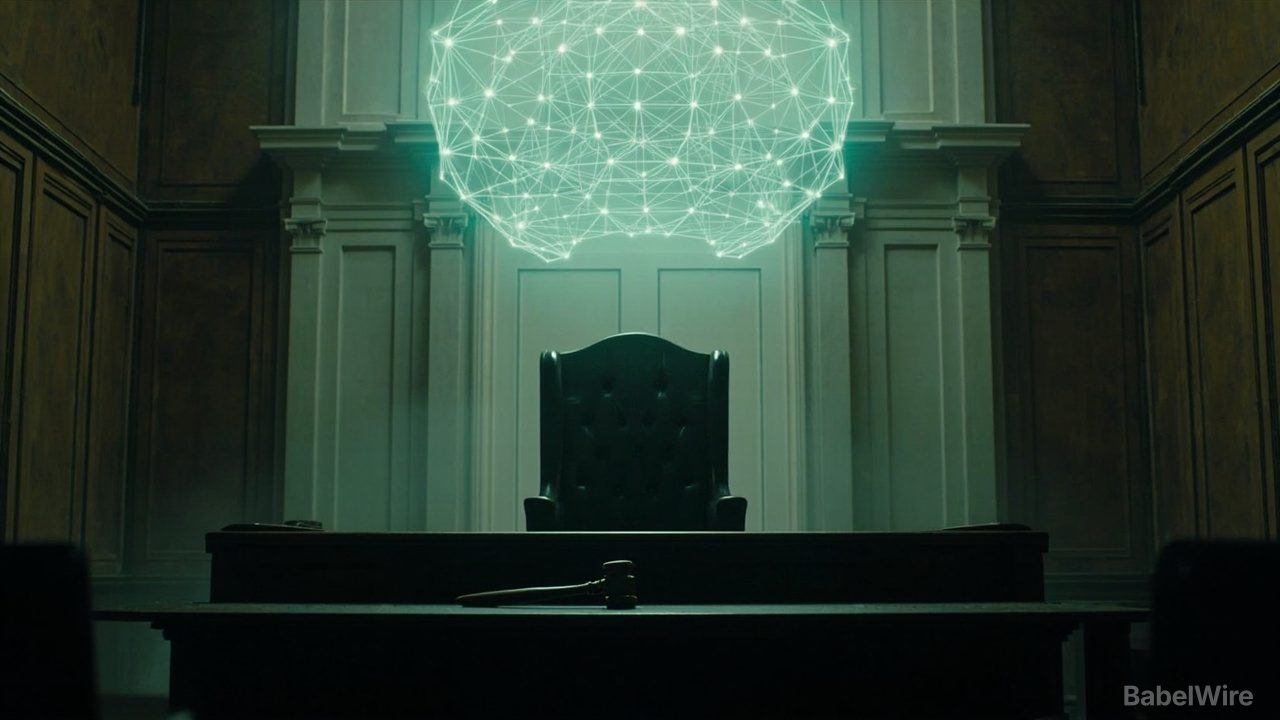
Sir Geoffrey Vos retires as Master of the Rolls, the most senior civil judge in England and Wales, within weeks. In his last days in office he has given two speeches that together amount to the most concrete programme for machine adjudication a sitting senior judge has put forward — and the clearest description of how it fails.
What he is proposing
In an interview with WIRED, Vos said artificial intelligence could resolve many civil disputes on its own and called for a debate on where the line should be drawn. The pivot was a visit to a court in Shenzhen, where civil disputes are already handled with heavy AI assistance. He puts damages assessments in personal injury and low-value professional negligence claims, and share valuations in minority shareholder disputes, on the machine side of the line. Complex commercial litigation and child custody stay with humans.
Vos says he uses Microsoft Copilot himself — to find documents, summarise long texts and check facts — but not to write judgments.
The line he draws
At the John Lehane Memorial Lecture at the Supreme Court of New South Wales he was more precise. Litigants might eventually choose to have cases determined "in minutes by a machine at little or no cost" rather than wait months or years for a person, provided the public comes to trust machine decisions once they are shown to be as reliable as human ones.
The distinction that carries the argument is consent. "Consensual machine-made decisions are one thing, and non-consensual ones are quite another," he said, arguing there are "important reasons of legal principle" why courts cannot impose a machine judgment on an unwilling party. The right to a human judicial decision is "deeply entrenched," and judges should not be replaced without legislation.
As evidence that machine dispute resolution is already ordinary, he cited eBay: 60 million disputes a year on the platform, 90% resolved without human intervention.
The sentence that matters
In the same lecture sits the best available description of the risk everyone else skips:
> "If a judge is presented with 1,000 decisions, economic and time pressures will inevitably lead to judicial approval of the machine's recommendations."
That is not science fiction. It is the standard failure mode of human-in-the-loop systems: the human stays formally in the process while lacking the time or context to deviate from it. Vos names it, and does not say how to prevent it.
The counter-evidence already exists
English courts are not running this experiment in a vacuum. Several lawyers have been caught citing AI-hallucinated case law; one lost his licence partly over AI misuse — reported as a first in the UK. New county court claims are rising around 10% a year, some of them drafted by chatbots. A system that decides faster is meeting a system that generates faster.
Vos's answer is that courts have always handled fabricated evidence — forged wills, for instance — and that deepfakes do not change the judge's task, which is still to decide whether someone is telling the truth. That is a good argument against panic. It is not an argument against rubber-stamping.
The succession keeps the agenda
Vos is succeeded as Master of the Rolls by Sir Colin Birss, who is also the lead judge for artificial intelligence in England and Wales. The portfolio does not merely survive the handover; it moves into the highest civil judicial office in the country.
What is missing
Four things, absent from both speeches: a standard for when a machine decision counts as "reliable"; a procedure for testing that independently; an appeal route designed for machine decisions rather than human ones; and an answer to how consent works when the alternative — months or years of waiting — is itself a form of pressure. Someone choosing between "a machine" and "three years" is not choosing freely.
None of that is an argument against Vos's proposal. It is an argument for treating it as legislation rather than as a technology rollout.
Sources
- wired.comShould AI Decide Your Court Case? This Judge Says Yes — WIRED
- ajosolicitors.co.ukPublic likely to accept AI-made decisions in time, says top judge — AJO Solicitors (reporting the John Lehane Memorial Lecture)
- atlabyte.comEngland's Top Civil Judge: AI Could Adjudicate Simple Civil Cases — Atlabyte
- golem.deJustiz: Englands oberster Zivilrichter plädiert für mehr KI vor Gericht — Golem.de