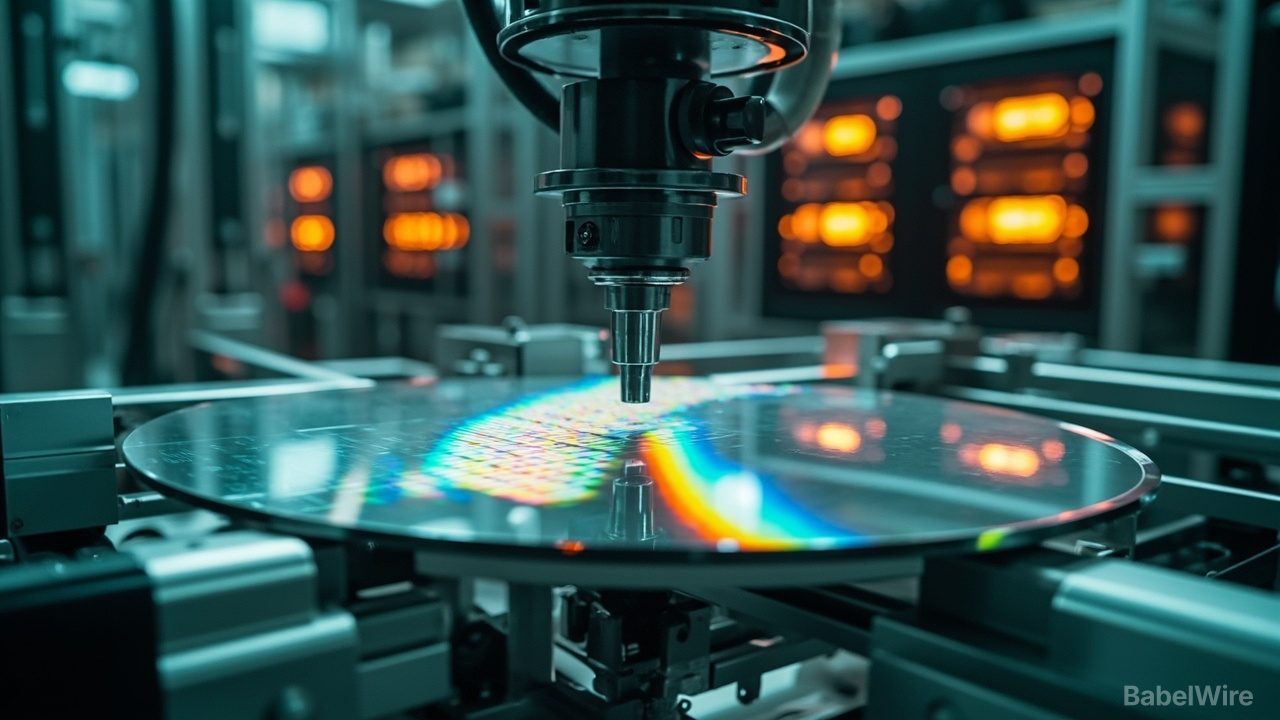
Vishay has a subsidy letter in hand and a much larger bill to pay. On Friday, Schleswig-Holstein's economy minister, Claus Ruhe Madsen, handed the US manufacturer's German subsidiary a grant worth roughly €215 million for its plant in Itzehoe, northwest of Hamburg. The money — federal and state funds, cleared by the European Commission in July — goes toward an additional fab that will run 300-millimetre wafers instead of the 200-millimetre wafers the site produces today.
The company describes the total investment as a "high three-digit million euro amount" and declines to be more precise. Andreas Hein, the CDU's economic policy spokesman in the state parliament, put it at about €1 billion.
The technical case is arithmetic. A 300mm wafer carries 125 percent more usable area than a 200mm one, so each run yields more die for the same handling. What Vishay wants to build on those wafers are power MOSFETs — the switches that gate current in everything from a car's inverter to a server's voltage regulator. The company names automotive, industrial and commercial applications, "including high-performance computers for artificial intelligence, telecommunications and IT infrastructure." That last clause is the interesting one: as AI racks push toward hundreds of kilowatts, the power conversion chain around the GPUs becomes a silicon problem, and it is different silicon from the logic chips everyone argues about.
Up to 250 jobs are expected despite heavy automation. Vishay is also part of the Northern Chip Network founded this year with Nexperia, NXP, Semikron Danfoss and X-Fab.
The subsidy argument is blunt, and the company makes it on the record. "Subsidising is dramatically important, because costs in Europe are significantly higher than in competitor countries, for example in Asia," said Markus Keil, who runs wafer manufacturing at the site. Madsen's version is about resilience: supply chains break "because a ship is lying across somewhere, or because there are wars and crises."
There is a domestic political sting. The FDP's Bernd Buchholz welcomed the investment but said the state government's information policy on the aid was inadequate: for a project of this size, he argued, the state constitution requires the parliament to be informed fully and early.
The bigger picture: Europe's chip subsidies have mostly been scored on logic and on packing more transistors into smaller nodes. Itzehoe is about the unglamorous half of the stack — parts that have to survive 600 volts and 150°C. If AI's binding constraint shifts from compute to power delivery, that half stops being unglamorous.
One detail worth keeping: the 200mm line does not close. Vishay is adding 300mm capacity alongside it, which is how a component maker hedges — the new line takes the volume and the efficiency, the old one keeps the customers who have not requalified their parts.