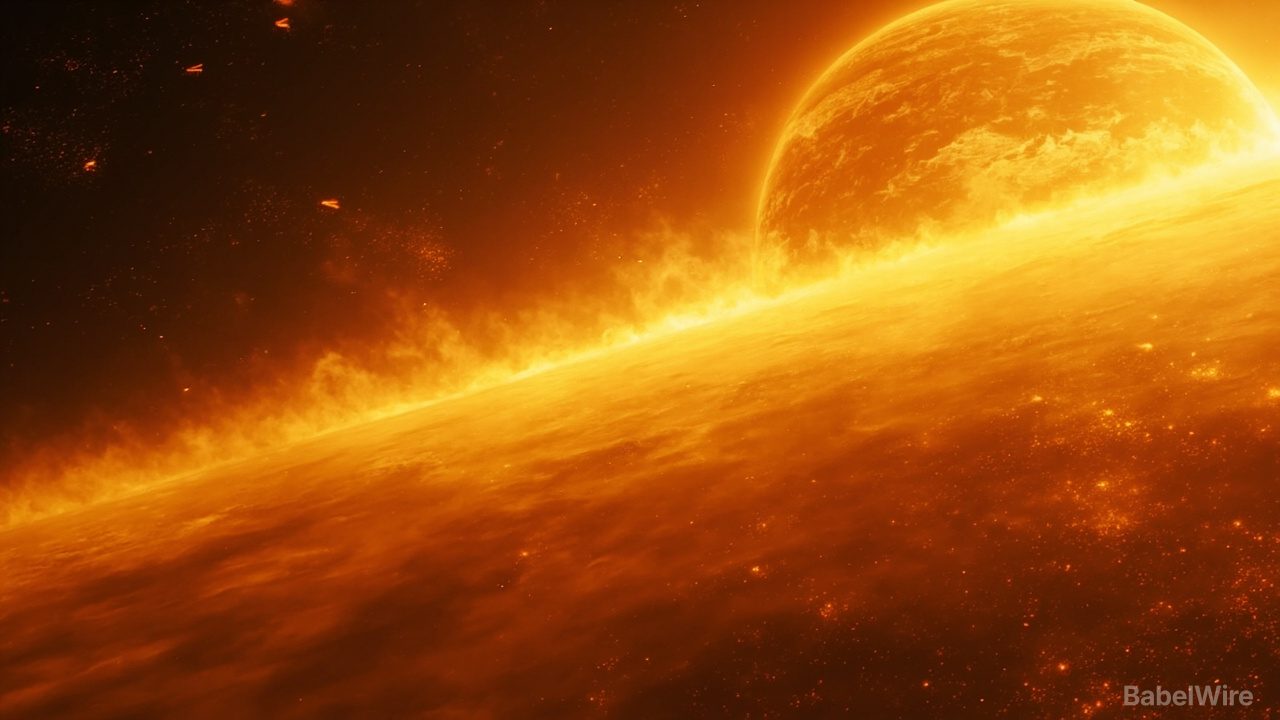
For nearly fifty years, the yellowish "lower haze" wrapped around Venus had no satisfactory explanation. The Soviet Venera and NASA's Pioneer Venus probes spotted it in the 1970s, and the leading candidates — volcanic ash and dust lifted from the surface — never quite fit the observations. Now a team at Tohoku University says the haze is cosmic dust: microscopic debris left behind by meteorites burning up in the planet's atmosphere.
Writing in Nature Astronomy, planetary scientist Hiroki Karyu and colleagues used a microphysical model — the same class of simulation used to explain cloud and precipitation formation on Earth — to track what happens to meteoritic material entering Venus' atmosphere. Incoming space rocks encounter friction with gas particles, burn up, and leave a trail of metal-rich dust. Sulfuric acid droplets then condense on those particles, exactly as water vapour condenses on dust and soot to form clouds on Earth.
The counterintuitive part is what happens next. More condensation nuclei do not produce more cloud droplets: instead the particles stick together into larger clusters before the acid condenses around them. Those clusters grow heavier until they sink into the scorching lower atmosphere, where temperatures reach roughly 100 °C and the sulfuric acid evaporates. What remains — bare, naked particles — forms the haze.
"The continuous influx of cosmic dust is sufficient to sustain this lower haze layer with the particle size distribution observed by the entry probes," Karyu said. "These haze particles of cosmic origin act as efficient condensation nuclei, promoting cloud formation in the main cloud deck even far from their initial source."
The model also closes a second, older mystery: the unknown substance in Venus' atmosphere that absorbs ultraviolet light. Meteorites carry magnesium, silicon and iron. Magnesium and silicon are poor UV absorbers; iron compounds looked far more promising, and probes dating back to Venera, Vega and Pioneer Venus had detected atmospheric iron and iron sulfate without being able to explain them. Iron sulfate matches the haze's optical properties.
There is an elegant detail about altitude. Between about 40 and 50 km, a nucleation barrier prevents sulfuric acid from sticking to the smallest particles. Those particles ride convection into the upper cloud layer, cool down, and only then are incorporated into acid droplets.
The findings also rule out the alternatives more firmly. Venus is the most volcanically active planet in the Solar System, but the team found that ash from its volcanoes cannot interact with atmospheric sulfur the right way to form the haze, and neither can surface dust — even at far larger influxes.
The implications reach past Venus. Upper hazes on Jupiter, Saturn and Neptune are well studied, but the microphysics below the main cloud deck remains obscure, and the team argues that observing metal layers in the giant planets' atmospheres would help pin down how much cosmic dust they receive — and how much haze results. "These effects establish cosmic dust as an essential component of planetary climates, a role that is also likely to be important for exoplanets," Karyu said.
The study is published in Nature Astronomy (DOI: 10.1038/s41550-026-02843-4).