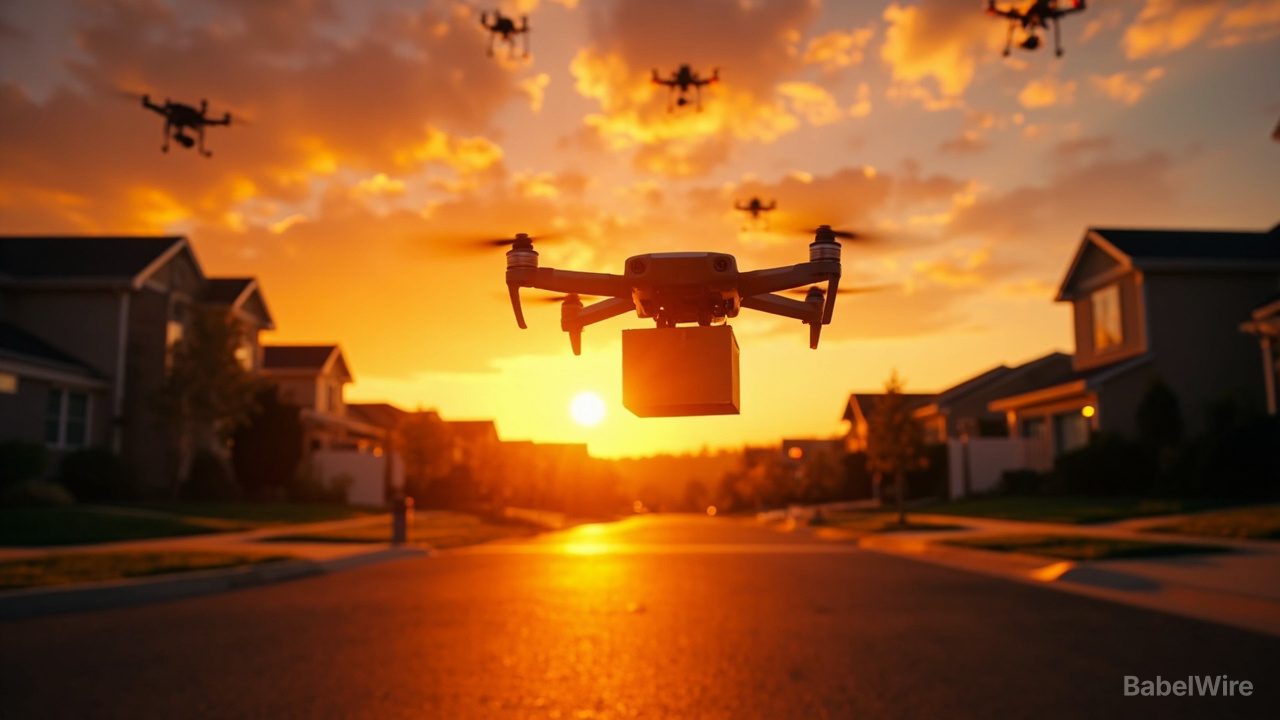
The United States is racing to catch up with China in drone delivery, and the FAA's newly proposed rules could be the catalyst that transforms a modest experiment into a national industry.
The Federal Aviation Administration has proposed regulations that would allow certified drone operators to fly beyond the visual line of sight (BVLOS) without requiring individual waivers — a hurdle that has kept the industry grounded for years.
"We're at a commercial inflection point," said Heather Rivera, chief business officer at Wing, Alphabet's drone division.
The Scale of the Opportunity
Researchers at PwC estimate the US drone market will grow 65% annually through 2034. Globally, drone deliveries are projected to surge from about 13 million this year to more than 800 million by 2034. Per-delivery costs could fall as low as $2.
Currently, the market is small — just a few billion dollars globally. But retail giants are investing heavily:
- Walmart operates drone delivery from 70 stores and aims to reach 270 by end of 2027. It is "inching toward 2 million" drone deliveries, with most coming this year as the program rapidly scales. - Amazon this week opened its 10th US drone delivery network in Baton Rouge, Louisiana, aiming to make Prime Air accessible to 30 million customers by end of 2026. - Alphabet's Wing, whose biggest client is Walmart, recently hired its first chief business officer to forge more commercial links. - Food industry players like Papa John's, Wonder, and DoorDash are building nascent programs through partnerships with waiver-holding drone operators.
Breaking the Visual Line of Sight Barrier
Until now, US federal rules required drones to remain within the operator's visual line of sight, making scaled delivery economically impossible. One operator who ran a Kroger drone pilot in Ohio had to place workers around town just to watch the drones. "It just couldn't scale," she said. Her company, Dexa, eventually received an FAA waiver — but the process took four years.
The new rules would eliminate that requirement for certified operators. "That could catalyze massive, exponential growth of the space over the next few years," said Andreas Raptopoulous, CEO of drone maker Matternet.
Challenges Ahead
Noise and privacy concerns remain, with several communities flagging objections. Current drones also have limited payload capacity — about 3 to 8 pounds at Walmart. Most operators are targeting suburbs, where spacious yards and congested road traffic make aerial delivery attractive.
But the economic logic is compelling. Without the line-of-sight restriction, one controller making $25 an hour can monitor 40 drones simultaneously on a screen — roughly 160 deliveries per hour. That is a fraction of the cost of deploying a fleet of drivers.
Meanwhile, China's "low altitude economy" is forecast to grow to more than 2 trillion yuan ($280 billion) by 2030, with drone deliveries concentrated in cities like Shenzhen and Guangzhou. The race for drone dominance has truly global stakes.