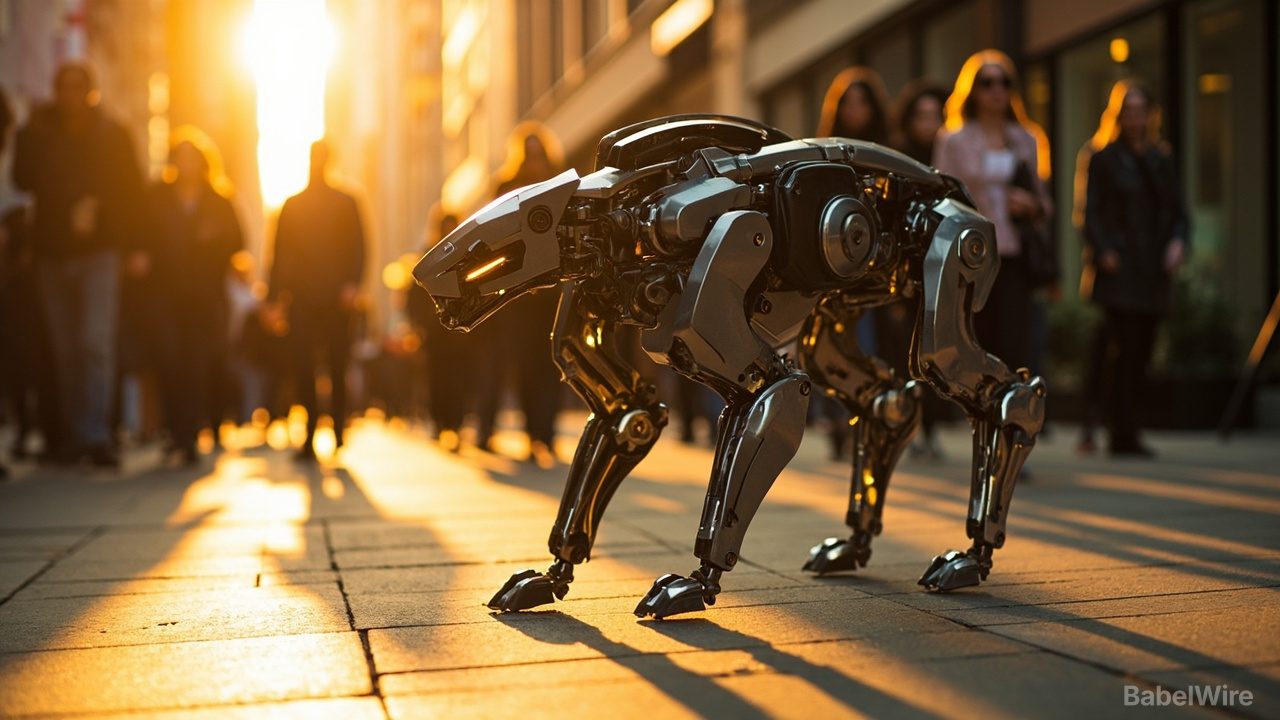
Timothy B. Lee, the technology journalist behind Understanding AI, spent $4,017 on a Unitree Go2 Pro robot dog and walked it two miles to his office near the White House — gaining more attention from strangers than any product he has ever reviewed.
The review, published on Ars Technica, paints a picture of a technology at an inflection point: impressive enough to stop people on the street, but rough enough to collapse on the sidewalk from overheating or battery exhaustion just steps from home. The robot can do handstands, shake hands, and follow voice commands through a phone app — but that same app is buggy, the stair-climbing feature doesn't work well in practice, and the robot sometimes thrashes wildly if powered on with its legs slightly out of position.
What makes the story significant isn't the individual product but the economics behind it. Unitree's Go2 Pro costs roughly 97 percent less than Boston Dynamics' Spot, which starts at around $75,000. The cost reduction comes from engineering tradeoffs: identical motors throughout (reducing part count), lower gear ratios (trading precision for agility and cost savings), and components that wear faster but are cheap to replace.
The review draws a direct parallel to DJI's trajectory in consumer drones. DJI's Phantom 1 shipped in 2013 for $679 with no camera, no gimbal, and ten minutes of flight time — but it was half the cost of build-it-yourself alternatives. By bringing key components in-house and scaling manufacturing, DJI drove costs down further, unlocked new markets, and eventually dominated the global drone market. Lee argues Unitree is following the same playbook for legged robots.
The numbers support the comparison. Unitree's revenue from humanoid robots grew eightfold between 2024 and 2025, from $16 million to $129 million. Humanoids now account for 51 percent of total revenue. The company's August IPO on the Shanghai stock exchange saw shares surge more than fivefold on the first day of trading, with the company still valued at $34 billion.
The piece also raises geopolitical concerns. A bipartisan group in the U.S. House introduced legislation in June to restrict Chinese robot imports, naming Unitree specifically. The FCC imposed broad new regulations on foreign-made robots in July. Lee compares this to the electric vehicle market, where Chinese companies like BYD are banned from the U.S. but making rapid gains globally — warning that restricting Chinese robots could make the U.S. a robotics backwater.