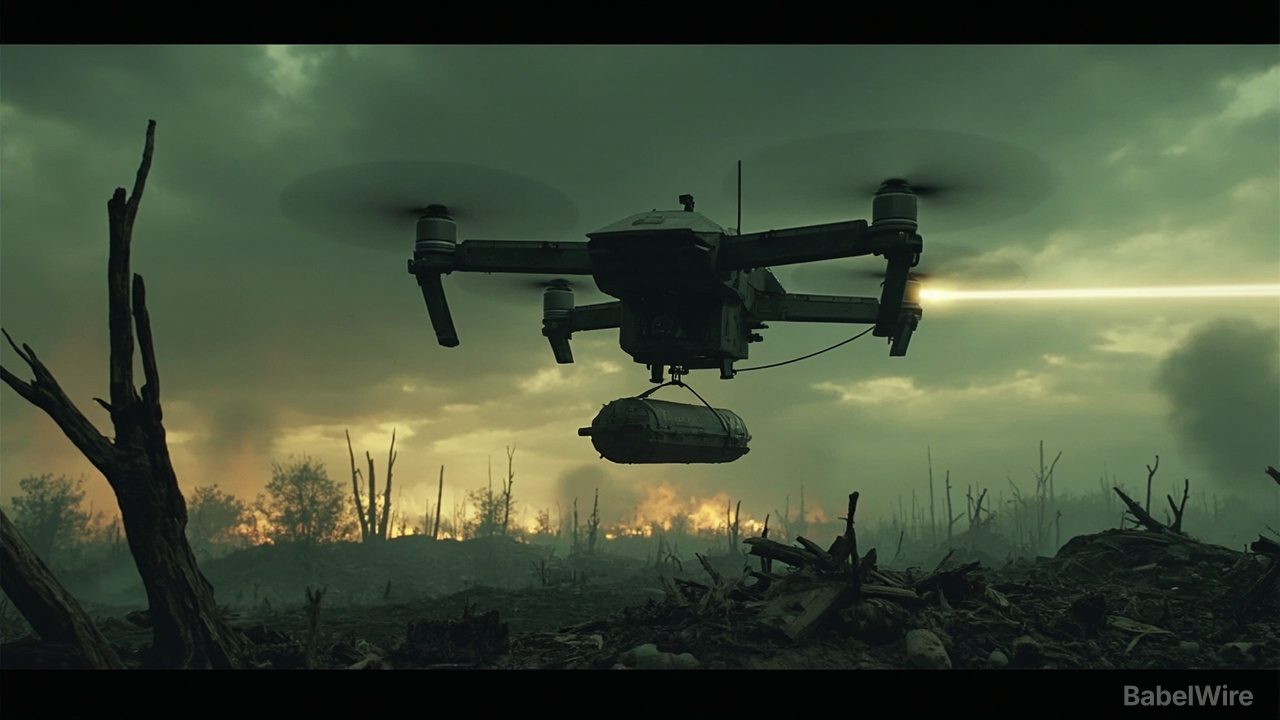
Golem reports that a Ukrainian drone evacuated soldiers from the battlefield — the first time an unmanned aircraft has been used to pull people out of the fighting rather than to strike. The detail that matters is not the airframe. It is that the most dangerous leg of casualty care has been done without putting a crew on the road.
Evacuation is where modern drone war has been quietly lethal. Casualty survival depends heavily on time to treatment, and the vehicles that close that gap — ambulances, armoured evacuators, medics on foot — are large, slow and predictable. On a front line saturated with reconnaissance drones and FPV strike aircraft, a marked evacuation vehicle is a target, and crews have learned to wait, to split loads, to move in the dark. Every one of those compromises adds minutes.
That is why the ground layer moved first. Ukrainian units have fielded unmanned ground vehicles for casualty extraction and logistics, and both sides have pushed robotic resupply into positions too exposed for trucks. Doing the same job from the air removes the last human from the last mile: no driver, no stretcher team, no engine noise on the approach.
The constraints are just as clear as the advantage. Payload is measured in kilograms, which limits how many casualties and how much medical equipment can travel. Range is bounded by battery and by the electronic-warfare environment, where jamming has already forced both sides to shorten drone flights and change frequencies. Landing or hovering under fire to take on a casualty is the most vulnerable moment a drone has, and a wounded soldier is a load that cannot be balanced by software alone.
The questions that will decide how significant this becomes are the unglamorous ones: how many soldiers, in what condition, over what distance, and whether it can be repeated under jamming. A single reported case is a proof of concept, not a capability — but militaries have been waiting for exactly this proof, and the Ukrainian front is where it keeps arriving first. Drone-on-drone naval attacks, autonomous strike aircraft and robotic logistics all crossed from demonstration to routine there within months.
What follows is likely unremarkable and important at once. If aerial extraction works, casualty care stops being a function of how brave a driver is, and starts being a logistics problem with a payload table. That is a smaller claim than "robots are fighting the war". It is also the one that saves people.