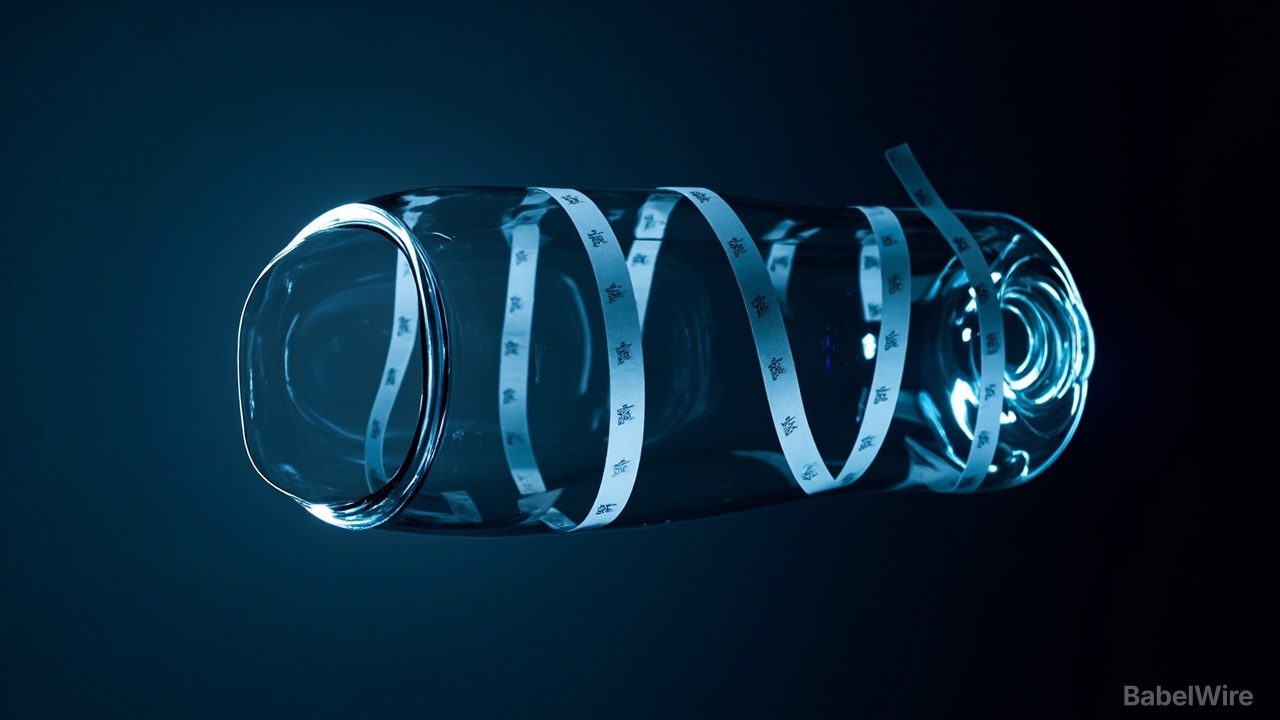
Many molecules come in two forms that are mirror images of each other — like left and right hands. They look nearly identical but can behave dramatically differently, especially in living systems. One version of a drug might be a lifesaving treatment while its mirror twin could be ineffective or even toxic.
Now, researchers from the Tata Institute of Fundamental Research (TIFR), the Indian Institute of Technology Bombay, and the Indian Institute of Technology Hyderabad have developed a remarkably simple way to tell them apart: using twisted laser light.
A Twist on Light
Published in Science Advances, the technique uses ultrashort laser pulses (a few hundred femtoseconds) with carefully controlled "spin and twist" — technically, spin angular momentum and orbital angular momentum. When this structured light strikes a chiral molecule, the interaction changes depending on whether the light's "thread" matches the molecule's natural handedness.
Think of a screw and nut: a right-handed screw fits a right-handed thread but not a left-handed one. The twisted laser beam works the same way, acting as a threaded probe that fits — or doesn't fit — each mirror-image version of a molecule.
Reading the Fragments
The researchers directed the twisted laser pulses at gaseous samples of R- and S-Camphor, a classic chiral molecule. The pulses caused the molecules to break into charged fragments, which were then analyzed with a time-of-flight mass spectrometer — an instrument that identifies ions by measuring how quickly they reach a detector.
The key finding: the number of fragments produced changed according to the combination of the light's twist and the molecule's handedness. Simply counting the fragments was enough to tell the two mirror-image forms apart.
"The results introduce a new way to 'match the threads' between light and matter," the researchers said.
Why It Matters
Conventional methods for detecting molecular chirality often rely on measuring extremely small differences in how molecules absorb light, or tracking the directions in which electrons are emitted. These approaches require complicated equipment, precise alignment, and painstaking angular measurements.
The new technique directly identifies chirality through ion signals — reducing complexity while increasing sensitivity. It works in the gas phase, free from the interference of solvents and surfaces, making it both cleaner and more reliable.
Pharmaceutical Implications
The potential impact on drug development and manufacturing is significant. The thalidomide tragedy of the 1950s and 60s — where one mirror-image version caused severe birth defects while the other was an effective sedative — stands as a stark reminder of why distinguishing chiral molecules matters.
Modern pharmaceuticals increasingly rely on single-enantiomer drugs that require precise chiral analysis during production. The twisted laser technique could provide a faster, cheaper, and more sensitive way to verify that only the desired molecular handedness is present.
"The method could create new opportunities in chemistry, biology, and pharmaceutical science," the team noted, "where selecting the correct enantiomer can be essential."
Beyond the Lab
The approach builds on a growing body of research into structured light — specially shaped laser beams that carry orbital angular momentum. While still in the research phase, the technique's simplicity suggests it could be commercialized for routine laboratory use.
The study, led by researchers at TIFR Hyderabad, was published in the journal Science Advances and represents a notable step toward practical, high-throughput chiral discrimination.