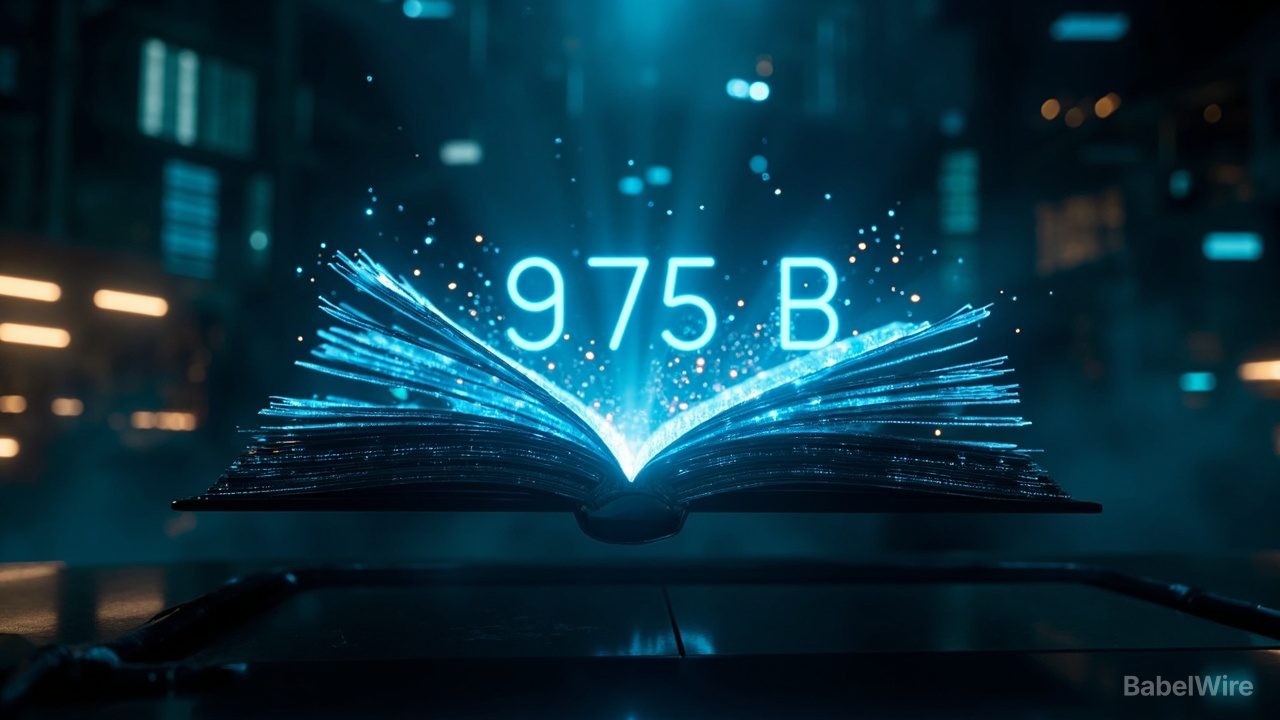
Thinking Machines Lab, the AI startup founded by former OpenAI CTO Mira Murati, released its first model on July 17 — a 975-billion-parameter open-weight system codenamed Inkling. The release marks the largest American open-weights model to date and signals a decisive bet on the open side of AI's biggest divide.
Open Weights, Frontier Scale
Inkling uses a mixture-of-experts (MoE) architecture inspired by DeepSeek-V3, with 256 routed experts and two shared experts. For each token, six experts are active — representing about 41 billion active parameters. The model was trained from scratch on Nvidia GB300 NVL72 systems using 45 trillion tokens across text, images, audio, and video.
The model supports a 1-million-token context window and is distributed under the Apache 2.0 license, allowing commercial modification and fine-tuning. Thinking Machines is also offering access through Tinker, its platform for model customization.
Benchmark Positioning
Thinking Machines claims Inkling matches Nvidia's Nemotron 3 Ultra on Terminal-Bench 2.1 while using roughly one-third as many reasoning tokens — a significant cost advantage. However, the company's own benchmarks show it still trails proprietary systems from OpenAI and Anthropic on general reasoning.
The $2 Billion Seed
Perhaps as remarkable as the model itself is the reported $2 billion seed round — one of the largest in history. Combined with Kimi K3 from Moonshot and DeepSeek V4, Inkling joins a growing wave of open-weight models proving that the open-versus-closed debate in AI has shifted decisively. When the person who ran engineering at OpenAI raises billions to give a model away, the economics of frontier AI are being rewritten.
Infrastructure Requirements
Inkling requires more than 2 terabytes of GPU memory to run at native 16-bit precision (roughly eight Nvidia B300 accelerators). An NVFP4 quantized version runs on about half as many GPUs. Thinking Machines is also previewing Inkling-Small, a 276-billion-parameter MoE model for latency-sensitive workloads.
The model is available on Hugging Face and through partners including TogetherAI, Fireworks, Modal, Databricks, and Baseten.