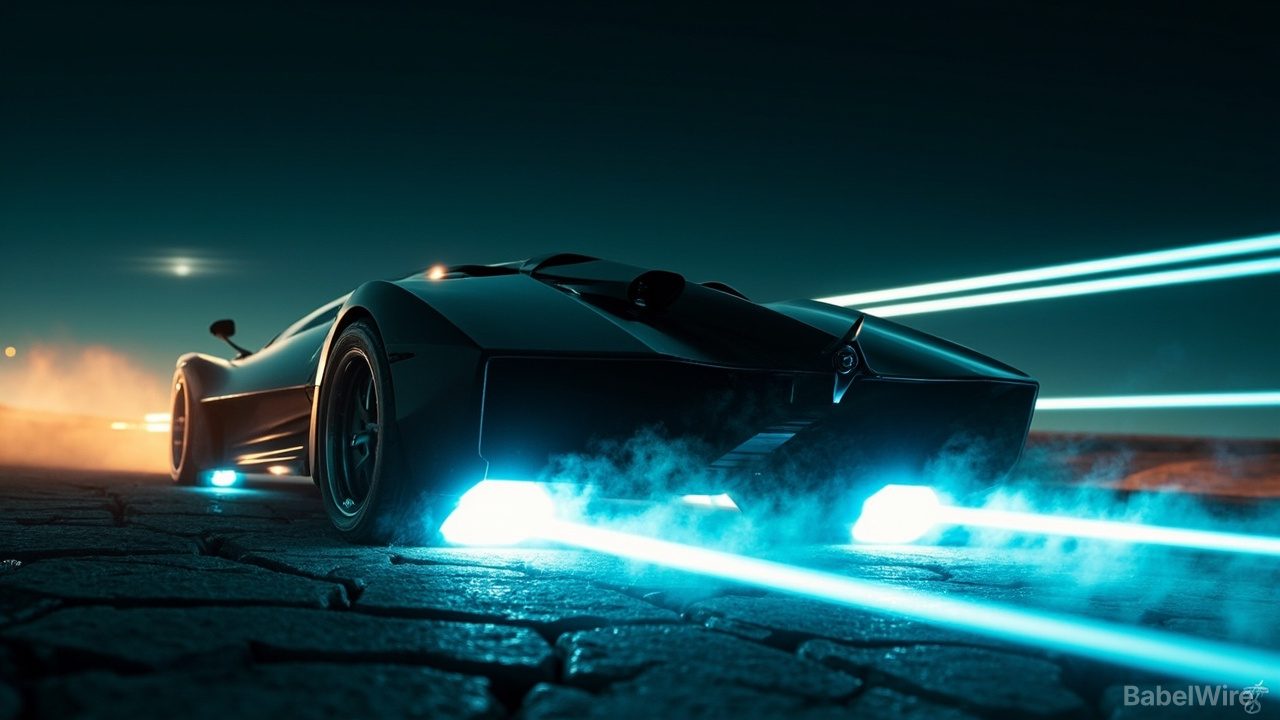
Nine years after Elon Musk first waved a prototype on stage, Tesla has finally shown the second-generation Roadster — and this time the car flew.
The reveal on 15 October was covered as much as a stunt as a product launch. The Verge reports the Roadster flew, drove upside down and hit 60 mph in under a second. Wired's headline is simply: the Roadster 2 is here — and it flies. TechCrunch calls it a "SpaceX-powered" car that "flies and falls with style", while Germany's Golem describes a hyper sports car that can fly.
The common thread across all four accounts is Musk's rocket company. The "SpaceX package" Musk promised in 2017 — an optional set of cold-gas thrusters in place of the rear seats, meant to improve acceleration and braking — appears to have become the car's headline feature rather than an optional extra.
If the sub-second figure holds, the Roadster would be, by a wide margin, the quickest production car ever claimed. It is also a claim that only makes sense with thrusters: no tyre can put that much force on the road.
What the coverage leaves unclear matters just as much. None of the four reports describes sustained flight; TechCrunch's "flies and falls" phrasing, and the very short hover implied by the demonstration, point to a brief manoeuvre rather than an aircraft. Nor is it established when the car will be delivered, what it will cost, or whether any of it is road-legal in any jurisdiction.
The Roadster was first announced in 2017 with a 2020 target and has slipped repeatedly since — including a delay our own coverage tracked in September, when the reveal was pushed from 1 October to 15 October. Tesla's newest party trick is impressive on video. Whether this is a car, a product or a demo is still the open question.
Sources
- theverge.comThe Verge — The Tesla Roadster flew, drove upside down, and hit 60mph in under a second
- techcrunch.comTechCrunch — Tesla reveals SpaceX-powered Roadster that flies and falls with style
- wired.comWired — The Tesla Roadster 2 Is Here—and It Flies
- golem.deGolem — Hypersportwagen: Tesla Roadster kann fliegen