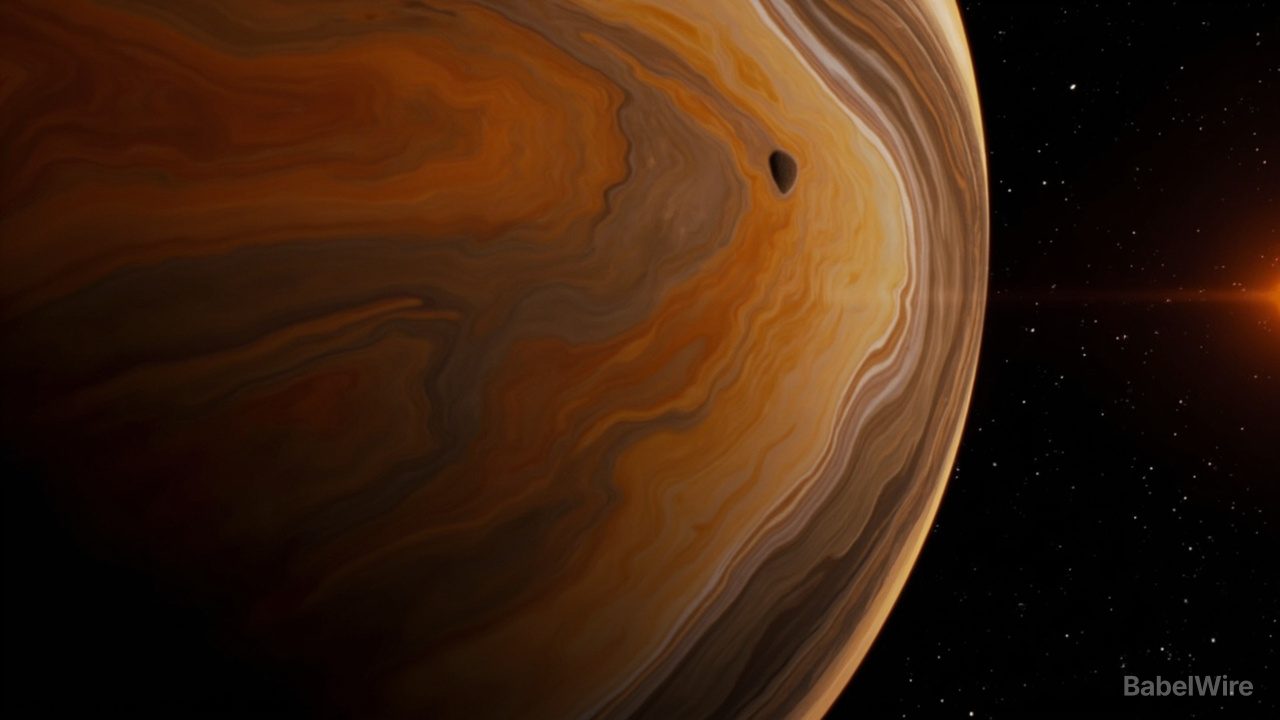
An international team of astronomers led by Queen's University Belfast has announced the discovery of NGTS-38 b, a rare "Super-Jupiter" exoplanet with a 180-day orbit — one of the longest orbital periods ever detected for a transiting exoplanet.
A Half-Year Planet
NGTS-38 b is about 8% larger than Jupiter and nearly five times more massive — placing it firmly in the "Super-Jupiter" category. But what makes the discovery extraordinary is its orbital period: the planet takes 180 days to circle its host star, roughly equivalent to half an Earth year.
"We're very good at finding planets on very short orbits, close to their stars. So, finding one much further out at 180 days is a big deal!" said Toby Rodel, the PhD student at Queen's who led the discovery under the supervision of Professor Christopher Watson.
Years of Detection Work
The journey began on Christmas Day 2020, when NASA's Transiting Exoplanet Survey Satellite (TESS) detected a single transit — a tiny dip in a star's brightness caused by a planet passing in front of it. One transit alone is not enough to confirm a planet, so the team turned to the Next Generation Transit Survey (NGTS) in Chile.
For over 200 nights, they watched and waited. Finally, they caught the last moments of a second transit. By measuring tiny gravitational wobbles in the star's light spectrum, they confirmed the planet's mass and locked in the 180-day orbit.
An Unusual Path
Unlike most planets in our solar system, which follow nearly circular orbits, NGTS-38 b follows an oval-shaped (eccentric) trajectory. At its closest approach, it lies only slightly further from its star than Mercury is from the Sun. At its most distant, it is almost as far away as Earth is from the Sun.
Because its host star is larger and hotter than our Sun, the planet is hotter than Earth despite the comparable orbital distance. But it is still much cooler than most exoplanets that astronomers can study in detail — making it a valuable laboratory for understanding planetary atmospheres at intermediate temperatures.
Could It Have Moons?
"Because the planet is so massive, it has a really strong gravitational pull and is far enough away from its star that it might be able to hold on to moons or rings," Rodel noted. "That's really exciting as we've never found moons or rings around any planet outside our solar system."
Independent Confirmation
In a rare scientific coincidence, a separate team led by Felipe Rojas and Dr. Rafael Brahm from Universidad Adolfo Ibáñez in Santiago, Chile, independently discovered the same system and released their own paper. Their results corroborated the findings of the Queen's-led team.
"This planet stands out among the transiting exoplanets known to date, with a mass of 4.5 Jupiters, a half-year orbit, and a mild eccentricity," said Rojas. "Worlds like this have barely been explored, and their properties preserve the fingerprints of their formation."
Why It Matters
The discovery has been published in the Monthly Notices of the Royal Astronomical Society. It demonstrates how detection techniques are steadily improving to find planets at wider, longer orbits — a crucial step toward the ultimate goal of finding an Earth-like world.
"Pushing the capability of detecting planets at longer orbital periods is essential if we wish to find another planet like the Earth," said Professor Watson. "This planet is nothing like the Earth, of course, but demonstrates how the game has moved on remarkably over the last two decades."
Fun Facts
- The planet was first detected on Christmas Day 2020 but took over five years to confirm - At 4.5 Jupiter masses, its gravity is powerful enough to potentially capture and retain exomoons - The 180-day orbit means its "year" lasts exactly half an Earth year — two of its years equal one of ours