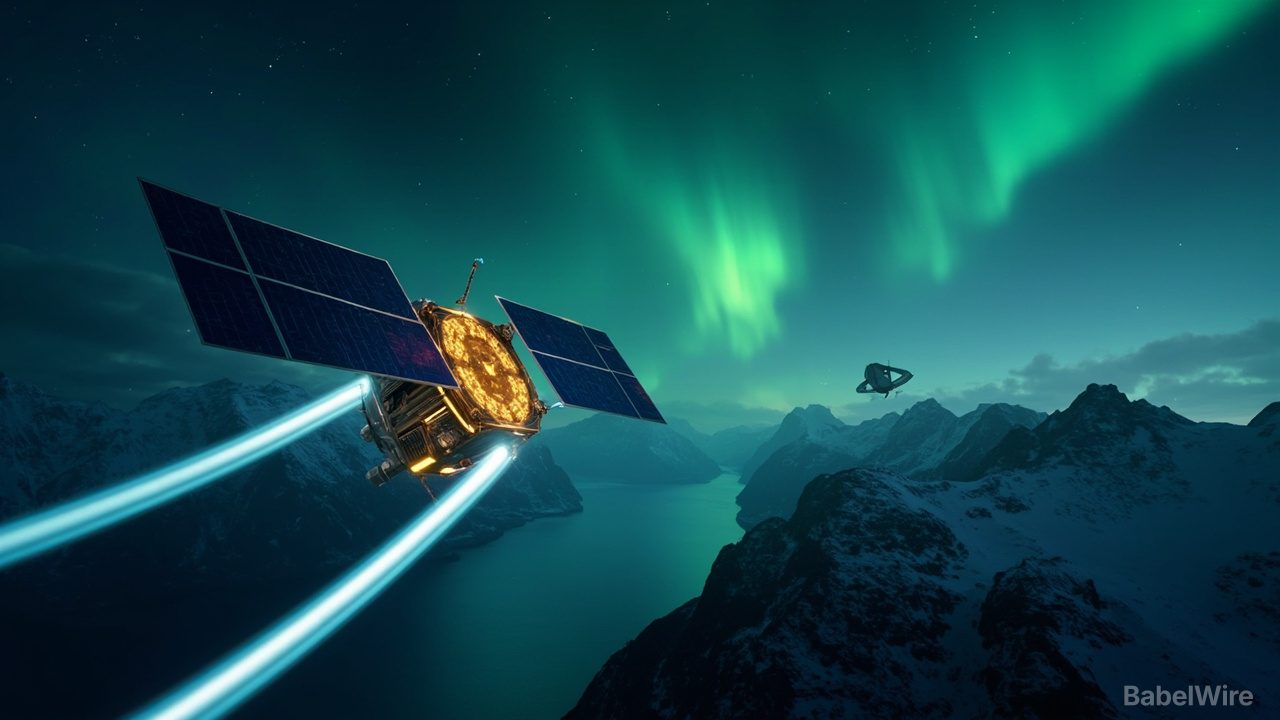
Google's Project Suncatcher — the company's long-running bet that some AI compute belongs in orbit — has passed its first real milestone: a data-center-class TPU has run a model in space and sent an answer back.
The prototype satellite launched on October 1. In the weeks since, the team completed commissioning checks, powered up the host and TPU trays, and ran initial machine-learning tests. This week, during a pass over the ground station at Svalbard, Norway, it sent a prompt to an onboard Gemma 4 open model asking for a haiku about being in space. The reply that came down:
> Blue marble below > Data streams in silent grace > Starlight feeds my core.
Google calls it a "Hello World" moment — the first inference from a data-center-class TPU in orbit. The team then ran space-themed limericks and, more usefully, prompts asking the payload to report on its own technical status, which is the sort of thing you actually want an orbiting computer to be able to do.
The point is not poetry. Google's thesis is that AI demand will eventually outrun what terrestrial power grids and cooling can supply, and that launch economics are falling fast enough to make solar-powered inference in space plausible within a decade. Under the concept, compact constellations of satellites would each carry TPUs, generate power from sunlight, and link to one another with free-space optical communications.
The prototype itself is modest: it carries four TPUs and generates up to about 1 kW from its solar panels, according to details shared about the mission. That is a laboratory bench in orbit, not a data center.
The hard engineering is ahead. The next tests will examine how the chips behave under thermal stress and radiation in orbit — the two problems that have historically kept general-purpose computing on the ground. Heat is the awkward one for space computing: in vacuum there is no air to carry it away, so radiators must do the work, and a satellite covered in radiators has less room for solar panels. Radiation is the other: commercial chips are not rad-hardened, and single-event upsets are ordinary events in low Earth orbit.
Surviving those tests would unlock the next milestone: two interconnected satellites in 2027. Linking two orbiting accelerators optically is the difference between a stunt and an architecture — a single satellite is a curiosity, a mesh is a substitute for a region of a data center.
Google is describing all of this as a long road, and it is. Nothing here competes with terrestrial capacity on cost today; the claim is about the trajectory of launch prices and the ceiling of ground-based power. Both are bets, not facts.
What the test does establish is narrower and worth saying plainly: the chips people build for AI workloads turn out to work in orbit, and a prompt can leave the ground, be answered above the atmosphere, and come back. The coming years of this project are about whether the answer also makes financial sense.
What to watch: results from the thermal and radiation campaigns, whether the 2027 two-satellite demonstration keeps its date, and any launch-price assumptions Google publishes — because the entire case rests on them.