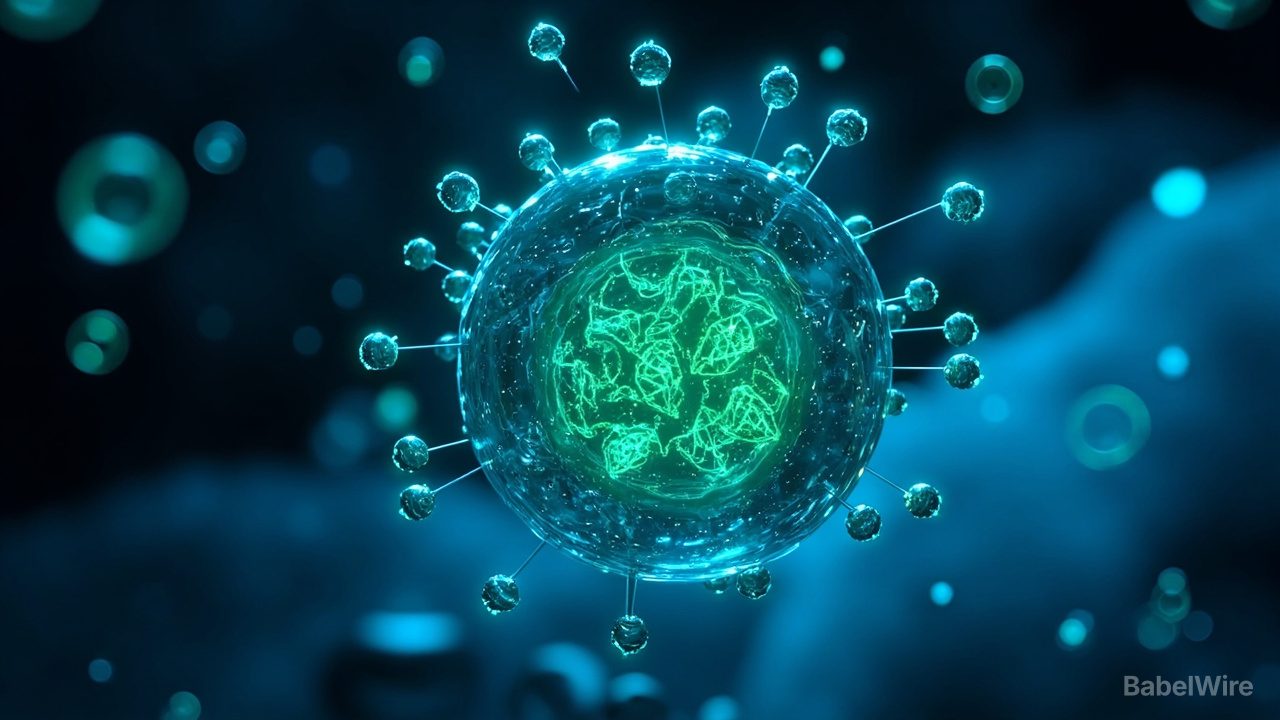
What Is SpudCell?
SpudCell is a microscopic water droplet surrounded by a fatty membrane (liposome), stuffed with chemicals and snippets of DNA encoding just 36 genes — 50 times smaller than a typical bacterium's genome. Created by Kate Adamala's team at the University of Minnesota, it is arguably the closest researchers have ever come to building a living cell from scratch.
How It Works
The SpudCell uses the PURE system — a basic kit of biomolecules needed to transcribe DNA into RNA and translate RNA into proteins. Its small genome produces molecular tags on the droplet's surface that act as attachment points for "feeder vesicles" — smaller liposomes containing nutrients. These "meals" enable SpudCell to grow and replicate its genome. A second mechanism uses FLAG surface tags that bind to streptavidin, generating enough repulsive force to split the droplet into two daughter cells.
Evolutionary Potential
In one experiment, Adamala inserted a genetic mutation that caused SpudCells to produce more surface tags, ingest more food, and grow faster. After five rounds of growth and division, about 60% of the genomes carried the mutation — the mutated SpudCells outcompeted the non-mutated versions. While not Darwinian evolution (the mutation was inserted, and division required mechanical help), it demonstrates the path toward truly evolving synthetic cells.
The 'Wright Brothers Moment'
Stanford synthetic biologist Drew Endy called it "a catalyzing moment" — akin to the Wright brothers' first plane. "It proves that by putting four or five different things together from disparate academic accomplishments, you can just barely get this thing growing and dividing." Endy has co-founded a public-benefit research institution called Biotic with seed funding of roughly $10 million, aiming to coordinate disparate research groups and accelerate the work.
What SpudCell Cannot Do Yet
SpudCell cannot divide over many generations — the process is inefficient, with only 30% of cells carrying the full genome after five divisions. The ribosome machinery degrades over time with no way to replace it. And while it shows selection, it is not yet capable of natural Darwinian evolution. Peers emphasize it remains "still far from a living cell."
Sources: Science.org (AAAS); The Economist; The New York Times; CNN.
Sources
- science.orgScience — Lab-created 'SpudCell' marks 'stunning' step toward building life from scratch
- economist.comThe Economist — Scientists take another step towards lab-made life
- nytimes.comThe New York Times — This Cell Feeds, Grows and Reproduces. And It's Manmade.
- cnn.comCNN — Scientists say they have built a cell from scratch for the first time