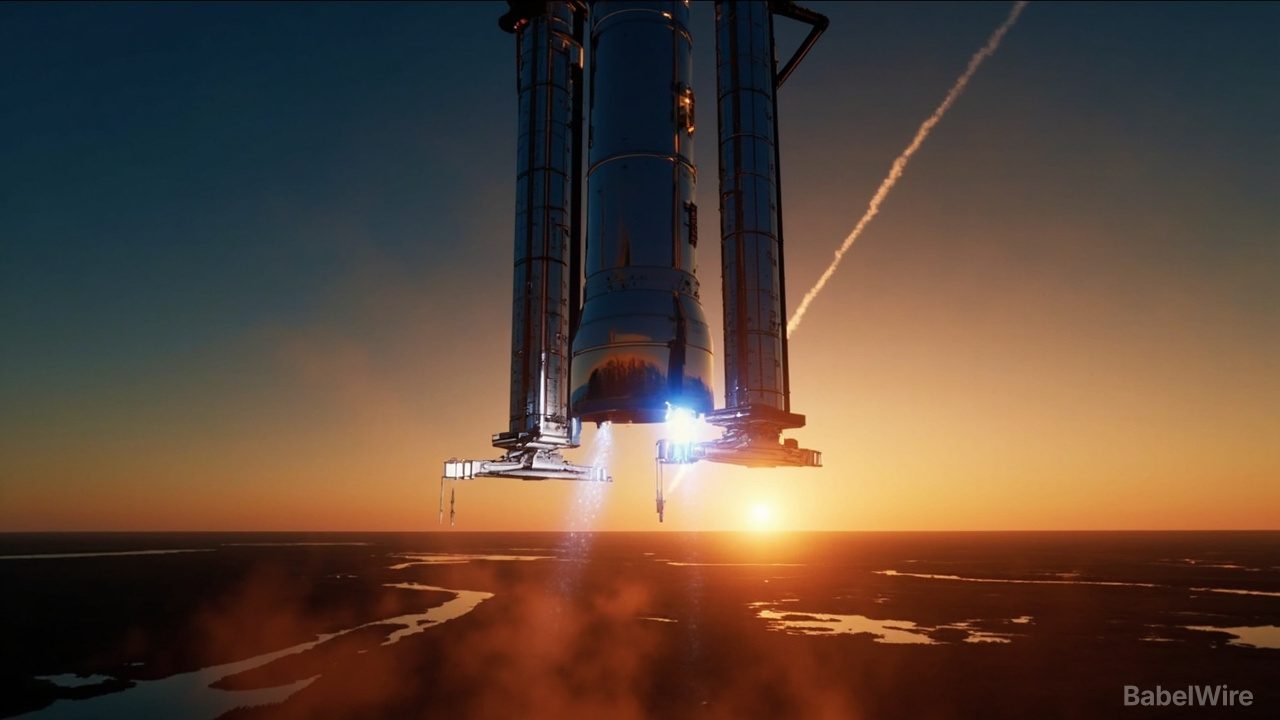
SpaceX caught the upper stage of its Starship rocket out of the air on Saturday, 14 November, completing the first-ever recovery of an orbital-class spacecraft at the launch site it left from.
The ship had spent roughly 22 hours and 32 minutes in space — 14 full orbits since lifting off from Starbase, Texas, on Friday evening — when it re-entered the atmosphere, descended to the tower on a single engine and was seized by the launch tower's two mechanical 'chopstick' arms at about 4:20 p.m. EST (21:20 GMT). The catch worked on the first attempt.
It was the 15th test flight of the vehicle. Along the way the mission deployed 26 next-generation Starlink V3 satellites, the heavier spacecraft the giant rocket was built to carry.
The flight was not flawless, however. SpaceX had also planned to catch the 72-metre Super Heavy booster a few minutes after liftoff, but called the attempt off. The booster was instead destroyed by its flight-termination system over the Gulf of Mexico. SpaceX has offered a preliminary explanation — an alarm over insufficient propellant mass — and says the exact cause is still under investigation. Had both stages been recovered, the company would have returned a complete rocket system from an orbital flight intact for the first time.
Even partial success is a significant milestone for a vehicle central to SpaceX's plans. Starship is the lander NASA has contracted to carry astronauts to the Moon, and it is also the only rocket able to loft the larger Starlink V3 satellites on which the company's satellite-internet business depends. Elon Musk has promised Mars flights as well, and SpaceX has floated the idea of placing vast constellations of AI-hardware satellites acting as data centres in orbit — though the feasibility of that plan has drawn scepticism from independent analysts.
Starship's test campaign has been erratic. A first full-stack launch in April 2023 lasted minutes before breaking up; the second flight six months later exploded again after a clean liftoff. Four flights followed in 2024, three of them successful, before a string of explosions in 2025 gave way to two clean tests. Flight 15 was the fourth launch of this year.
With the upper stage now recoverable, the focus returns to the booster: SpaceX must show it can catch both halves of the stack on the same flight before Starship can approach the rapid-reuse cadence the company has promised.