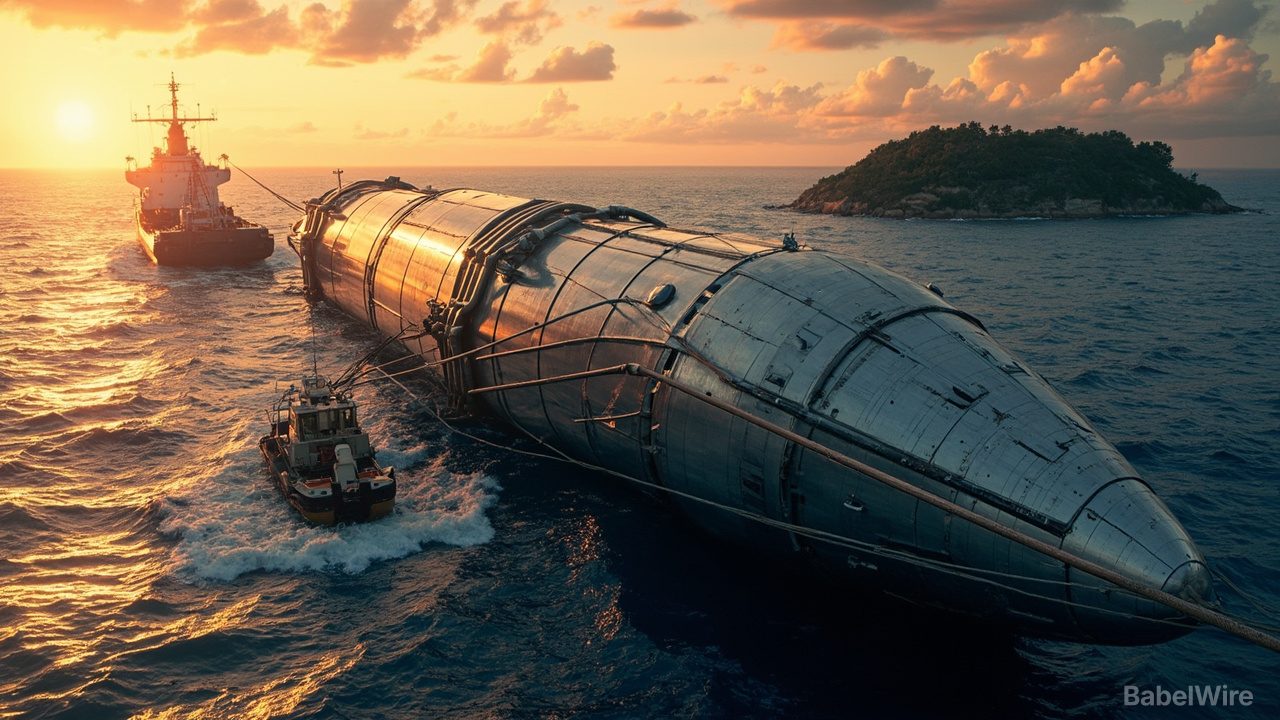
SpaceX has pulled off its biggest salvage operation yet, recovering the Starship upper stage known as Ship 40 from the Indian Ocean after it splashed down intact on July 24, 2026. The splashdown marked the first time a Starship upper stage has survived contact with the ocean, surprising even SpaceX engineers who expected the vehicle to disintegrate after tipping over, as previous Starships had done.
The 52-meter, 9-meter-diameter spacecraft was towed engine-first several hundred miles across the Indian Ocean to Christmas Island, an Australian territory, arriving on August 18 after a 24-day journey. SpaceX kept the vehicle afloat in rough seas using air-filled Yokohama fenders. At one point during the operation, CEO Elon Musk said recovery was not looking good, but the team persevered.
Ship 40 is now being transported over 10,000 miles back to Starbase, SpaceX's Starship development site in South Texas. The vehicle is too large to fit into any aircraft, so it must travel entirely by sea. A team of SpaceX engineers is conducting additional analysis on the vehicle in calmer waters before the return journey.
The recovery is significant because inspecting actual hardware after returning from space provides data that no amount of onboard sensors can match. SpaceX routinely recovers and reuses Falcon 9 boosters, but the Starship's heat shield, made of approximately 18,000 ceramic tiles, remains the most pressing unsolved problem for full reusability.
Musk declared the heat shield problem solved during SpaceX's first quarterly earnings call on August 4, but industry experts remain skeptical. The recovered tiles will undergo laboratory testing and may fly on future Starship missions to validate their durability for the high flight rate SpaceX envisions for Moon and Mars missions.
This particular Starship will not be reused due to salt water corrosion and damage sustained during the tip-over after splashdown. However, the data from inspecting the actual heat shield tiles, engines, and stainless steel structure after atmospheric reentry is invaluable for SpaceX's goal of making Starship fully and rapidly reusable. The company ultimately plans to catch returning Starships directly at the launch site using mechanical arms on the launch tower.
Sources
- arstechnica.comAgainst all odds, SpaceX finally tugs Starship into port after 24 days at sea - Ars Technica
- sun-sentinel.comSpaceX recovers Starship from Indian Ocean to ship it back to Texas
- phys.orgSpaceX recovers Starship from the Indian Ocean a month after launch - Phys.org
- scitechpulse.comSpaceX Loads Starship's Recovered Upper Stage Onto Ship - SciTechPulse