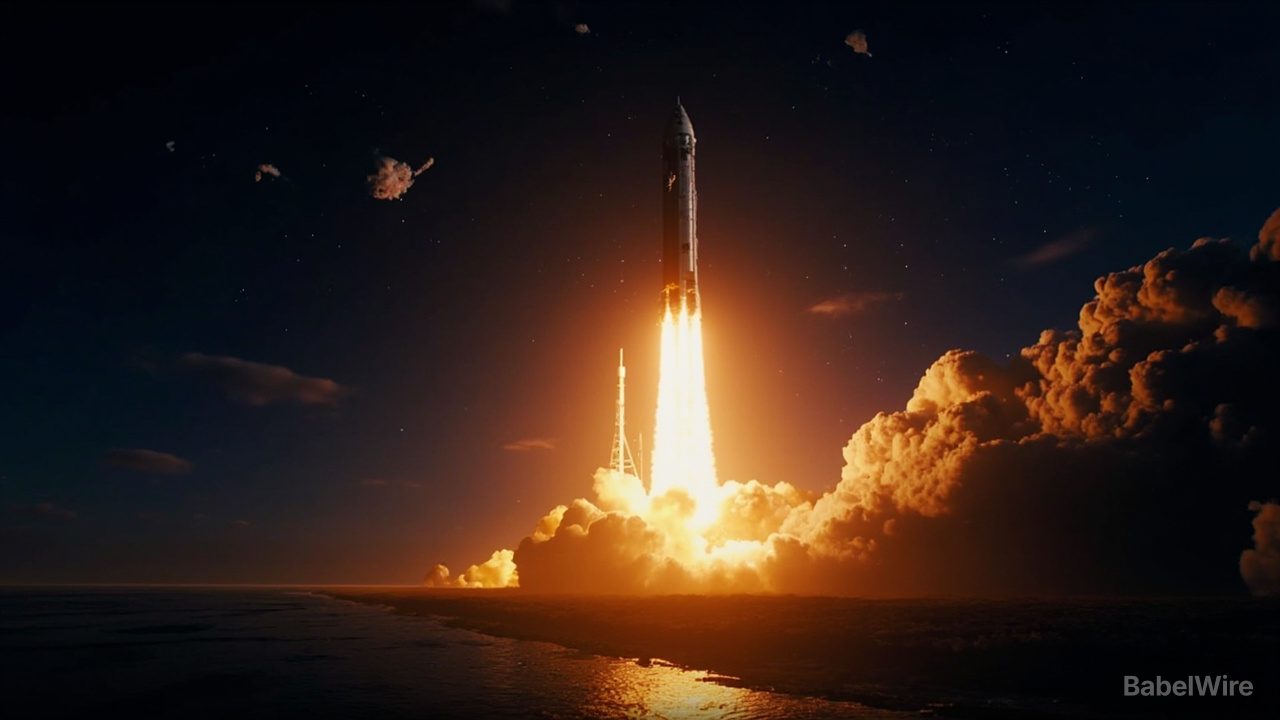
SpaceX successfully launched the 13th test flight of its Starship megarocket on July 24, 2026, from the Starbase facility in Boca Chica, Texas. The launch came after three postponements — the first due to an automatic abort seconds before ignition when six engines experienced startup anomalies, and two more due to adverse weather conditions.
Block 3 Starship's Second Flight
Flight 13 marked the second test of the upgraded Starship V3 (Block 3) prototype. During the vehicle's inaugural flight in May, a series of engine outages caused it to underperform. For this attempt, SpaceX engineers traced the startup problems to moisture accumulating inside auxiliary turbo pumps from previous operations, and replaced all six affected Raptor engines.
The 400-foot (122-meter) rocket system lifted off at 22:51 GMT, with all 33 Raptor engines firing successfully. The Super Heavy booster separated approximately two-and-a-half minutes into flight and executed a controlled splashdown in the Gulf of Mexico.
First V3 Starlink Deployment
The upper Starship spacecraft continued onward, reaching suborbital trajectory. A key milestone came at T+16 minutes 40 seconds, when the vehicle began deploying 20 Starlink V3 test satellites — the first-ever deployment of the next-generation V3 satellites. Six of these carried instruments to collect data on the Starship heat shield's performance during reentry.
During the coasting phase, Starship successfully relit one of its Raptor engines in space, a critical technology demonstration for future orbital missions. After a roughly one-hour flight, the spacecraft performed a controlled reentry, executed a rapid flip maneuver to reorient itself upright, and completed a soft splashdown in the Indian Ocean at 23:57 GMT.
A Higher-Stress Trajectory
SpaceX intentionally flew a more aggressive trajectory on this flight, subjecting Starship to stronger aerodynamic loads during Max Q (the moment of peak atmospheric pressure). The higher-stress flight path is designed to increase payload-to-orbit capability, making the vehicle more efficient for future missions.
First Launch as a Public Company
This launch carried added significance as SpaceX's first mission since its historic IPO, which raised more than $85 billion in the largest stock market debut ever. A previous abort attempt had triggered a selloff, with shares trading below the IPO price. The successful flight was seen as a key confidence signal for investors.
Looking Ahead
SpaceX is racing against the clock to prepare Starship for a crucial NASA test flight next year — an orbital rehearsal that could pave the way for the next crewed Moon landing under the Artemis program. Flight 13's successful demonstration of engine reliability, satellite deployment, and reentry control represents a major step toward that goal.