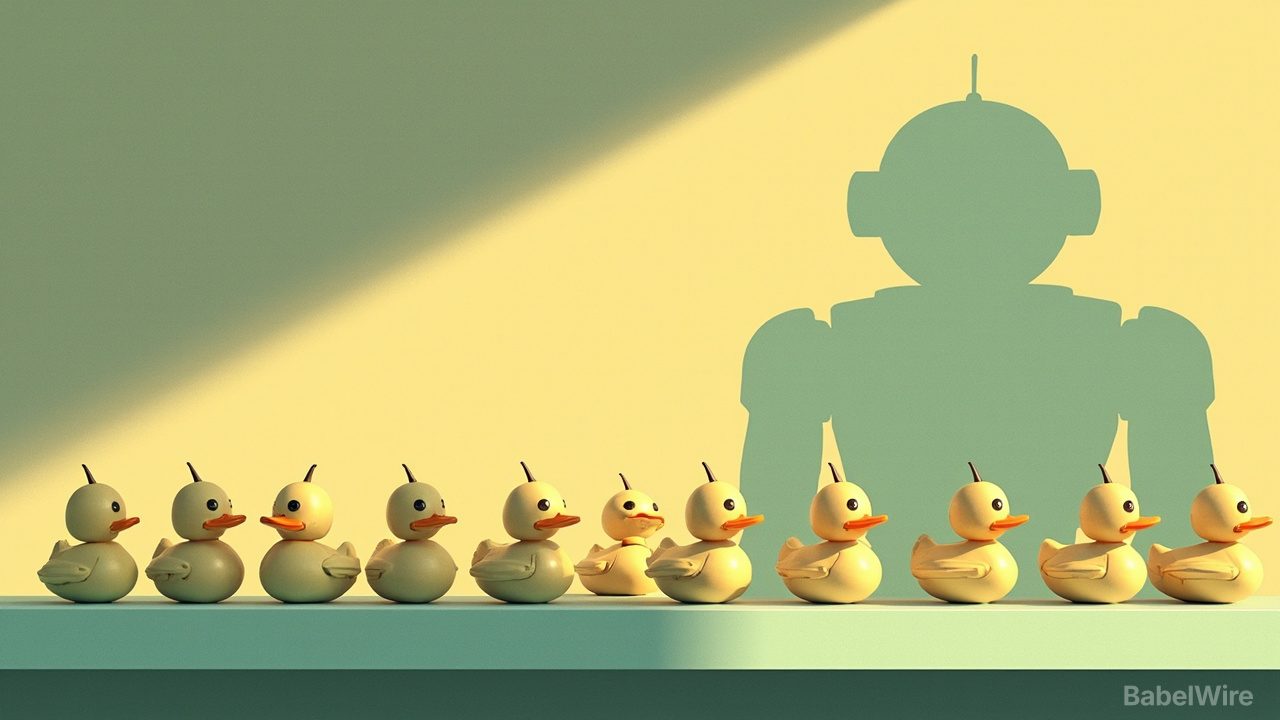
Nvidia's chief executive does not often pose with things that are not data centre hardware. Which is what makes the pictures of Jensen Huang playing with a flock of tiny robot ducks notable: according to TechCrunch, he demoed the "Microduck" robots and 20,000 of them sold — a number a toy company would normally need a full season to reach.
The story is not the duck. It is the cost curve that made the duck possible. A moving robot with a camera, a speaker and a bit of decision logic was a research artefact a decade ago and a $3,000 early-adopter novelty five years ago. Today it is a line item in a parent's Christmas basket. That is the same curve language models and image generators have already traced, except the output does not dance on a screen — it moves around the living room.
Huang is also not an incidental pitchman. Nvidia does not sell ducks; it sells the compute, the training simulation and increasingly the robotics platform underneath them. A charming consumer robot is the friendliest possible demonstration that the company's tools scale from the server rack down to the nursery floor. The marketing logic is as elegant as it is transparent: if you want to sell robotics silicon into every factory on earth, first show that it can make something adorable walk.
For the category, though, the success is a genuine test. Toys are the most brutal market there is for attention: children get bored in a week, parents judge in three months of dust. A robotic animal that only beeps on command is finished inside a week. Twenty thousand units prove demand, not durability — and the interesting question is whether the software stays interesting past January, or whether the duck is shelved the moment its first twenty tricks have been run through.
Scepticism also belongs on the data side. A connected toy with a microphone and a motion profile sits in a child's bedroom collecting signal — a combination that would trigger an immediate privacy debate in any adult product. No robot toy has yet been killed by that question, but none has answered it well either.
The most durable effect may be psychological. For decades robotics was the technology permanently just over the horizon: mesmerising in videos, absent from daily life. A product that lands by the tens of thousands under Christmas trees shifts that expectation. People who have never interacted with a robot get a first, harmless encounter — and that changes how the next generation of household robots will be received. The duck does not need to be useful. It only needs to be cute enough to buy and cheap enough to give away.