A Shield for the Planet
A team of researchers has proposed an audacious plan to protect Earth from the most dangerous natural disaster that modern civilization could face: a Carrington-class solar superstorm. The concept involves launching a giant magnetic 'airbag' — a large-aperture magnetically deployable shield — and positioning it at the Sun-Earth L1 Lagrange point, a gravitationally stable location about 1.5 million kilometers from Earth.
Experts who reviewed the proposal say it is 'quite feasible' with current or near-term technology.
The Threat
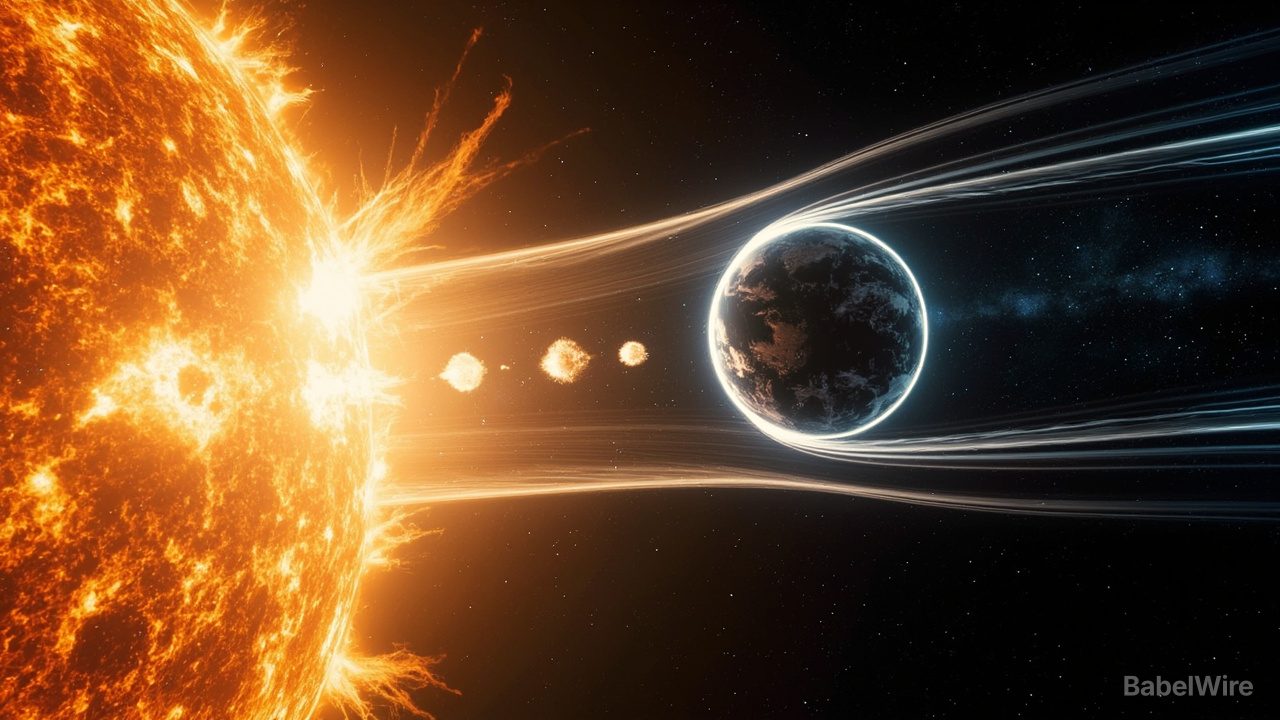
The sun regularly launches coronal mass ejections (CMEs) — massive bursts of magnetized plasma traveling at millions of kilometers per hour. A direct hit from a Carrington-class event — named after the 1859 solar storm that set telegraph wires on fire — could collapse power grids, disable satellites, ground aviation, and knock out communications networks worldwide.
Modern risk assessments estimate the economic cost of a severe solar storm at $1-2 trillion in the first year alone, with recovery taking years. The power grid is the most vulnerable: geomagnetically induced currents can destroy high-voltage transformers that take months or years to replace.
How the Airbag Works
The shield would generate a magnetic field that deflects charged solar particles before they reach Earth's magnetosphere. Positioned at L1 — the same location where NASA's DSCOVR satellite monitors solar wind — the shield would intercept CMEs roughly 30-60 minutes before they would otherwise hit Earth, providing critical warning time and reducing the impact.
The 'airbag' design is inspired by the magnetospheres that naturally protect Earth and other planets. Rather than trying to stop all solar particles, the artificial magnetic shield would create a sufficiently large deflection zone to push the worst of the CME's energy harmlessly past Earth.
Feasibility and Timeline
The researchers estimate that a demonstration-scale shield could be deployed within 10-15 years at a cost comparable to a major space science mission — in the range of $5-10 billion. Full operational deployment would likely cost more but remain a fraction of the economic damage a single superstorm would cause.
'This is not science fiction,' one researcher emphasized. 'The physics is well understood, the technology is largely available, and the benefits far outweigh the costs. The question is whether we treat solar storm protection as an insurance policy worth investing in before the big one hits — not after.'
Context: The July 4 Solar Activity
The proposal takes on added urgency given recent solar activity. Over the July 4 weekend, the sun launched 10 M-class solar flares within 24 hours — earning the nickname 'machine-gun sun' — and auroras were visible across more than a dozen US states. While none of these flares were Carrington-class events, they serve as reminders that the sun is approaching the peak of its 11-year activity cycle, increasing the probability of a major event.