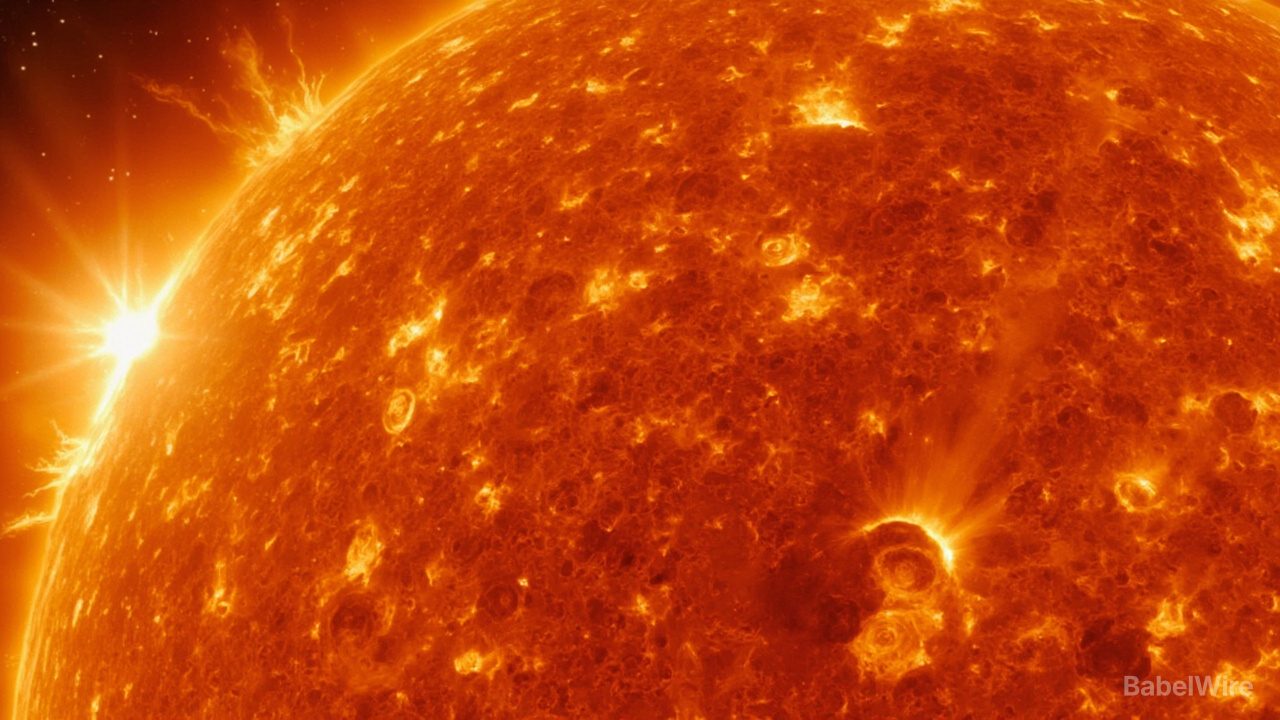
Using the Daniel K. Inouye Solar Telescope in Hawaii, astronomers have captured the highest-resolution images ever taken of the Sun's visible surface — and spotted something no one had seen there before: tiny, whirlpool-like vortices of plasma only about 20 kilometers (12 miles) across.
The structures are the signature of the Kelvin–Helmholtz instability, a phenomenon that occurs when two layers of fluid slide past each other at different speeds, creating ripples that curl into wave-like vortices — much like breaking ocean waves. Although this instability had been observed on Earth, in planetary atmospheres, and in the Sun's corona, it had never been confirmed in the Sun's visible surface layer, the photosphere.
Reporting this week in Nature, the team led by astronomers at the National Solar Observatory says these minuscule vortices may act as hidden engines that twist and tangle the Sun's magnetic field lines. As the stressed fields snap, they could release the energy behind solar flares, coronal mass ejections and other eruptions — and help explain one of solar physics' oldest puzzles: why the Sun's outer atmosphere, the corona, is millions of degrees hotter than the surface below it.
The findings could also resolve a separate mystery. The Sun's magnetic cycle lasts just 11 years, which means the magnetic flux generated by its internal dynamo must dissipate remarkably quickly; existing models struggle to explain that. The newly discovered vortices, the researchers argue, could be a key source of this 'missing' magnetic diffusion.
'It is very exciting to see that the highest-resolution observations of the solar photosphere revealed a new dynamical regime,' said Dr. Matthias Rempel of the High Altitude Observatory. The team adds that the observations also provide the most stringent validation yet of computer simulations of the Sun's magnetized plasma.
Sources
- sci.newsSci.News: Inouye Solar Telescope Discovers Hidden Plasma Vortices on Sun
- sciencedaily.comScienceDaily: The sun is covered in tiny whirlpools we've never seen before
- mpg.deMax Planck Society: Tiny Vortices Discovered on the Sun's Surface
- doi.orgNature (Kuridze et al.): Ubiquitous Kelvin-Helmholtz instabilities driving plasma mixing on the Sun