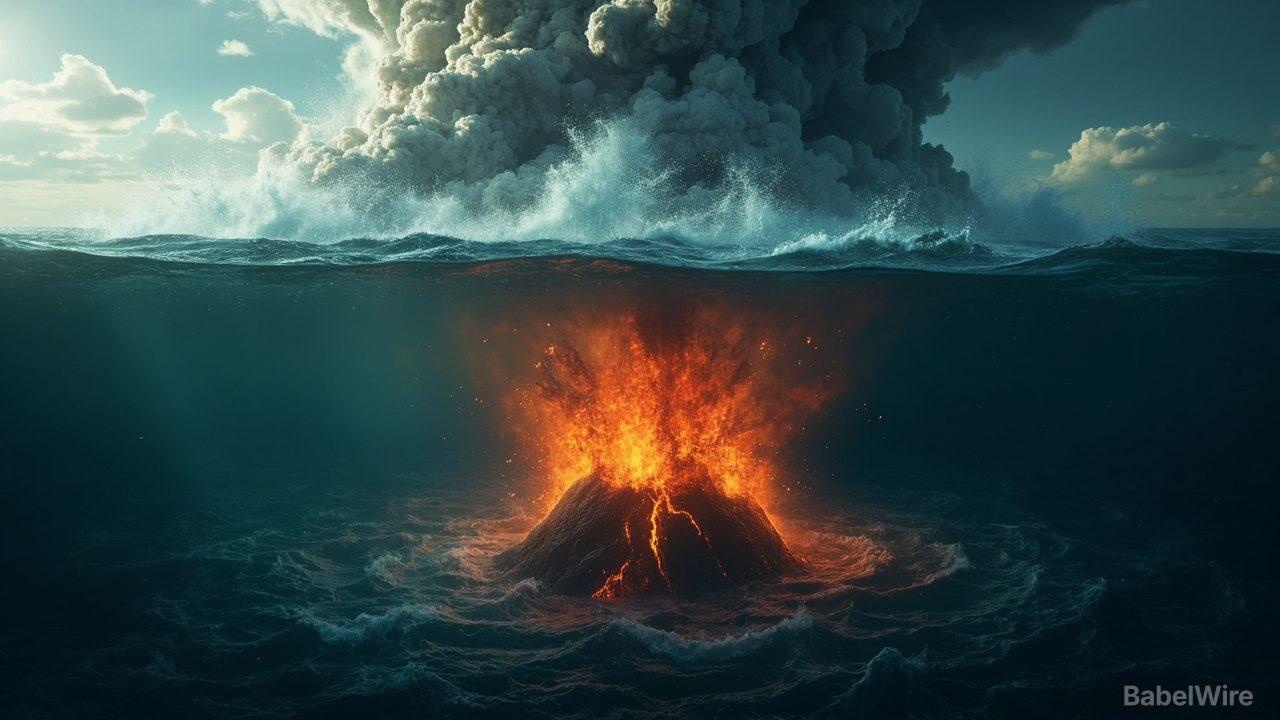
The most dangerous volcanoes on Earth are the ones nobody can see. Most of the planet's volcanism happens underwater, along mid-ocean ridges and on seamounts that rarely break the surface, and the tsunami they can generate is one of the hardest hazards to forecast. New research reported by Ars Technica suggests the physics are even less reassuring than assumed: relatively small submarine volcanoes can drive disproportionately large tsunamis, meaning the size of the eruption is a poor guide to the size of the wave.
The reason is that a tsunami is not simply a function of how much magma erupts. When a shallow underwater volcano blows, several mechanisms can displace water at once. Pyroclastic flows — dense, fast-moving clouds of hot gas and rock — can pour into the sea and shove a wall of water ahead of them. The sudden collapse of a caldera can drop the seafloor and pull the ocean down with it. And the flanks of volcanic islands and seamounts can fail, sending landslides into the deep that push water outward in all directions. In shallow water, these effects couple far more efficiently to the surface than they do at depth, which is why a modest vent near the surface can outperform a much larger eruption in the abyss.
The 2022 Hunga Tonga–Hunga Ha'apai eruption was a brutal demonstration. The blast sent a shockwave around the globe and produced a tsunami felt from the Pacific to the Atlantic, driven in part by mechanisms that classic tsunami models — built mostly around earthquakes — did not anticipate. That event pushed researchers to look harder at volcanogenic tsunamis as a distinct class of hazard, and at how many potentially dangerous shallow volcanoes are poorly mapped or not monitored at all.
The practical problem is the map itself. Most of the seafloor remains unmapped at high resolution, and recent global surveys have added thousands of previously unknown seamounts, underlining how much of this volcanic landscape is still a blank. Better bathymetry, more seismic and hydroacoustic monitoring, and faster detection of eruptions are the tools that would turn a warning into something that reaches coastlines in time. Until then, the lesson from the new work is uncomfortable: for the volcanoes that pose the greatest risk, smaller does not mean safer.