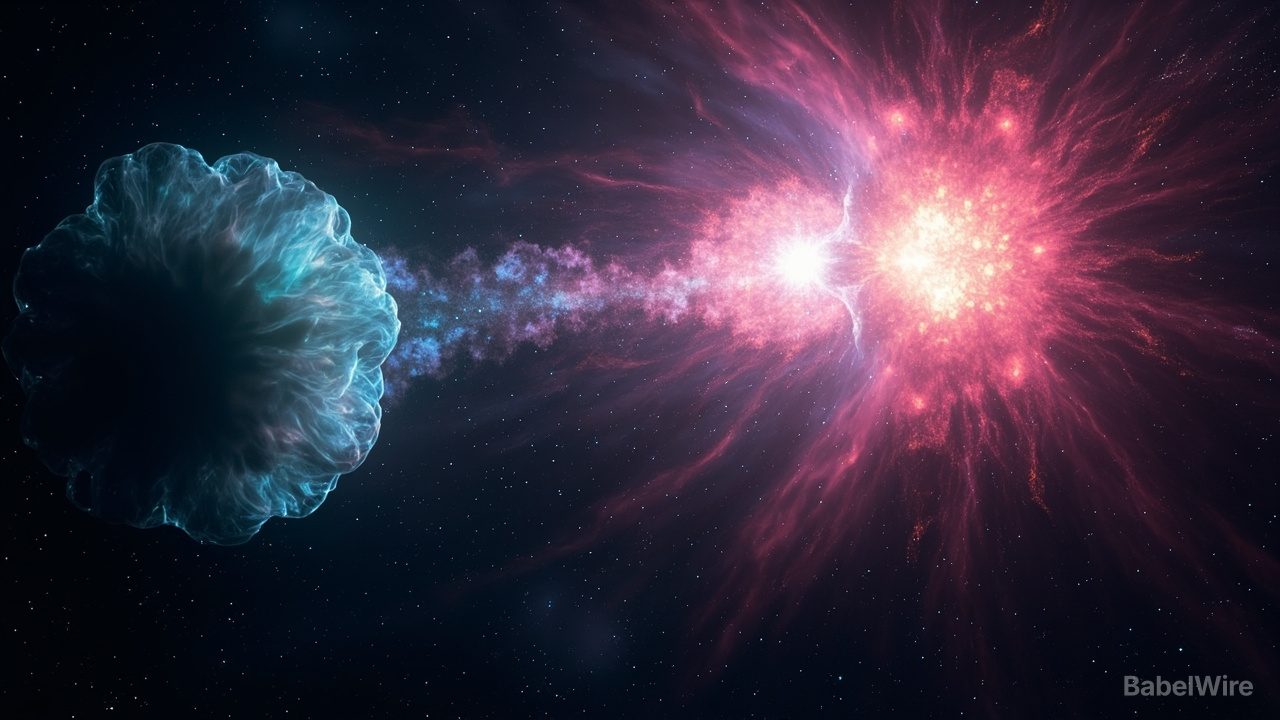
Astronomers have found what appears to be the first known pair of supernova remnants left behind by two stars that once orbited each other — a binary system in which both members exploded, tens of thousands of years apart.
The discovery emerged from 16 years of data from NASA's Fermi Gamma-ray Space Telescope. A team led by Miltiadis Michailidis of Stanford University was studying a faint, overlooked remnant called G189.6+3.3, which sits beside the well-known Jellyfish Nebula (IC 443). Combining Fermi's gamma-ray view with X-ray, radio, ultraviolet and optical observations, they found the remnant glows unevenly: its northern half is dominated by accelerated protons, its southern half by electrons — a clean split never seen before within a single remnant.
The explanation lies in the environment. The remnant's northern edge presses against a dense cloud of hydrogen gas, giving fast-moving protons something to collide with and produce gamma rays; the southern half lacks that material. Earlier work showed IC 443 interacts with the same cloud, implying both remnants lie at roughly the same distance. To rule out coincidence, the team simulated a million hypothetical binary systems; the odds of two unrelated remnants landing this close ranged from about 1 in 1,000 to 1 in 100 — strongly suggesting the two blasts came from the same stellar pair.
The two explosions were probably separated by tens of thousands of years, consistent with one star going supernova first and its companion following long after. 'We weren't really looking for a binary supernova remnant,' Michailidis said.
The findings, published in Nature Communications, offer a rare real-world laboratory for testing long-standing theories about how massive binary stars live and die. Measuring the distance between the two remnants' explosion centers, for instance, could reveal how much energy a supernova actually releases — a quantity astronomers could previously only estimate. The team's next step: searching for more sibling pairs elsewhere in the galaxy.
Sources
- livescience.comScientists Uncover the First-Ever Pair of Sibling Supernovas — Live Science
- universetoday.comThis Is the First Pair of Sibling Supernova Remnants — Universe Today
- humsci.stanford.eduResearchers Uncover Evidence for Sibling Supernovas — Stanford University
- doi.orgShared Cloud Interactions Unveil a Candidate Binary-System Supernova Pair — Nature Communications