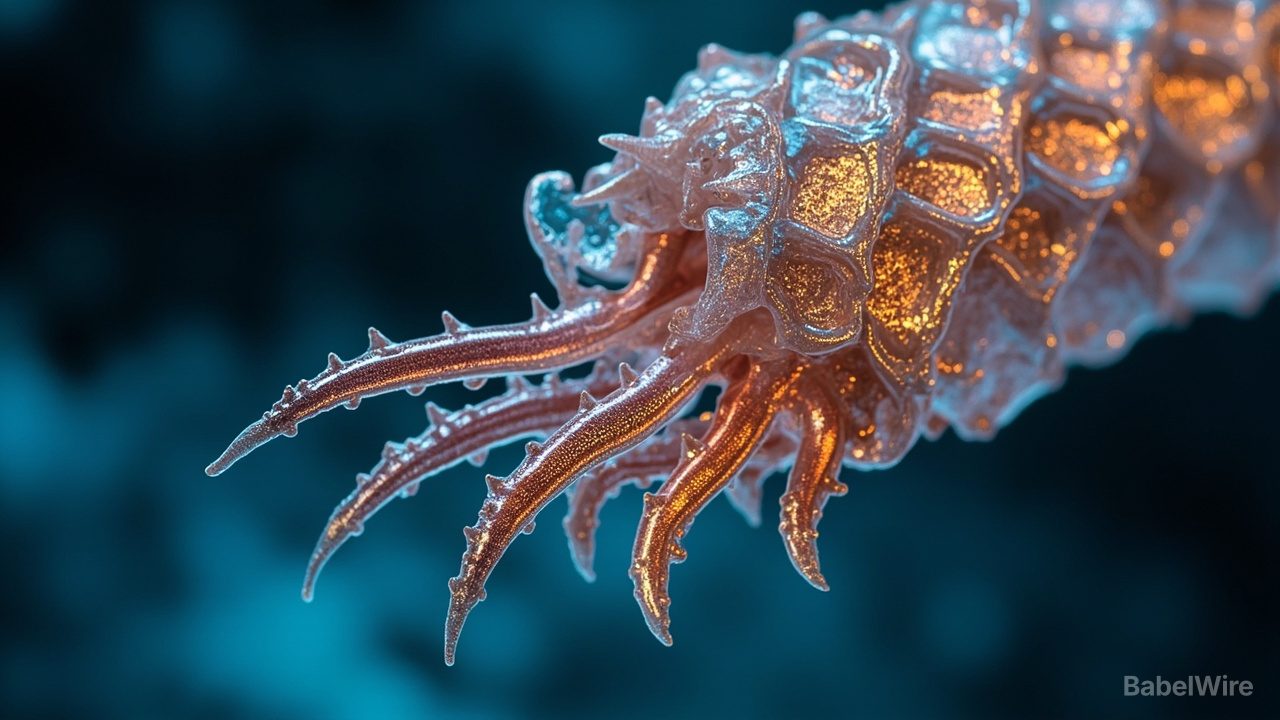
In the classic guessing game "20 Questions," imagine asking "animal, vegetable, or mineral?" For the ancient sea worm Perinereis cultrifera, scientists now say the answer is surprisingly complicated: its jaws may belong to an entirely new category of natural material.
Researchers from TU Wien and the University of Vienna have published a study in Biophysics Reviews proposing the term "bio-metals" for biological materials that combine the hardness and nanoindentation behavior of metals with elastic properties that no crystalline metal possesses.
The team used nanoindentation — pressing a microscopic probe into the material — to measure the worm's jaw hardness. They discovered a phenomenon called the Nix-Gao nanoindentation size effect, previously observed only in metals like copper and silver: at smaller scales, the jaw tips become progressively harder to dent.
The secret lies in metal ions concentrated at the jaw tips, making them especially hard for biting and crushing prey. But the jaws also showed size-dependent elasticity — the ability to bend and spring back changes depending on the scale examined. Conventional crystalline metals like copper or silver do not exhibit this behavior, making bio-metals a distinct category.
"Bristle worm jaws showed size-dependent elasticity — this is a distinguishing feature of bio-metals when compared to standard crystalline metals," said author Christian Hellmich. The researchers now plan to examine more species and explore whether genetic interventions could alter the structure and performance of these natural materials.
"All this comes with true excitement about the beauty, elegance, and refinement found in and produced by nature," Hellmich added.