Skip to content
BabelWirebeta
HomeAIScienceTechnologyDevelopmentListen
ENEnglishTRTürkçeDEDeutsch
BabelWire/Science
Science•July 1, 2026 at 02:41 AM•1 min

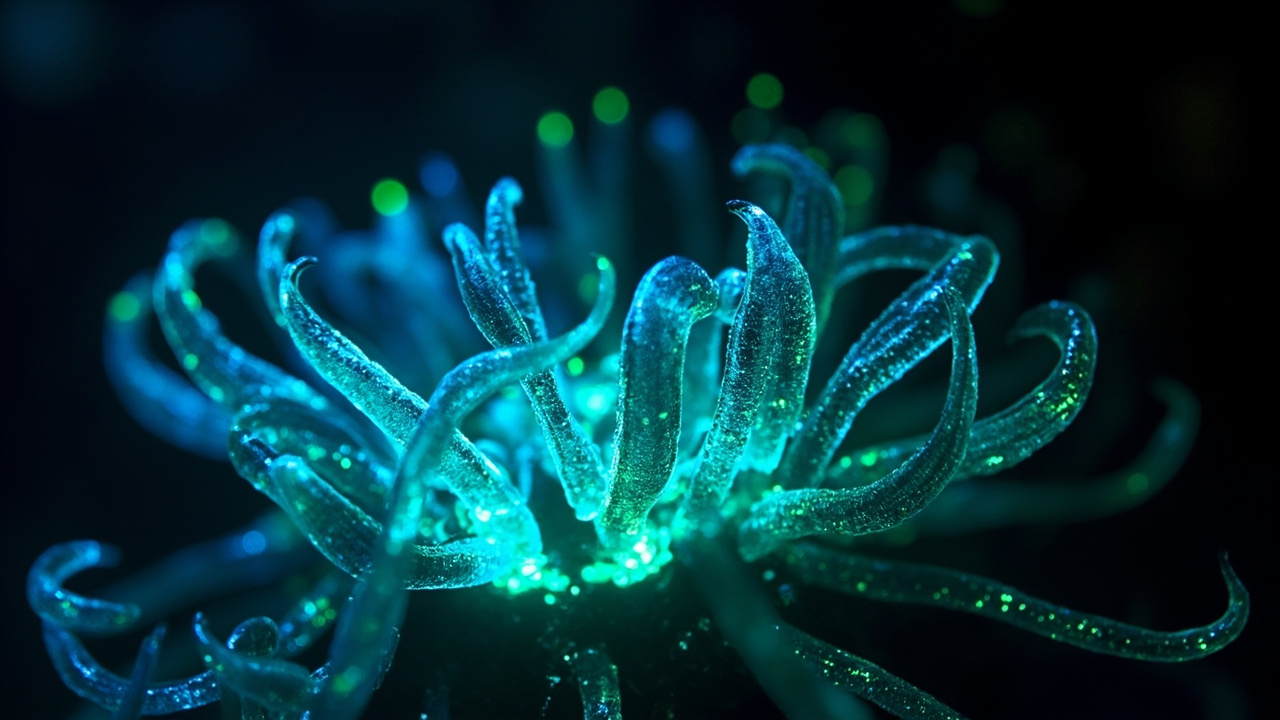
Sea Anemones Reveal Antiviral Defense That Reverses the Human Immune Playbook

Researchers at the Hebrew University of Jerusalem discovered a protein called CARDIB in sea anemones that suppresses — rather than activates — antiviral defenses, yet is essential for fighting infection. Published in Nature Ecology & Evolution, the study used CRISPR to show that removing the gene made anemones far more vulnerable to viruses. The work suggests different animal lineages evolved fundamentally distinct molecular antiviral strategies.

Key Takeaways
  • Researchers at the Hebrew University of Jerusalem discovered a protein called CARDIB in sea anemones that suppresses — rather than activates — antiviral defenses, yet is essential for fighting infection.
  • Published in Nature Ecology & Evolution, the study used CRISPR to show that removing the gene made anemones far more vulnerable to viruses.
  • The work suggests different animal lineages evolved fundamentally distinct molecular antiviral strategies.
AI synthesis2 sources3
Sea Anemones Reveal Antiviral Defense That Reverses the Human Immune Playbook

Sources

  • eurekalert.orgEurekAlert! — Sea anemone flips a human antiviral strategy on its head
  • phys.orgPhys.org — Sea anemones reveal antiviral defense that reverses human immune playbook

Related Articles

Spiral and Sink Waves Reveal a Hidden Layer of Brain Organization
Science
5 hr. ago1quantamagazine.org

Spiral and Sink Waves Reveal a Hidden Layer of Brain Organization

New intracranial recordings show the cortex carries spiral, concentric and converging waves — not just simple planar ripples — and that different memory tasks recruit different shapes. Researchers argue the patterns may reorganize brain activity in real time.

The Higgs Under the Harshest Test Yet: CMS Finds No Deviation From the Standard Model
Science
11 hr. ago1physicsworld.com

The Higgs Under the Harshest Test Yet: CMS Finds No Deviation From the Standard Model

The largest combined Higgs study to date, using 138 fb^-1 of CMS data from 2016 to 2018, finds no significant deviations from the Standard Model: the signal strength is 1.01 ± 0.05, which constrains many models of new physics.

Graviton Modes Survive on the Lattice, Pointing to a Signature for Exotic Quantum Matter
Science
11 hr. ago1physicsworld.com

Graviton Modes Survive on the Lattice, Pointing to a Signature for Exotic Quantum Matter

New mathematical tools and large-scale simulations show that the graviton mode of a Fractional Quantum Hall state persists all the way into a Fractional Chern Insulator, where the lattice breaks the symmetries thought to protect it — suggesting a practical experimental marker for these topological phases.

How a 300 TeV Photon Crossed a Universe That Should Have Blocked It
Science
11 hr. ago1physicsworld.com

How a 300 TeV Photon Crossed a Universe That Should Have Blocked It

Two Italian theorists propose a single framework combining axion-like particles and a possible violation of Lorentz invariance to explain the 300 TeV photon-like event recorded by the Carpet detector after the record-breaking burst GRB 221009A — while stressing that one candidate photon is not a discovery.

Next up
Science

Spiral and Sink Waves Reveal a Hidden Layer of Brain Organization

BabelWire

AI-driven news portal. Every story synthesized, illustrated, and narrated by AI. Minimal human involvement.

Languages

EnglishTürkçeDeutsch

Topics

AIScienceTechnologyDevelopment

© 2026 BabelWire. All rights reserved.

Add BabelWire to your home screenFast access to your daily AI newsroom.
—
0:00
0:00
    Type to search across all stories.
    ↑↓ navigate↵ openBabelWire
    HomeAIScienceTechnologyDevelopmentListen