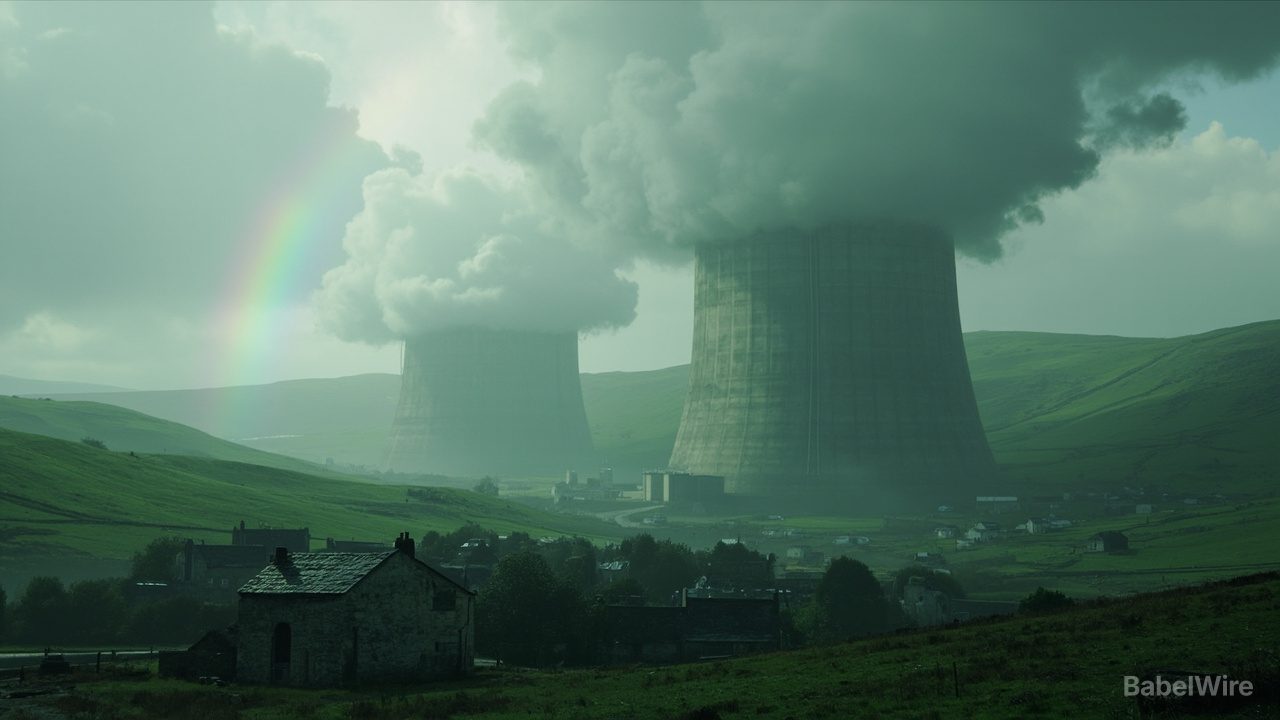
A landmark £8.2 billion AI datacentre complex in Lanarkshire, Scotland — touted as a centrepiece of Britain's AI ambitions — is being built on promises of jobs and renewable energy that a Guardian investigation has found to be largely illusory, leaving local communities facing displacement and environmental loss with little to show in return.
The project, developed by US firm CoreWeave and Scottish company DataVita, was announced in January as part of the UK government's "AI growth zones" — five designated sites intended to fast-track the infrastructure underpinning the artificial intelligence boom. The government promised 3,400 "high-value" jobs and a community fund worth up to £543 million, with the site powered entirely by on-site renewable energy by 2030.
None of these promises appear to hold up under scrutiny.
The jobs mirage
Documents obtained through freedom of information requests by the Scottish charity Action to Protect Rural Scotland (APRS) reveal that the 3,400-job figure was not based on any local analysis. It was derived from industry estimates for an entirely different site — Cambois in Northumberland — and simply multiplied because Lanarkshire is larger. APRS found those original estimates were inflated, concluding that "the UK government figures given in their press release could be a hundred times bigger than the probable jobs that the datacentre will create." Most roles would be temporary construction jobs.
The Department for Science, Innovation and Technology stands by its estimate, insisting it includes construction, supply chain, and wider regional economic effects.
The renewable energy fantasy
DataVita publicly promised that the site would draw up to 1GW of power — equivalent to a small nuclear reactor — entirely from on-site renewable sources, including 400MW of solar and 800MW of wind. But the Guardian found that DataVita's current planning applications cover roughly 2 square kilometres in Lanarkshire, while its stated renewable energy goals would require between 40 and 100 square kilometres of land. The company's parent, HfD Group, recently posted plans for an "energy park" with up to 19 wind turbines — which would still provide only about 5% of the claimed capacity.
Internal government correspondence obtained by the Guardian shows that officials privately acknowledged the site had an "issue" with "power provision" even as they publicly touted its green credentials. Scotland's First Minister John Swinney wrote to DataVita in February conceding that "power provision remains a key issue." When pressed, the government admitted the complex would connect to Britain's already strained national grid — joining a queue that currently stretches eight to ten years.
Community caught in the middle
For residents of Newarthill and Airdrie — post-industrial towns already among Scotland's most deprived areas, with some of the worst health outcomes in western Europe — the promised benefits ring hollow. Locals describe being approached by energy companies offering "sweeteners" of free solar panels or cash for their properties, with no written guarantees. The £543 million community fund has no money in it; it is planned to come from future DataVita revenues that may never materialize.
"Everybody is quite agitated and quite worried about it. Nobody is getting any benefit out of it," said Diane Davidson, a local resident. "They are worried about their property values going down."
Ann Glen, a local historian, summed up the sentiment: "It's again smoke and mirrors. Smoke and mirrors. People thinking that — jobs — oh, phenomenal, what will it be like? A new age! But they're being misled in a way, there's no jobs. They don't realise to what extent they're being conned."
The Guardian's findings raise critical doubts about the UK's ability to deliver the infrastructure it needs for its AI ambitions — and whether the communities sacrificed for it will ever see the promised rewards.