A German startup has unveiled what it calls the world's first diamond-based quantum computer to break past the 10-qubit mark — and it runs at room temperature, straight from a standard power outlet.
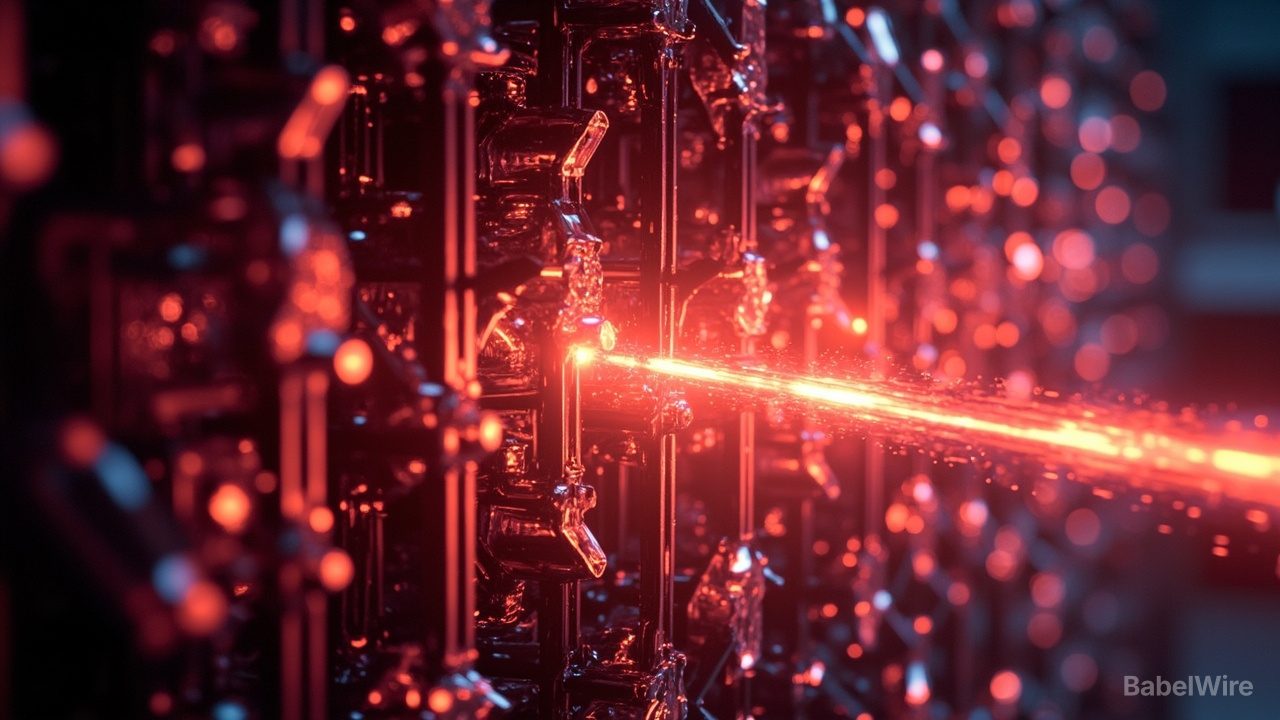
The machine, built by Saxon Q, a company spun out of Leipzig University, is a nitrogen-vacancy (NV) quantum computer: it uses defects in synthetic diamonds — places where a nitrogen atom replaces a carbon atom next to an empty lattice site — as qubits. Lasers set the electrons' 'spin' state, and microwave pulses manipulate them into the superpositions that give quantum computers their power.
The key breakthrough, said co-founder Marius Grundmann, a professor of experimental physics at Leipzig University, was a materials discovery: co-implanting sulfur into the diamond vacancies. The sulfur raises the chemical potential so the vacancy becomes negatively charged and binds to the nitrogen with very high yield, giving researchers far greater control over individual qubits. The company reports qubit fidelity of 99.92 percent before error correction — and 99.98 percent for single-qubit operations as of late July, though the results have not been independently verified.
Saxon Q's systems are currently available in rack-mounted configurations of up to 128 qubits, with 512-qubit versions promised for next year. The company's roadmap targets more than 10,000 qubits after 2030. Because the hardware needs no cryogenic cooling, it can be plugged into alternating current and slotted into a standard server rack — an advantage the company says matters for edge computing scenarios such as autonomous driving and robotics, where cloud round-trips introduce unacceptable latency.
Saxon Q also demonstrated a live application running on a mobile quantum computer powered by Quantum Machines' control technology. Comparisons with superconducting platforms remain difficult to verify independently, and questions remain about whether the diamond architecture can scale to the hundreds or thousands of qubits needed for serious quantum advantage — but the room-temperature, plug-and-play form factor marks a notable departure from the cryogenic giant machines that dominate the field.