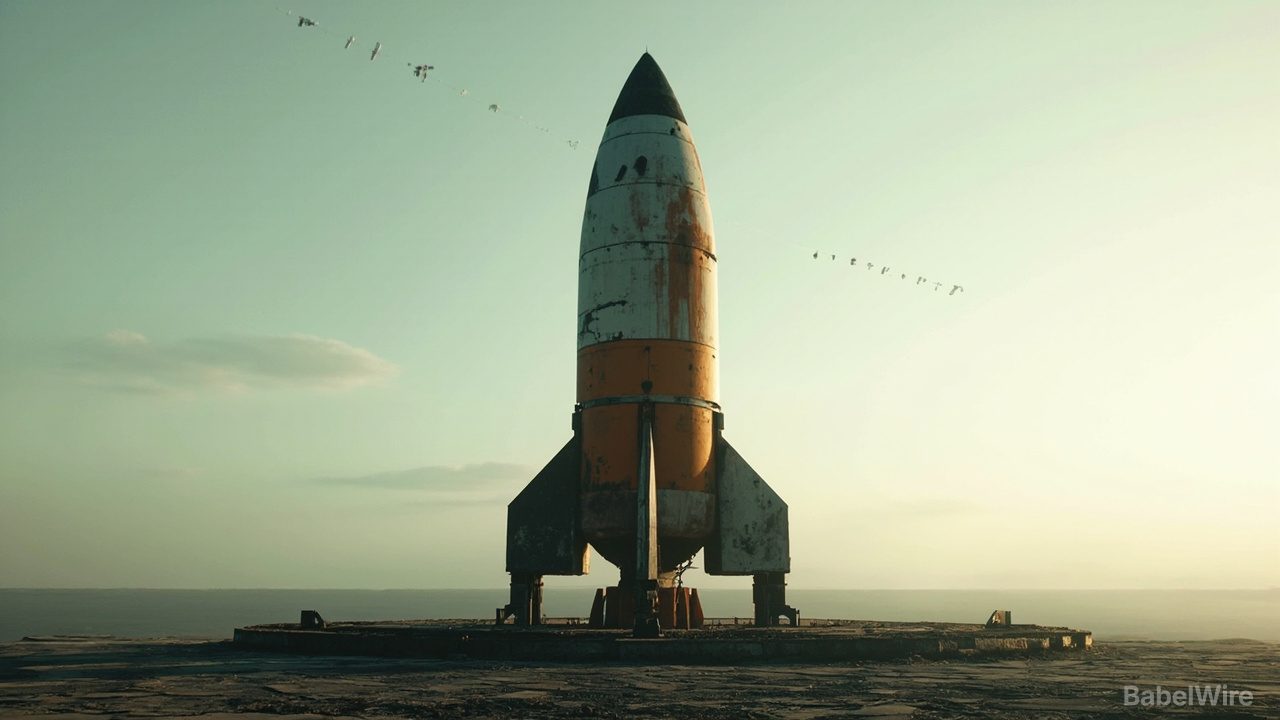
A ten-day slip is not usually news. This one is, because of what is standing behind it.
Blue Origin now plans the next New Glenn launch for January 2027, according to a memo CEO Dave Limp sent to staff that CNBC and the Financial Times reported on Wednesday. In October, Jeff Bezos told Fox News the company was aiming for December, joking it would be "probably December 31st." Limp reportedly cited weather affecting the launchpad rebuild as a factor, and framed the change as small: "This small adjustment doesn't diminish what we've accomplished or the importance of the work still ahead. Returning New Glenn to flight remains our top priority — it's worth it."
What it is returning from
New Glenn exploded on its only launchpad in May, days before a scheduled mission carrying Amazon Leo satellites, and badly damaged the pad. The rocket — 322 feet, thirty storeys — has lifted off three times since its 2025 debut. Its most recent flight, in April, was its first mission failure: a problem with the second stage put an AST SpaceMobile satellite into the wrong orbit, from which it fell back into the atmosphere.
So the vehicle will go from April to January without a launch, and 2026 will end with a single flight and a destroyed pad to show for it. That is the context in which "ten days" should be read.
The pad is the bottleneck
The reason a weather delay on one facility moves a national launch schedule is that Blue Origin has exactly one New Glenn pad. It is spending to fix that: more launch and landing pads in Florida are planned, part of a Florida footprint that Reuters reported at over $3 billion invested, roughly 31 acres and some 5,000 employees. A $330 million expansion, targeting completion in summer 2027, is meant to support the heavier New Glenn 9x4 and allow production of up to 150 upper stages a year.
The end-state goal, per Blue Origin senior vice president of operations Ian Richardson, is "multiple flights per week by the end of the decade." For scale: SpaceX flew 165 Falcon missions last year.
Who is waiting
The customer that matters most is Amazon, which is both Blue Origin's sibling under Jeff Bezos's ownership and one of the largest satellite programmes on Earth. Amazon Leo — the constellation formerly called Project Kuiper — was designed to take 48 satellites per New Glenn launch. Its FCC licence required 1,618 satellites in orbit by July 30, 2026; Amazon was at 231 in the spring and had petitioned the Commission for an extension, arguing the milestone did not anticipate the supply-chain and launch-availability realities of a first-of-kind system. It has been filling the gap by buying rides on Atlas V, Falcon 9, Ariane 6 and Vulcan — including from its own rocket's direct competitor.
Beyond Amazon, the New Glenn explosion landed in the middle of what Reuters described as a global launch squeeze that has left dozens of satellite companies desperate for rides. A grounded heavy-lift vehicle is not just one company's bad year; it is a tighter spot in a market that is already oversubscribed, and every month of grounding pushes customers toward the one provider with spare capacity.
And Blue Origin is not a single-program company. It holds a multibillion-dollar NASA contract to build a lunar lander that returns astronauts to the Moon. Limp's stated prioritisation — return to flight above everything — is a ranking of programmes, not a slogan.
The honest read
January versus December is not the story. The story is that New Glenn's cadence remains theoretical while its manifest is contractual. Three flights since 2025, one of them a failure, an explosion on the pad, and a rebuild schedule sensitive to Florida weather is not a record that supports 48 satellites per launch at constellation scale — and the customers who signed for that capacity have alternatives, which they are using.
What to watch
Whether January holds, and whether Blue Origin publishes a cause for the May explosion alongside the return to flight — it has not, in public, so far. Whether Amazon's FCC extension comes with deployment milestones tied to specific vehicles, which would make New Glenn's cadence a regulatory matter rather than a commercial one. And whether AST SpaceMobile, whose satellite was lost to the April upper-stage failure, books its next flight on New Glenn or somewhere else.