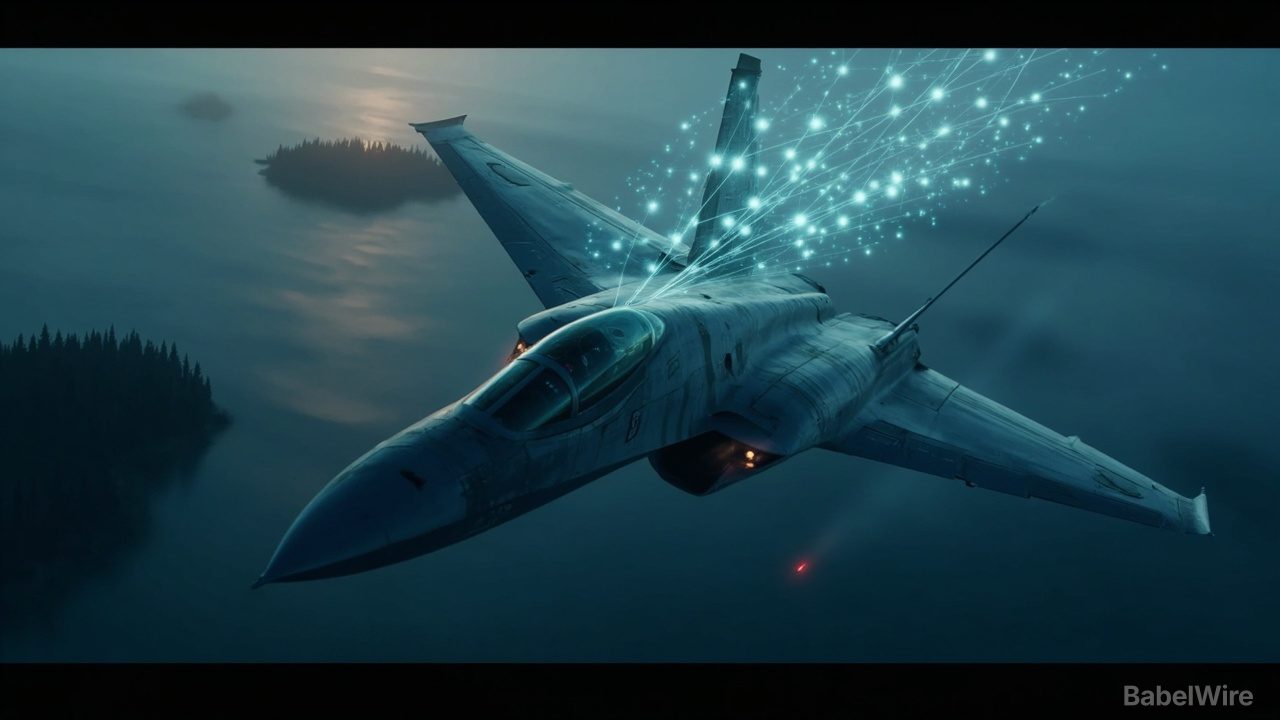
Saab announced on 3 November that AI agents it developed, trained and flight-tested itself have flown the Gripen E, predominantly in beyond-visual-range combat scenarios. The company's phrasing is that it can now "develop, train, and fly its own AI for air combat."
The detail that matters is the pronoun. In 2025, the Gripen autonomy flight trials that made headlines used Helsing's Centaur: a supplier's model, integrated into Saab's airframe. This announcement is about Saab's own agents — and about the machinery behind them.
Peter Nilsson, head of Advanced Programs at Saab Aeronautics, framed the flights as the easy part: "The harder question is how we turn this success into a dependable capability that can learn, improve, and be relevant over time. That is the true purpose of the AI Fighter Pilot Academy." The academy is the infrastructure to create, train and evaluate agents; Nilsson's argument is that military advantage increasingly comes from shrinking "the distance between experience, learning, and field-led capability" — a data flywheel, in plain language, inside a fighter programme.
The compute for it will be Swedish. Saab has become a partial founder in Sferical AI, a government-backed venture built on Nvidia DGX SuperPOD architecture, formally inaugurated in Stockholm last month. Nilsson's reason is candid: without it, "you have to go to Google or Amazon … and pay some money" while not having "full control of your data." On a slide, Saab claimed that one hour of simulated training flight can yield the equivalent of one billion human pilot hours.
The agents are designed to work with a pilot in the cockpit or from an uncrewed air vehicle, and Saab's road to a loyal wingman runs through three unmanned designs: A1, A2 and A3.
What the announcement does not include: a fielding date, a description of the decision authority the agents hold, or any independent evaluation. Flight tests in BVR scenarios are a milestone in autonomy; they are not a certification, and the ethical and legal basis of armed autonomous decision-making remains unresolved in every air force testing it.
Sources
- breakingdefense.comSweden's Saab launches family of AI agents for future aircraft projects (Breaking Defense)
- saab.comSaab unveils its AI agents for future fighter systems (Saab press release)
- defence-industry.euSaab says its own AI autonomously controlled Gripen E in beyond-visual-range combat trials (Defence Industry Europe)