Astronomers have discovered the fastest known star in the Milky Way — a star so close to the galaxy central supermassive black hole that it can be used to measure the black hole spin for the first time.
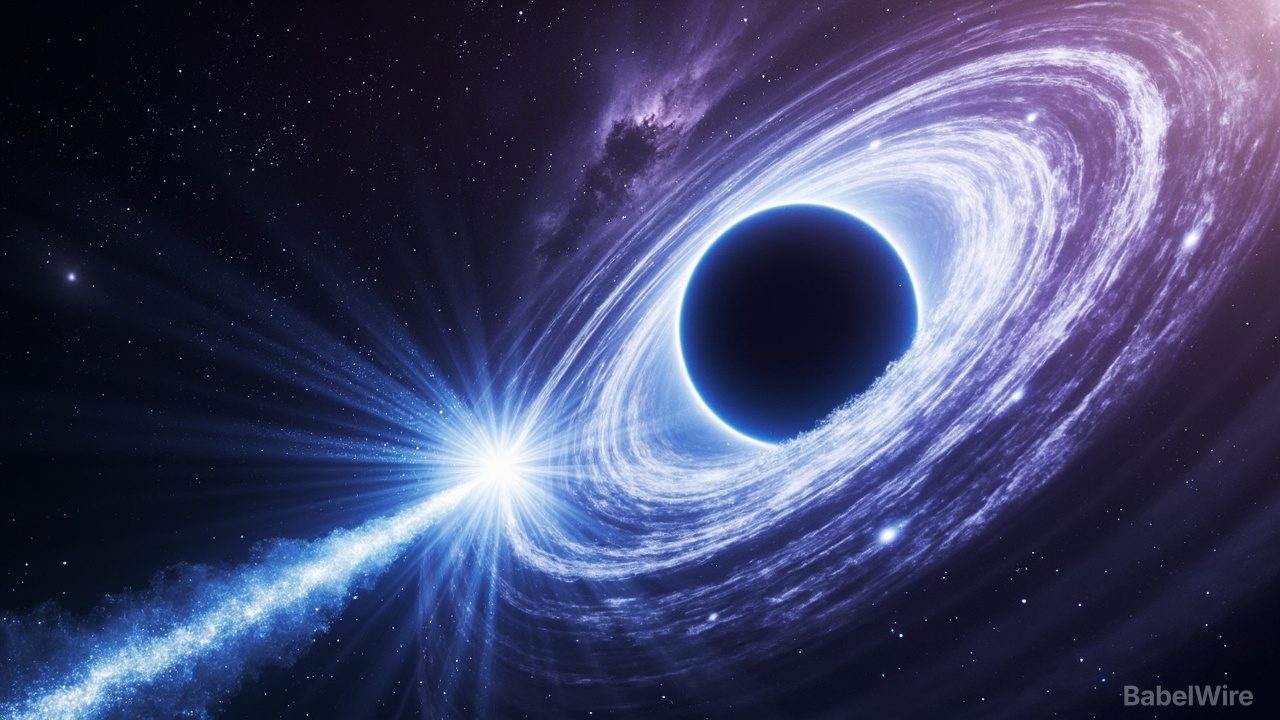
The star, named S301, was detected with the European Southern Observatory Very Large Telescope Interferometer (VLTI) using its GRAVITY+ instrument. It orbits the four-million-Solar-mass black hole Sagittarius A at speeds reaching 25,000 kilometres per second — over 8 percent the speed of light — making it 100,000 times faster than a commercial aircraft.
S301 also approaches Sagittarius A closer than any star previously observed, passing within 12 times the Earth-Sun distance — roughly the distance from the Sun to Saturn. This proximity is what makes it scientifically extraordinary: according to Einstein general theory of relativity, a spinning black hole drags spacetime along with it, and this frame-dragging effect is strongest for objects in very tight orbits.
What is special about this star is that it is orbiting Sagittarius A on a very tight orbit, taking just 8.7 years to complete it, and is approaching the black hole at a mere 12 times the distance of Earth to the Sun. That is unprecedented, says Felix Mang, PhD student at the Max Planck Institute for Extraterrestrial Physics and lead author of the study published in Nature.
Nobel Prize winner Reinhard Genzel, who pioneered the decades-long effort to track stars near the galactic centre, called the discovery a breakthrough: Because it orbits so close to Sagittarius A, S301 opens a new window to the fundamental properties of spacetime in this extreme black-hole environment.
The team traces S301 orbital history back to 2017, finding it made its closest approach in early 2023. Its properties suggest it was originally part of a binary star system that was torn apart by the black hole tidal forces — S301 was captured while its companion was likely ejected at high velocity, possibly enough to escape the galaxy entirely.
Observations with GRAVITY+ and ESO upcoming Extremely Large Telescope (ELT) over the next decade will be crucial. When S301 makes its next close passage in 2031, observing at least two complete orbits will enable the team to directly determine the spin of Sagittarius A — something never before achieved for a massive black hole.
For the first time, we would actually be able to measure very directly the spin of a massive black hole, which would be a key test of Einstein theory, says MPE researcher Stefan Gillessen.
Publication: GRAVITY+ Collaboration, Discovery of a star sensitive to the spin of Sgr A, Nature (2026). DOI: 10.1038/s41586-026-10894-w