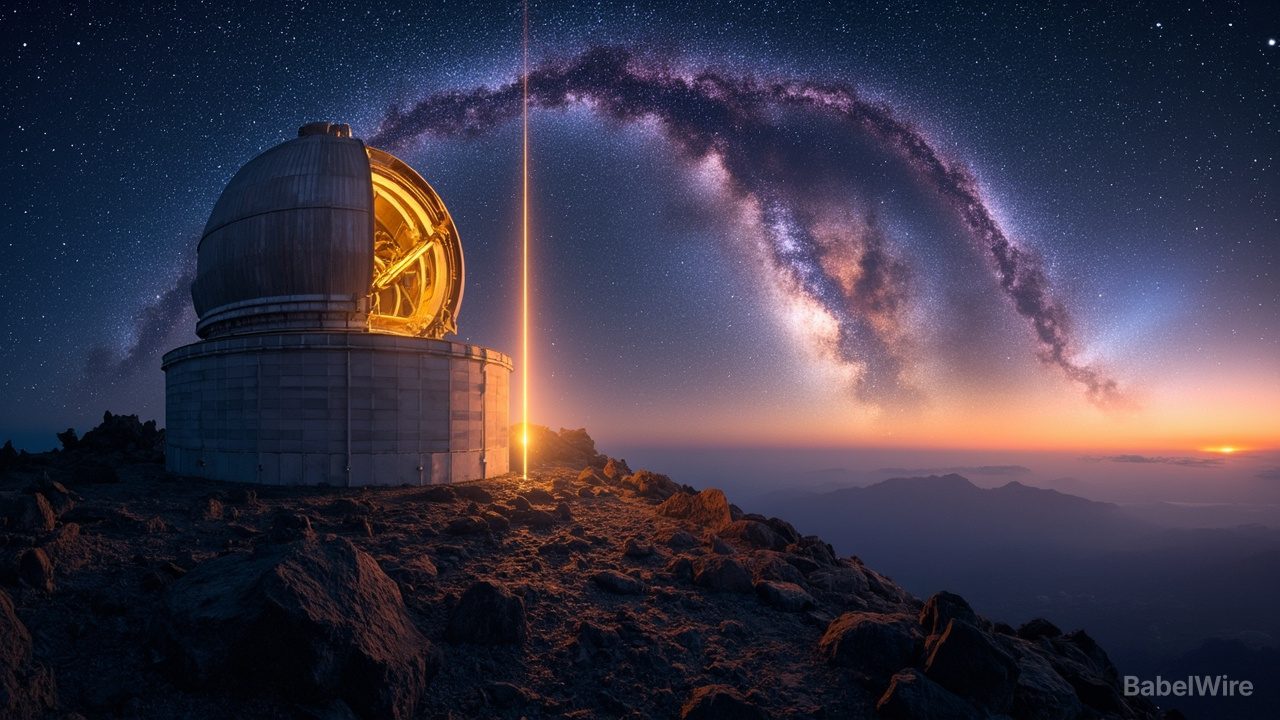
Cerro Pachón, Chile — On June 29, 2026, the Vera C. Rubin Observatory fired its 3.2-gigapixel camera — the largest digital camera ever built — and began what astronomers are calling the most ambitious astronomical survey in history.
A 10-Year Journey Into the Cosmos
The Legacy Survey of Space and Time (LSST) will image the entire visible sky from the southern hemisphere once every few nights for a decade. Over its lifetime, the survey is expected to:
- Catalog 20 billion galaxies — more than 10 times the number currently known - Detect 10 million supernovae — providing unprecedented data on the expansion history of the universe - Map 17 billion stars in the Milky Way — creating the most detailed 3D map of our galaxy - Track 6 million asteroids and comets in our own solar system, including potentially hazardous near-Earth objects
The Camera That Changed Astronomy
At the heart of the observatory sits the LSST Camera, a 3,200-megapixel instrument the size of a small car. Each image covers an area of sky equivalent to 40 full moons. Every night, the telescope will generate 20 terabytes of data — enough to fill roughly 20,000 laptop hard drives annually.
"This is not just a telescope. It's a time machine," said Dr. Sarah Ballard, Rubin Observatory Director of Science Operations. "We're not just taking still images of the universe — we're making a movie. We'll see things move, change, brighten, and fade in ways we've never been able to capture before."
Dark Matter and Dark Energy in the Crosshairs
The LSST's primary science goals include understanding the nature of dark matter and dark energy, which together make up 95% of the universe but remain largely mysterious. By measuring how galaxies cluster and how the universe has expanded over time, scientists hope to test — and potentially rewrite — the standard model of cosmology.
A Data Firehose
Processing the nightly deluge of data required building a completely new data management system. The Rubin Observatory's data facility at SLAC National Accelerator Laboratory will issue real-time alerts within 60 seconds of detecting moving or changing objects — enabling ground-based telescopes worldwide to immediately follow up on transient events like supernovae or asteroid discoveries.
"The LSST alert stream will fundamentally change how astronomy is done," said Dr. Mario Jurić, Rubin Data Management Lead. "It's no longer about astronomers applying for telescope time. The data comes to everyone, all at once, every single night."
International Collaboration
Built at a cost of over $1 billion, the Rubin Observatory is a joint project of the National Science Foundation (NSF) and the Department of Energy (DOE), with contributions from institutions worldwide. After years of delays caused by the pandemic and complex engineering challenges, the survey's start marks a triumphant moment for the astronomical community.
What Comes Next
The first data preview release is expected 2–3 months after survey start, with the first major data release roughly a year later. The full 10-year dataset — expected to reach 60 petabytes — will be publicly available, ensuring that the LSST's scientific impact extends well beyond the professional astronomical community.
As night falls over Cerro Pachón, the 8.4-meter Simonyi Survey Telescope has begun its relentless scan of the cosmos. The universe's greatest photo album is finally being written.