Relativity Networks has raised $22 million in SAFE note funding and secured a $40 million follow-on order from a major unnamed hyperscaler, betting that a faster kind of fiber optic cable could fundamentally change where and how the world's AI data centers are built.
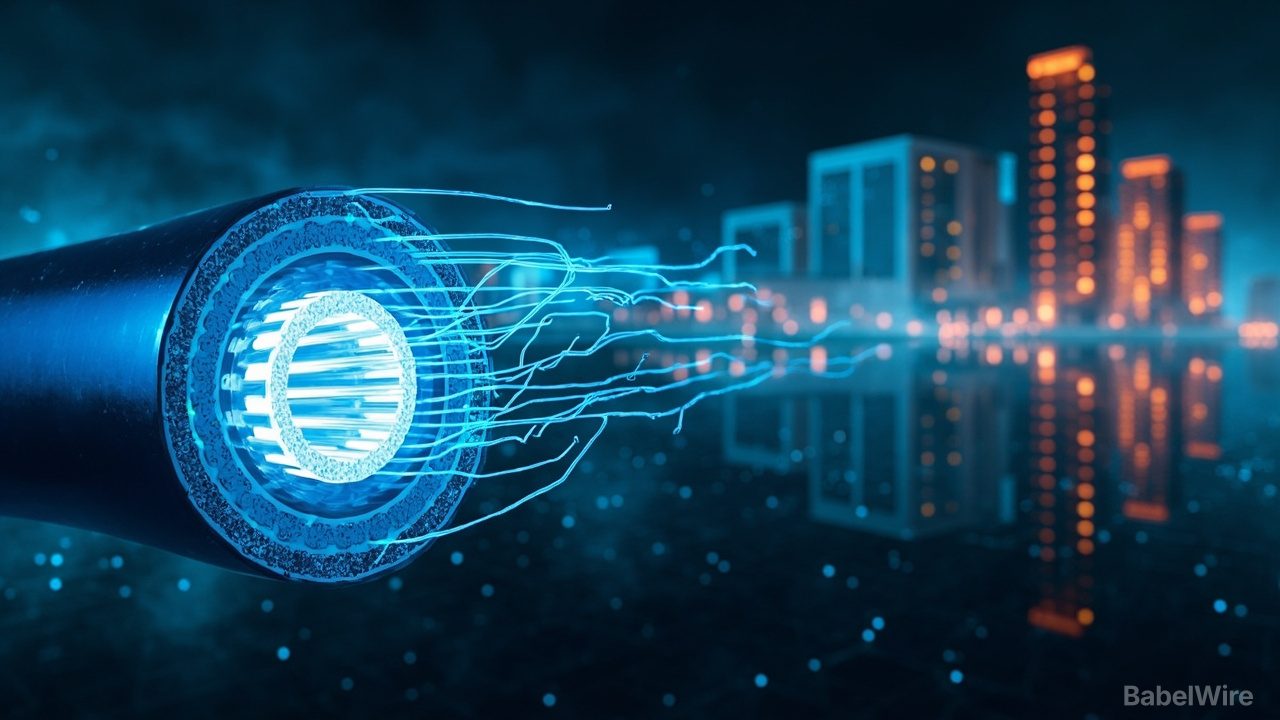
The company specializes in hollow-core fiber, a technology that transmits data through a vacuum chamber at the center of the cable rather than through solid glass. This seemingly simple change allows light to travel roughly 50% faster than in conventional fiber-optic cable, bringing transmission speed closer to the theoretical limit of light.
The practical difference comes down to microseconds. In conventional fiber, a signal takes roughly five microseconds to travel one kilometer. With hollow-core fiber, that drops to about three and a half microseconds. While that gap sounds negligible, it compounds dramatically at the scale of modern AI infrastructure.
Today's largest AI compute clusters sprawl across hundreds of acres and dozens of buildings, sometimes spanning multiple campuses. As these systems grow, the physical distance between GPUs becomes a binding constraint — data must travel farther, and every microsecond of latency degrades performance. Hollow-core fiber could effectively double the geographic radius within which a data center cluster can operate as a single synchronized machine.
"The largest systems are distributing the compute across multiple campuses to reach the power that exists," CEO Jason Eichenholz told TechCrunch. "They're moving to where the warm shell is, but they still need to operate as one synchronized machine."
The funding round was led by Rhapsody Venture Partners, Bell Ventures Inc., and Faster Than Glass LLC, among others. The $40 million hyperscaler order is a significant commercial validation — it suggests that at least one of the world's largest cloud operators sees hollow-core fiber as a near-term solution to the geographical constraints limiting AI buildout.
Data center developers are expected to spend as much as $4 trillion by the end of the decade, but they are already heavily constrained by power availability, permitting, and land. Hollow-core fiber doesn't solve the power problem directly, but by extending the effective range of compute clusters, it could allow operators to build in locations with available power that are currently too distant from existing infrastructure.
Eichenholz frames the development as the third era of AI optimization. "The first era optimized for compute — GPU, GPU, GPU," he said. "The second era optimized the networking inside the data center to take advantage of that compute. The third era that we see coming is optimizing the geography."
The technology also has implications for high-frequency trading, where microseconds translate directly into competitive advantage, and for edge computing applications where low latency is critical. But it is the AI data center market — with its insatiable demand for both compute and the infrastructure to support it — that is driving the near-term opportunity.
Relativity Networks' challenge will be scaling production of hollow-core fiber to meet demand. The technology has existed in research labs for years but has seen limited commercial deployment due to manufacturing complexity and cost. The new funding and hyperscaler order suggest the company is making progress on both fronts.