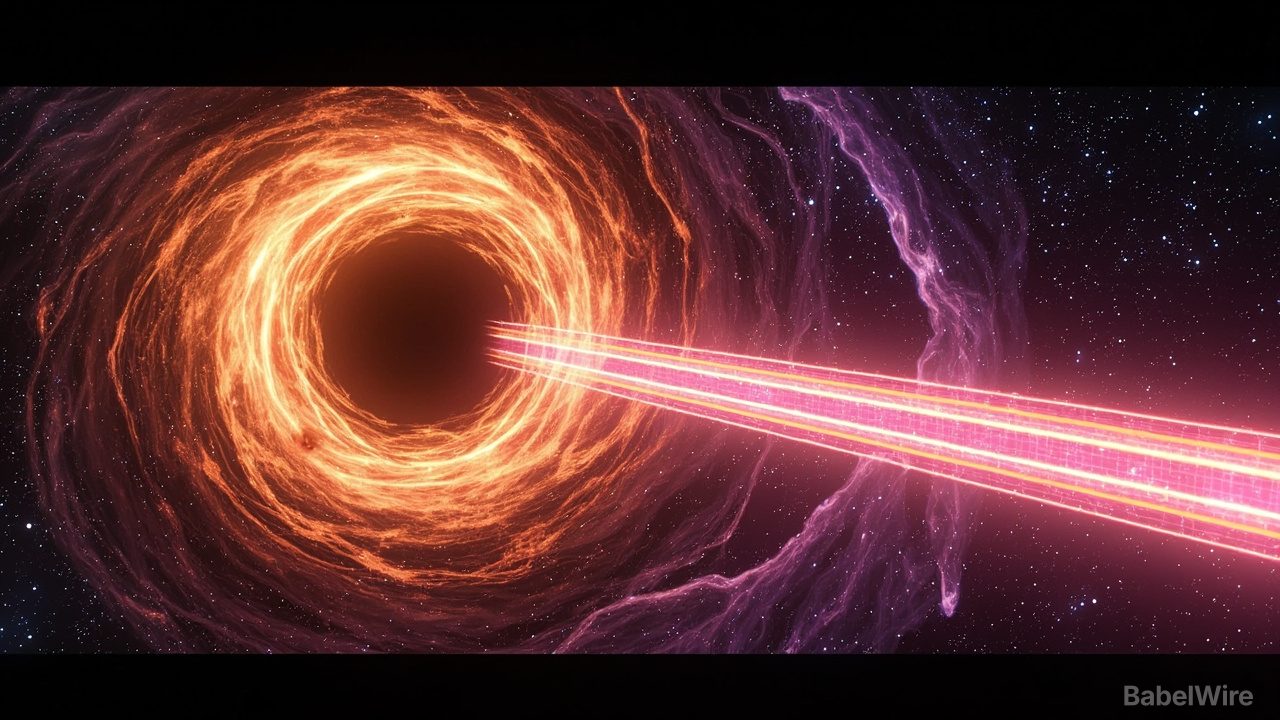
Theorists have found that a black hole spinning close to the maximum rate allowed by general relativity could develop a horizon with an unusual shape — one that resembles a pair of trousers. Physics World reports the result, a purely theoretical calculation that pushes Einstein's equations into one of their most extreme corners.
In classical relativity a black hole is described by just two numbers: mass and spin. The faster one rotates, the more the surrounding structure is dragged around with it, and the closer the inner and outer horizons of the hole sit to one another. At the limit of maximum spin — the so-called extremal case — that geometry becomes degenerate, and the tidy picture of a single well-behaved sphere gives way to something more complicated.
The trouser description, as Physics World presents it, is about topology rather than anything visible. A trousers surface begins as one tube and splits into two legs; it is the same class of shape a tailor would recognise. In a rapidly rotating black hole, the calculation suggests, the region around the horizon can pinch and divide in a way that produces just that transition.
Why anyone should care comes down to what the interior of a black hole is really like, a question general relativity answers in a way that clashes with quantum mechanics. Rotating black holes are the arena where that clash is sharpest, because their inner horizon is thought to be unstable to the smallest disturbance. If the near-horizon geometry can genuinely split, then the way infalling matter and information are routed through the hole's interior may be more complicated than textbook treatments assume.
The result is a paper, not an observation, and it carries the usual caveats. It concerns black holes spinning near a limit that astrophysicists have never confidently seen in nature: real holes are spun up by accreting matter but tend to stay well below maximum, and any such object would also be fighting instabilities. Whether the trouser-like geometry survives a full stability analysis is a question the theorists themselves flag as open. Still, results like this matter because they map the territory where general relativity is expected to break down — the same territory telescopes are now probing from the outside.