A breakthrough quantum sensor built by researchers at Imperial College London has shown for the first time that a central idea behind next-generation quantum detectors can work under realistic experimental conditions — recovering signals buried in noise so deep that individual measurements were rendered unusable.
The study, published June 17 in Nature and reported widely on July 5, demonstrates that comparing two long baseline atom interferometers — instruments that use lasers to measure atomic behavior with extreme precision — can effectively cancel experimental noise. This makes it possible to detect faint signals from gravitational waves originating in the early universe and signs of unusual forms of dark matter.
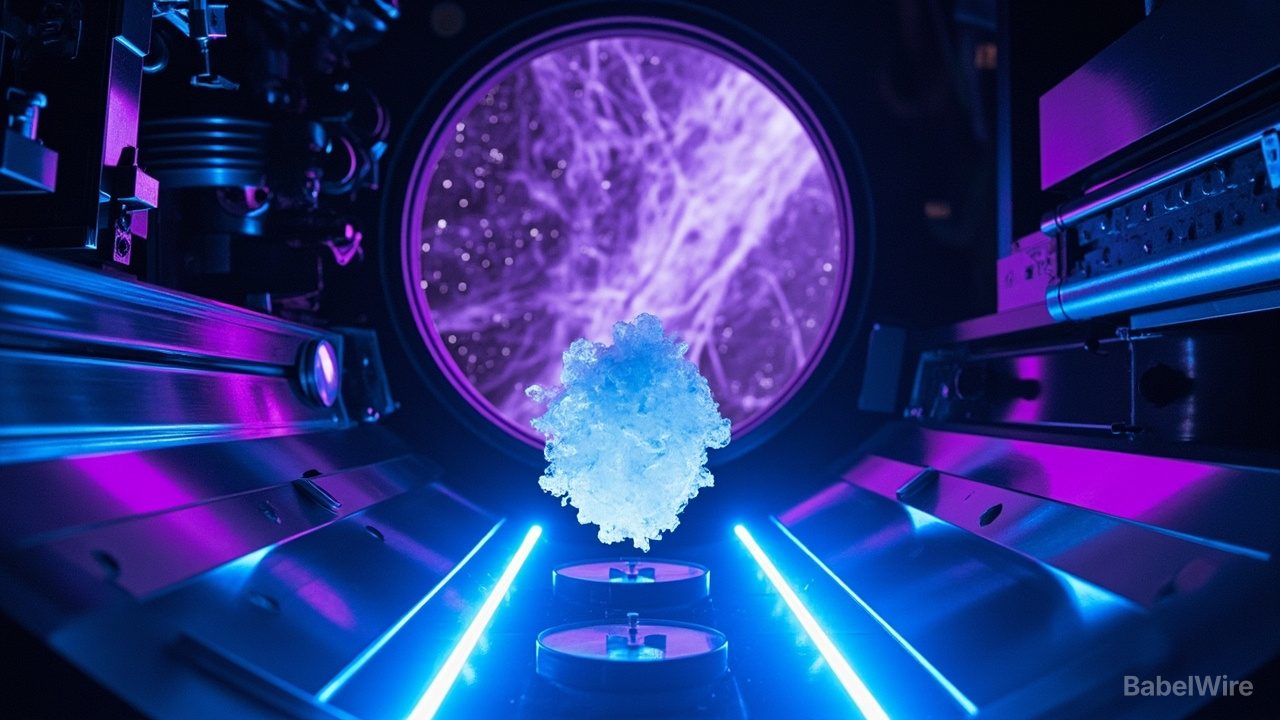
The prototype was built inside the Imperial Ultracold Strontium Laboratory. Researchers created two widely separated clouds of ultracold strontium 87 atoms, both measured with a single ultrastable clock laser. To stress-test the technique, they intentionally added large amounts of phase noise to mimic the conditions of much larger future detectors.
On their own, both interferometers became unusable — noise completely overwhelmed their signals. But when the two were compared, the signal reappeared. The combined measurement reached the fundamental limit set by quantum physics, proving laser noise cancellation works as needed. The team then added an oscillating signal similar to what a passing gravitational wave or dark matter field might produce, and it remained clearly detectable.
"We've known for a long time that quantum sensors can help us understand the universe, but it's only recently that it's become possible to build them with the resolution needed," said Dr. Charles Baynham, co-lead of the lab. "I can't wait for the day when signals from an atom are telling us about a black hole that merged millions of years ago."
The work is part of the Atom Interferometer Observatory and Network (AION) collaboration, which connects to the MAGIS project at Fermilab and the proposed AICE facility at CERN. If realized, such facilities could become some of the largest quantum experiments ever built, studying gravitational wave frequency bands currently inaccessible and searching for entirely new forms of matter.