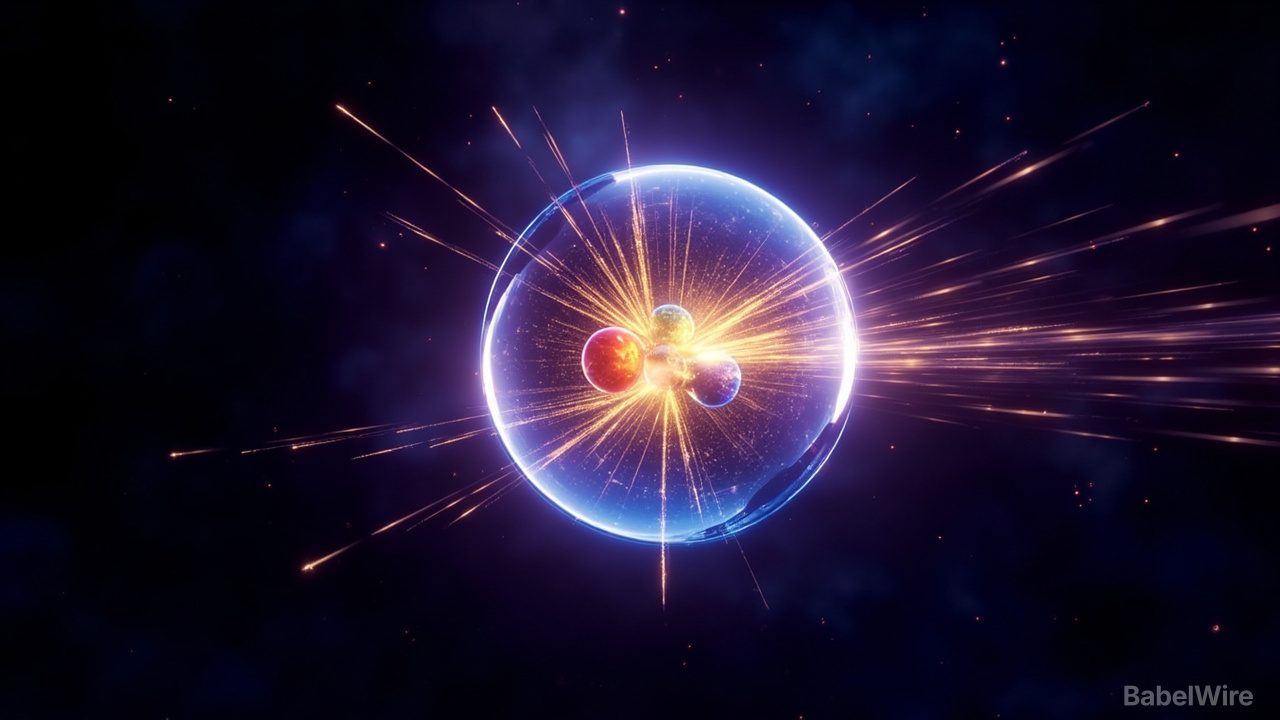
Physicists have found new evidence for how a proton carries its identity — and the answer is stranger than the textbook model suggests: the particle's baryon number is not carried by its three quarks alone, but by a web of gluons binding them together.
The baryon number is the quantum property that marks a particle as matter rather than antimatter — conserved since baryogenesis in the early universe. The conventional picture holds that each of a proton's three valence quarks carries one-third of the baryon number. An alternative hypothesis proposes that baryon number instead rides on a "baryon junction" — a nonperturbative, Y-shaped gluonic configuration.
To adjudicate between the two ideas, the STAR Collaboration at the Relativistic Heavy Ion Collider (RHIC) at Brookhaven National Laboratory studied particle collisions involving photons, gold nuclei and heavy ions. Across the experiments, the baryon number traveled farther and differently than would be expected if it rode along with the quarks alone, consistently favoring the gluon-junction model.
"Our results suggest that the baryon number is not simply carried by individual quarks," said Professor Zhangbu Xu of Kent State University and Brookhaven Lab. "Our findings strongly support the idea that baryon number is more favorably carried and transported by gluons, the particles that hold quarks together, when arranged in this special configuration." His colleague Dr. Rongrong Ma added: "This new understanding reshapes how we think about the structure of matter and deepens our knowledge of the most fundamental element that is responsible for the universe in its current form."
The study was published on August 13 in the journal Science (STAR Collaboration, "Tracking the baryon number with nuclear collisions," Science 393 (6812): 727–731). Beyond sharpening the picture of the proton, it has practical consequences for interpreting heavy-ion collisions — including the hunt for the quark-gluon plasma, the state of matter that existed in the first instants after the Big Bang.