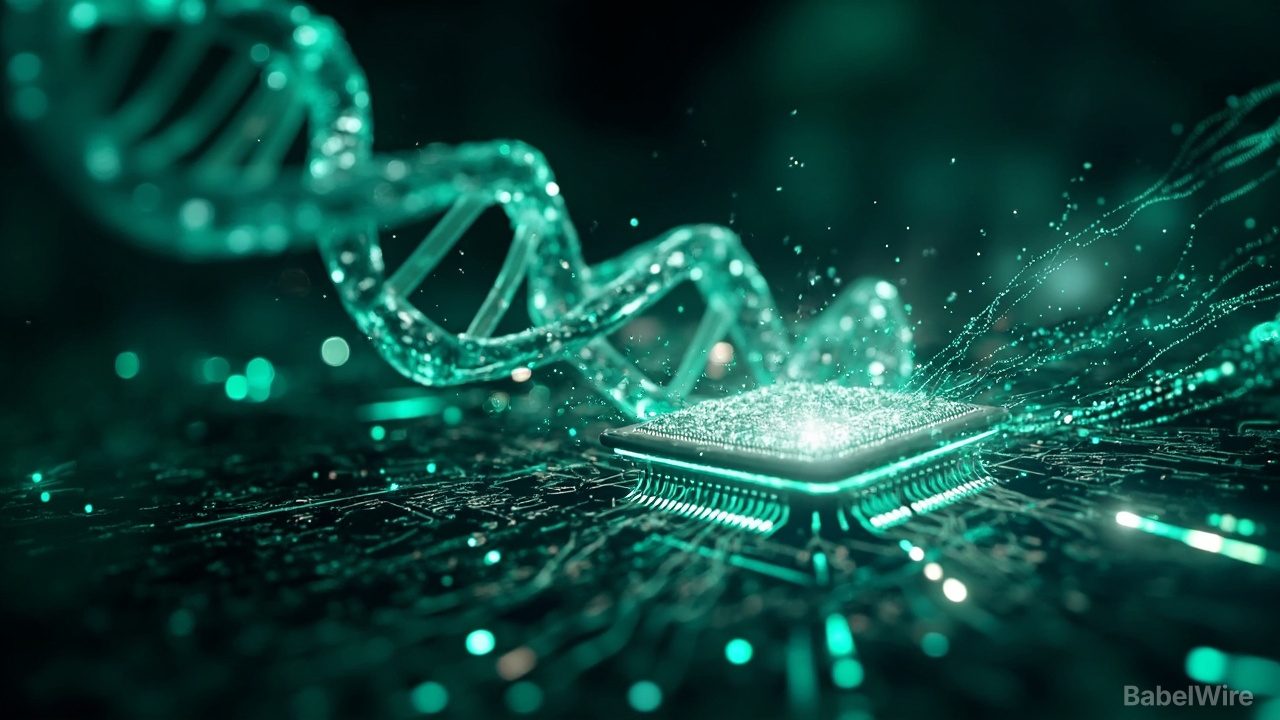
Researchers at Penn State have created an ultra-low-power memory device by combining synthetic DNA with a semiconductor, an advance they say could point the way to far more energy-efficient computers and AI systems.
DNA is extraordinarily dense as a storage medium — a single gram can hold roughly 215 million gigabytes — but making it work alongside electronic materials has been a stubborn challenge. The Penn State team's solution, published in Advanced Functional Materials and the subject of a patent application, pairs synthetic DNA — short, chemically engineered sequences tailored for electronics — with crystalline perovskite, a semiconductor already used in solar cells, lasers and data storage.
The result is a memristor, a memory resistor that preserves a record of previous electrical activity even when power is removed. Because memristors can store and process information in the same place — similar to neurons in the brain — they could support neuromorphic computing, which processes multiple inputs at once and learns from experience, a paradigm researchers say AI will increasingly depend on.
To build the device, the team added silver nanoparticles to customized DNA sequences integrated with thin perovskite films. The silver "doping" made the DNA conductive and helped its molecular units line up in a more orderly way. Unlike natural DNA — long, tangled strands that handle like wet spaghetti — short, rigid synthetic DNA can be arranged with precision at tiny scales. "We can computationally determine exactly which sequences we need and how long they should be," said co-author Neela H. Yennawar.
The device operated reliably at under 0.1 volt — for comparison, a standard U.S. outlet provides 120 volts — and responded predictably when current direction was reversed. It continued working consistently at temperatures approaching 250 degrees Fahrenheit and stayed functional at room temperature for more than six weeks, exceeding the stability of existing perovskite-based memory devices.
"Usually, it takes more power to store more information. Our device, however, consumes 100 times less power and the storage capacity is higher than traditional storage devices, like flash drives," said co-corresponding author Bed Poudel. The team found the combination performed far better than DNA or perovskite alone. "It's this combination that enables a very high memory storage density that requires very little power," added Kavya S. Keremane.
The research was supported by the U.S. National Science Foundation, the National Institutes of Health, Penn State and the University of Minnesota. The team plans to refine the technology and explore further bio-inspired electronics. "Nature has the solution — we just have to find it and apply it," Poudel said.