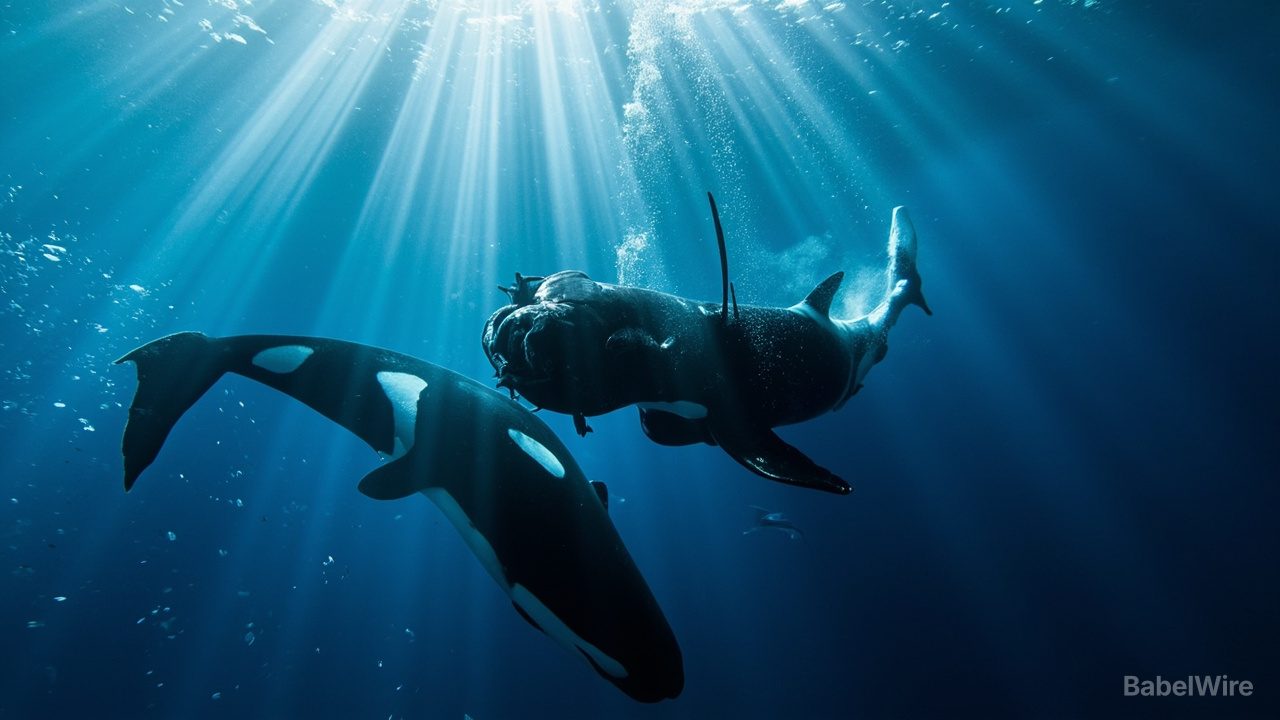
Researchers in the Gulf of California have documented a dramatic orca behavior that has never been formally described before: one orca gripping a dead sunfish by the fin while another charges into it at high speed, blasting the carcass into thousands of fragments.
"We document how one orca holds the sunfish and lets go just before another orca hits it at high speed, causing the tissue to break apart into thousands of pieces," said Dr. Kathryn Ayres, lead author of the study published in Frontiers in Ethology and a scientist at Beneath The Waves. "We think this may help younger orcas feed more easily or it could also just be for fun. Orcas are known for playing with their food."
High-Speed Sunfish Shattering
Sunfish (Mola mola) can exceed three meters in length and weigh as much as 2,000 kg (4,400 lbs). Though they travel through different ocean depths, they often rise to the surface to rest, regulate body temperature, or have parasites removed — leaving them exposed to predators.
The newly documented behavior was recorded in two separate events about a year apart. In July 2024, Ayres observed a group of orcas including a juvenile handling a dead sharp-tail sunfish. A female gripped the fish by its large tail fin while a male gained speed and charged. She released the sunfish just before the male struck it. The force of the collision shattered the fish's tissue into fragments.
A second incident filmed in September 2025 by Héctor Franz followed the same sequence: holding, releasing, ramming, and feeding.
More Than Just Dinner
The researchers believe ramming serves primarily as food processing rather than killing — the sunfish were already dead. The technique breaks the tough, gelatinous tissue into manageable pieces, making it easier for calves and juveniles to feed.
But feeding may not be the only purpose. "Orcas often tear apart prey and share it with other members of the group, including calves and juveniles," said Ayres. The interactions could also serve a social function, or the orcas may simply have been playing.
Interestingly, this tissue fragmentation has only been observed with sharp-tail sunfish — not other, larger sunfish species. Researchers suggest sharp-tail sunfish tissue may respond to powerful impacts in a distinctive way, revealing potentially unique biological properties.
Why This Matters
When the sunfish tissue disintegrates, its microbiome — the community of microorganisms living within its gelatinous outer layer — spreads into the surrounding water. This may increase contact between sunfish and orca microbiomes, potentially offering nutritional advantages or immune regulation benefits.
The discovery adds to our understanding of orca intelligence and social complexity. "Collecting good identification photographs whenever possible is key: we are still seeing new techniques of how orcas hunt and process their prey," concluded Ayres. "They're one of the most iconic marine predators in the world, yet they continue to surprise us."