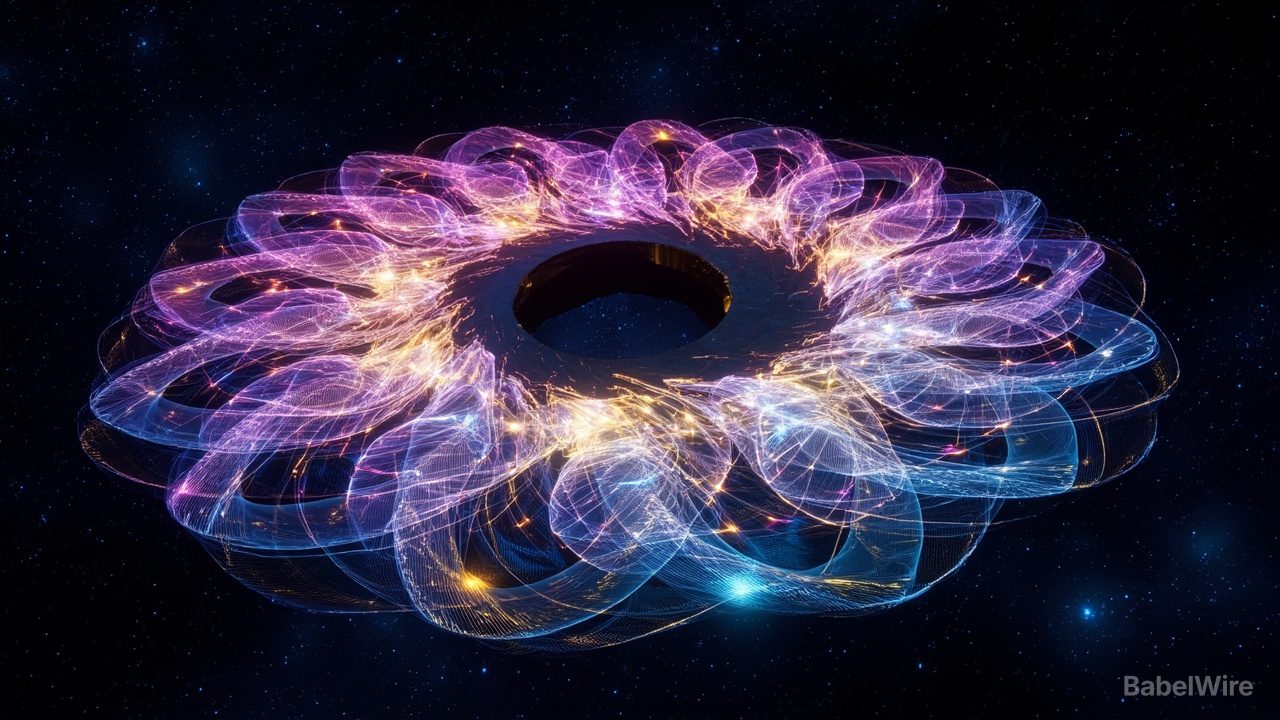
Sometimes the most groundbreaking discoveries hide in plain sight. Scientists at Nanyang Technological University in Singapore (NTU Singapore) have demonstrated that the Poisson spot — a diffraction phenomenon first described by Siméon Denis Poisson in 1818 — can be used to create optical skyrmions, exotic topological structures in light that have been one of the hottest subjects in photonics.
**What Are Optical Skyrmions?**
Skyrmions are topologically protected quasiparticles originally theorized in particle physics and later observed in magnetic materials. Optical skyrmions are their photonic counterparts — swirling, vortex-like light structures whose topological properties make them remarkably stable against perturbations. This stability makes them highly attractive for next-generation information technologies, including ultra-dense data storage, secure communications, and advanced sensing.
The Breakthrough
The NTU team, led by researchers from the School of Physical and Mathematical Sciences, made a surprisingly simple discovery: when structured light shines on a microscopic opaque disk, the resulting Poisson spot naturally contains not just one, but four different types of optical skyrmions simultaneously.
"The Poisson spot is one of the simplest optical phenomena, known for over 200 years," the researchers explain. "Finding that it intrinsically generates multiple topological skyrmion fields was completely unexpected."
The findings, published in the journal Optica on June 18, 2026, detail how the team produced and characterized optical skyrmions with different topological charges and properties — all emerging from a single, elegantly simple setup.
Why It Matters
Previous methods for generating optical skyrmions required complex experimental apparatus, specially engineered materials, or intricate laser setups. The Poisson spot approach dramatically lowers the barrier to entry, allowing researchers to generate, study, and manipulate these exotic light structures with equipment found in most optics laboratories.
"This discovery democratizes access to optical skyrmion research," the team notes. "What previously required nanofabricated metamaterials can now be achieved with a microdisk and a structured light source."
Applications Ahead
Optical skyrmions hold promise for: - Ultra-high-density data storage: Their topological stability means data encoded in skyrmions is resistant to local perturbations. - Secure communications: The topological charge itself can serve as an information carrier immune to certain types of noise. - Super-resolution imaging: Skyrmion-based techniques could surpass conventional diffraction limits. - Quantum information processing: The robust topological properties align well with quantum state protection requirements.
The research represents a beautiful example of how revisiting classical physics with modern tools and fresh eyes can yield discoveries with profound technological implications.
Sources
- phys.orgPhys.org: Scientists create optical skyrmions using a two-century-old light phenomenon
- ntu.edu.sgNTU Singapore: Creating complex light patterns using a two-century-old light phenomenon
- opg.optica.orgOptica: Optical skyrmions in Poisson spots
- thedebrief.orgThe Debrief: Two-Century-Old Light Phenomenon Could Power Next-Gen Communications