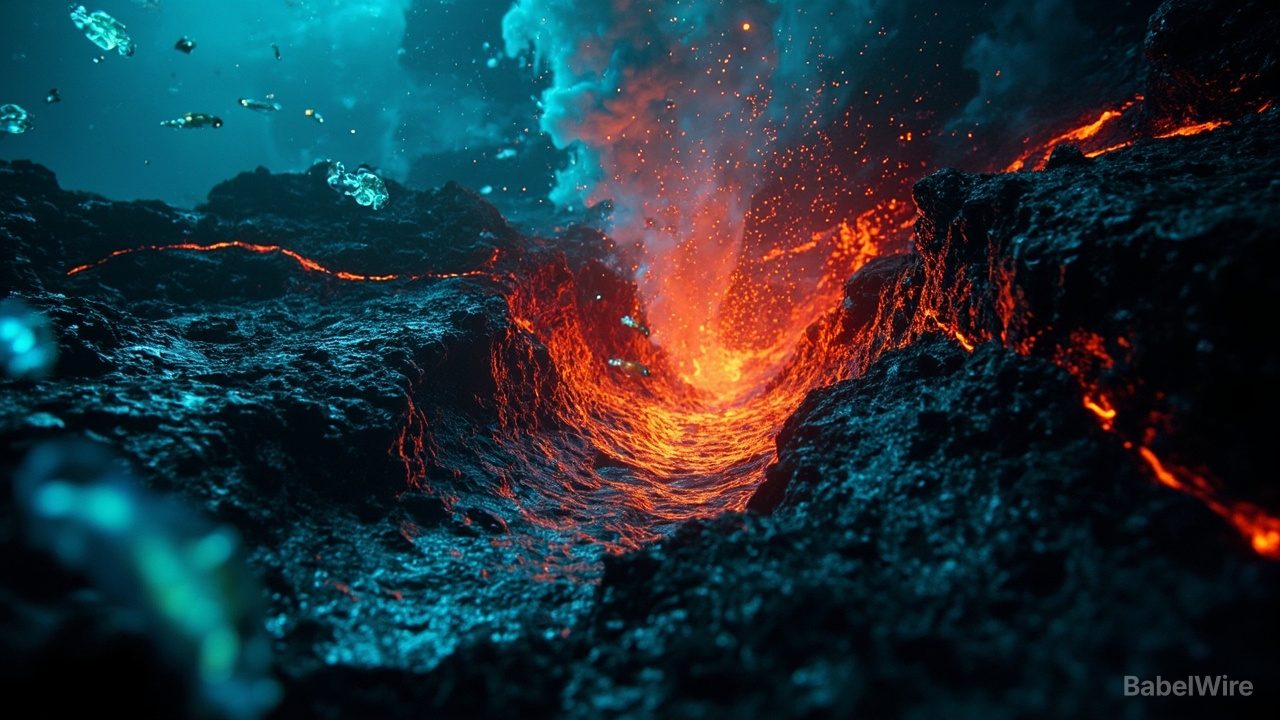
For the first time in history, scientists have witnessed the birth of new ocean floor in real time — capturing the moment the seabed ripped apart, collapsed, and unleashed a torrent of molten lava at the bottom of the Indian Ocean.
The event, recorded at the Southeast Indian Ridge by a team led by French CNRS researchers, represents humanity's first direct observation of seafloor spreading — the fundamental geological process that creates the Earth's crust and drives plate tectonics.
"We have theorized about this for decades, but no one has ever seen it happen live," said Dr. Marie Royer, the expedition's lead geophysicist. "What we witnessed was extraordinary — the seafloor didn't just crack. It tore apart by several meters in a matter of days."
Using an array of more than 20 seafloor instruments deployed in 2024, the research team detected the entire sequence: a swarm of earthquakes signaled the onset, followed by the valley floor along the ridge axis collapsing by 4.2 meters (13.8 feet). The seafloor then spread laterally by up to 4 meters as magma surged upward from the mantle. In total, between 148 and 160 million cubic meters of lava erupted — enough to cover Manhattan in a layer over 2.5 meters deep.
The entire spreading event unfolded over just 16 days, a geological blink of an eye. The new crust formed during that brief period would normally take years or even decades to accumulate through slower, continuous spreading.
"The speed was astonishing," said Dr. Royer. "These ridges were thought to spread at roughly the rate fingernails grow. Instead, we saw meters of displacement in two weeks. It challenges our understanding of how quickly the seafloor actually forms."
The observations provide the first real-world validation of seafloor spreading theory, which was first proposed in the 1960s as a cornerstone of plate tectonics. Until now, scientists relied on indirect evidence — magnetic striping on the ocean floor and seismic readings — to infer that new crust was being formed at mid-ocean ridges.
The event also raises new questions. The rapid, pulse-like nature of the spreading suggests that seafloor creation may occur in dramatic bursts rather than the gradual, steady process long assumed. This has implications for understanding earthquake cycles, volcanic hazards, and the global carbon cycle, since mid-ocean ridges are a major site of chemical exchange between the Earth's interior and the oceans.
"This changes everything about how we model crustal formation," said Dr. Royer. "We now know that a significant portion of the Earth's crust may be created in short, violent events rather than slow, steady accretion."
The team plans to maintain the instrument array to capture future events, hoping to determine whether such rapid spreading episodes are the rule or the exception at mid-ocean ridges worldwide.
Sources
- nature.comOcean floor witnessed splitting apart for the first time — Nature
- nytimes.comIn a first, scientists observe creation of new seafloor — NYT
- phys.orgNew deep-sea measurements show how the ocean floor forms — Phys.org
- discovermagazine.comSeafloor spreading event caught in real time — Discover Magazine
- timesofindia.indiatimes.comScientists witness first-ever seafloor spreading event — Times of India