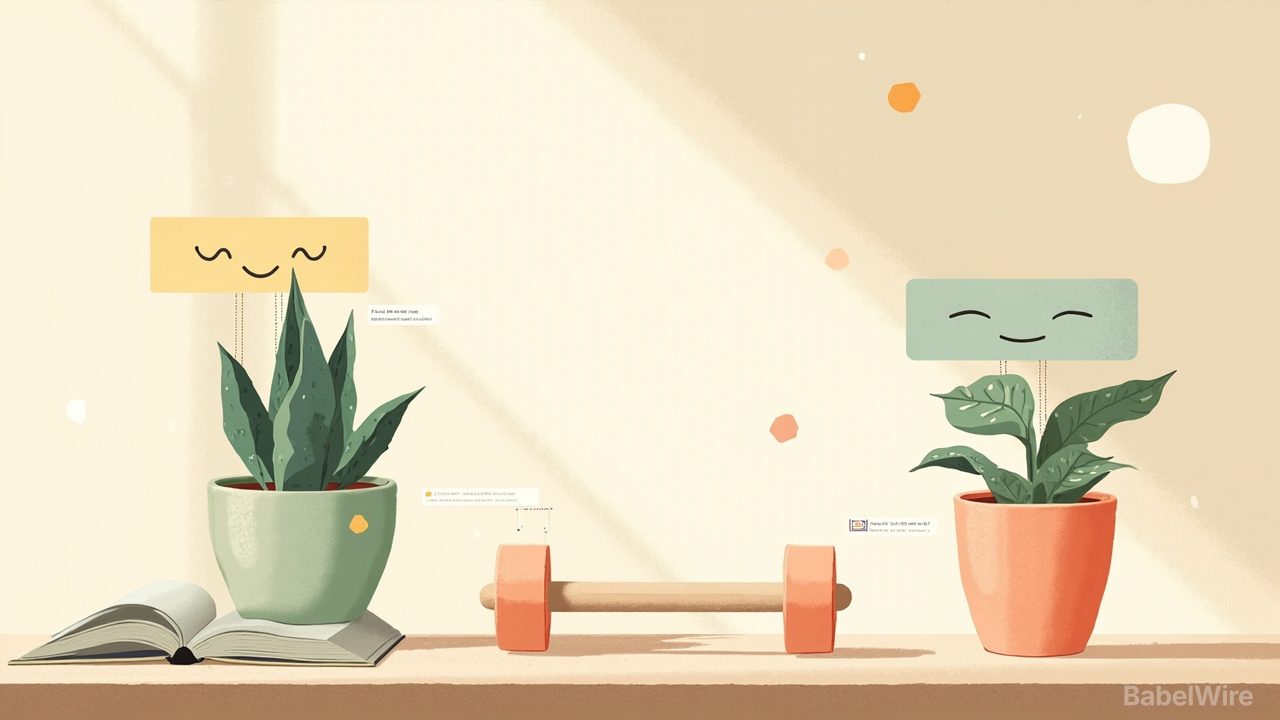
Tamagotchi taught a generation to keep a virtual pet alive. Now a researcher wants to apply that guilt-inducing loop to the objects already in your home. OATs — short for Object Agent Twins — are small E Ink displays paired with sensors that clip onto houseplants, skateboards, dumbbells and coffee machines, each running a tiny animated avatar that reacts to how you treat the object.
The project comes from Daehwa Kim, a fifth-year PhD student in Carnegie Mellon University's Future Interfaces Group. Kim presented OATs at the ACM Symposium on User Interface Software and Technology in Detroit in early November, earning two Honorable Mention awards.
The hardware is deliberately cheap — around $20 for the main module — and simple: an E Ink screen wired to internal and external sensors that track moisture, temperature, humidity, light, occupancy and motion. You configure it through a web portal, naming the OAT and choosing which sensors matter for the object it is attached to. The expressive sprites are generated with Google's Gemini image service, known as Nano Banana, producing a range of moods driven by the sensor data. Set positive and negative triggers — "low humidity" for a desert plant, "no motion for several days" for a neglected skateboard — and the avatar rewards or sulks accordingly.
Kim found people used the gadgets in three ways: to confirm an object is being used, to warn people nearby about an operating device (a 3D printer releasing fumes, for instance), and to nudge their own habits — one user attached an OAT to a dumbbell to feel obliged to keep lifting.
The catch is battery life: three to four days, dropping to about a day with the sound sensor, which is why this is a proof of concept rather than a product. Kim has been urged to sell kits but has not decided whether to commercialize the idea.
The demo also triggered debate about anthropomorphizing AI. Giving chatbots human-sounding traits can distort how much people trust them, a concern Kim shares — which is why OATs are limited to expressive faces rather than conversation. "People name their car, and they name their bike," she said. "We should definitely be careful not to abuse this."